Movement & Strength
Exercise and Cancer:
Lowering Your Risk, Getting Through Treatment and Improving Survival
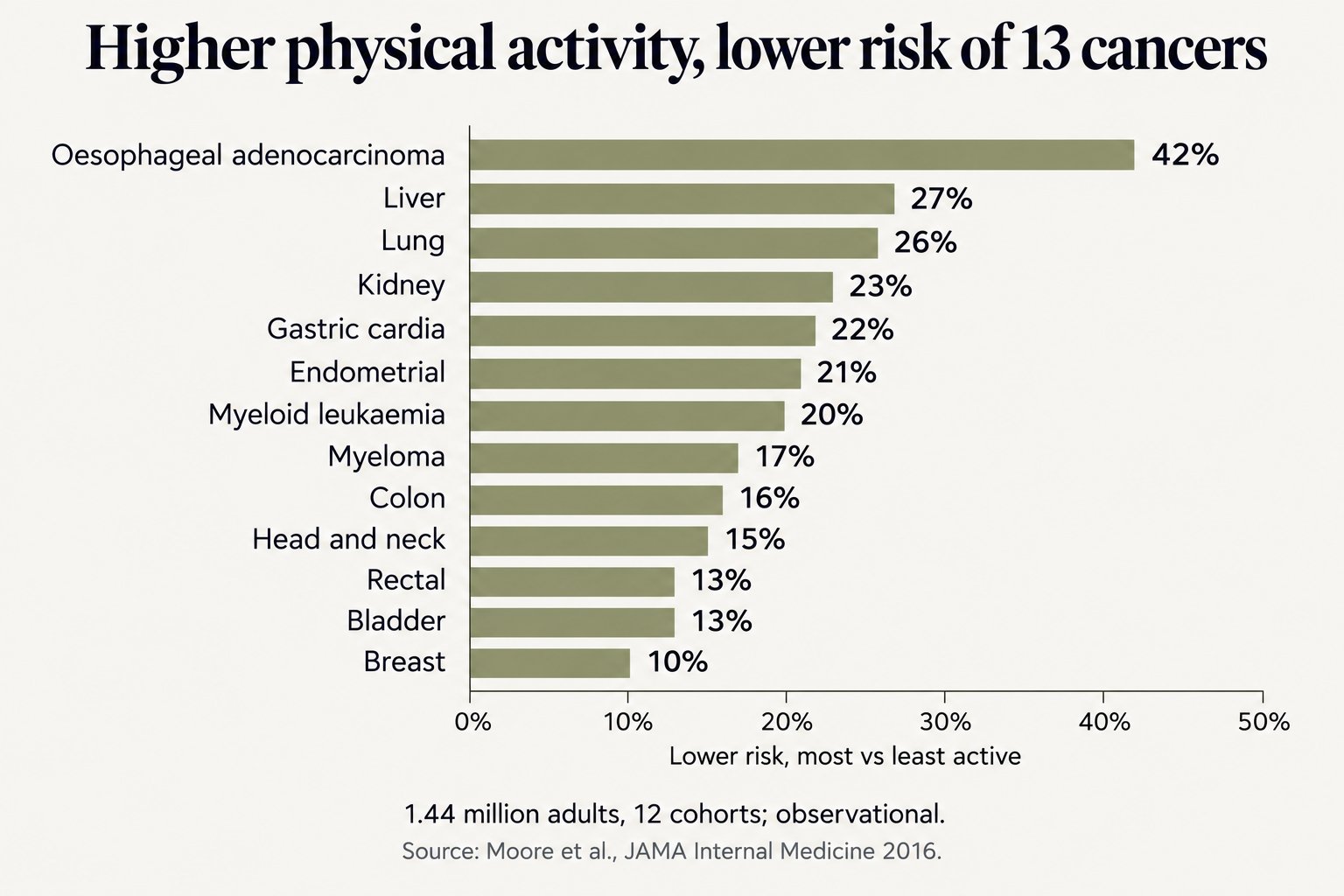
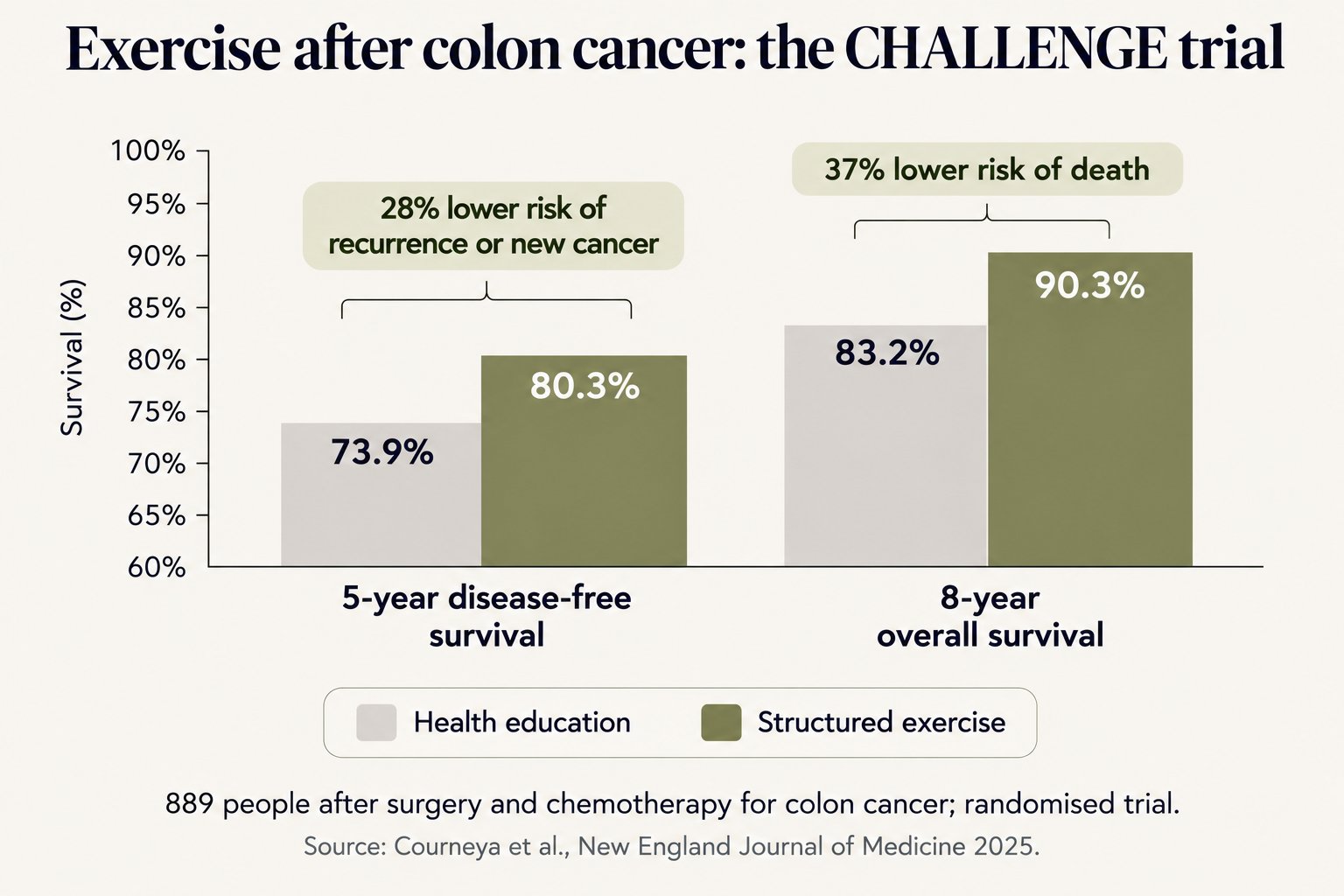
Exercise affects cancer at every stage: before diagnosis, during treatment and afterwards. For prevention, a study of 1.44 million adults found that people who were most active had a lower risk of 13 types of cancer, including 42% lower oesophageal adenocarcinoma, 26% lower lung cancer, 21% lower endometrial cancer, 16% lower colon cancer and 10% lower breast cancer. An expert panel convened by the American College of Sports Medicine (ACSM) concluded that the evidence is strong for seven cancers: colon, breast, endometrial, kidney, bladder, oesophageal and stomach. During and after treatment, exercise is safe for most people and is one of the best-proven treatments for cancer-related fatigue, outperforming medicines in a meta-analysis of 113 trials; it also improves anxiety, depression, sleep, physical function and quality of life. Weight training doesn't worsen arm swelling (lymphoedema) after breast cancer, and in fact reduced flare-ups. Most strikingly, the 2025 CHALLENGE trial found that a 3-year structured exercise programme after colon cancer treatment reduced the risk of recurrence or new cancer by 28% and the risk of death by 37%. Exercise isn't a replacement for cancer treatment, but it's now considered part of it. This article explains the evidence, how much and what kind of exercise helps, and how to exercise safely during and after treatment.
Key numbers
| Finding | Detail |
|---|---|
| Physical activity and cancer risk (1.44 million adults, 12 cohorts) | Lower risk of 13 of 26 cancers, by 10% to 42% |
| Meeting activity guidelines (over 750,000 adults, 9 cohorts) | Lower risk of 7 cancers, for example liver 18 to 27% and endometrial 10 to 18% |
| Exercise vs medicines for cancer-related fatigue (113 trials, 11,525 people) | Exercise and psychological therapy worked; medicines didn't significantly help |
| Weight training with lymphoedema after breast cancer (141 women) | Flare-ups 14% vs 29%; no worsening of swelling |
| Structured exercise after colon cancer (889 people, CHALLENGE trial) | Recurrence or new cancer 28% lower; death 37% lower |
| ACSM dose during and after treatment | Moderate aerobic and/or resistance exercise, at least 3 times a week for 30 minutes |
How exercise affects cancer
Researchers think exercise lowers cancer risk and improves outcomes through several pathways:
- Lower insulin and growth factors: exercise improves insulin sensitivity and lowers insulin levels, which can drive the growth of some cancer cells.
- Sex hormones: exercise lowers circulating oestrogen and other hormones linked to breast and endometrial cancer.
- Less body fat: excess fat, especially around the abdomen, produces hormones and inflammatory signals linked to at least 13 cancers.
- Lower inflammation: regular activity reduces chronic low-grade inflammation.
- Immune function: exercise mobilises immune cells that can detect and destroy abnormal cells.
- Faster gut transit: this may reduce exposure of the bowel lining to cancer-causing substances.
Exercise and lowering cancer risk
13 cancers. In a 2016 study in JAMA Internal Medicine, researchers from the US National Cancer Institute pooled 12 cohorts with 1.44 million adults followed for a median of 11 years, during which 186,932 cancers were diagnosed. People with the highest leisure-time activity had a lower risk of 13 of the 26 cancers studied, compared with the least active:
- Oesophageal adenocarcinoma: 42% lower
- Liver: 27% lower
- Lung: 26% lower
- Kidney: 23% lower
- Gastric cardia (upper stomach): 22% lower
- Endometrial: 21% lower
- Myeloid leukaemia: 20% lower
- Myeloma: 17% lower
- Colon: 16% lower
- Head and neck: 15% lower
- Rectal: 13% lower
- Bladder: 13% lower
- Breast: 10% lower
The benefit held regardless of body weight and smoking history. Two cancers showed a higher risk: melanoma (27% higher), likely because active people spend more time in the sun, and early-stage prostate cancer (5% higher), likely because active men are screened more often. Most participants were white, and activity was self-reported.
How much activity?. In a 2020 study in the Journal of Clinical Oncology, researchers pooled 9 cohorts with over 750,000 adults. Meeting the recommended 2.5 to 5 hours a week of moderate activity, such as brisk walking, was linked to a lower risk of 7 cancers:
- Liver: 18 to 27% lower
- Multiple myeloma: 14 to 19% lower
- Endometrial (women): 10 to 18% lower
- Kidney: 11 to 17% lower
- Non-Hodgkin lymphoma (women): 11 to 18% lower
- Colon (men): 8 to 14% lower
- Breast (women): 6 to 10% lower
The lower figure in each range is for 2.5 hours of moderate activity a week and the higher figure for 5 hours. As one of the researchers put it, walking about 30 minutes a day is enough to meet the recommendation.
The expert consensus. In 2019, the ACSM brought together an international panel of experts to review the evidence. They concluded that physical activity is protective against colon, breast, endometrial, kidney, bladder, oesophageal and stomach cancers (strong evidence), and that people who are more active before and after diagnosis have a lower risk of dying from breast and colon cancer (moderate evidence).
Exercise during cancer treatment
For many years, people with cancer were told to rest. That advice has changed: the ACSM panel concluded that exercise is safe during and after most cancer treatments, and advised people to avoid inactivity.
What it helps.
- Cancer-related fatigue: a Cochrane review of 56 trials found that exercise reduced fatigue during and after treatment, particularly aerobic exercise in people with solid tumours such as breast and prostate cancer. In a 2017 meta-analysis in JAMA Oncology of 113 trials with 11,525 people, exercise and psychological therapy reduced fatigue, while medicines didn't significantly help. The authors recommended exercise and psychological treatments as first-line options.
- Anxiety, depression and sleep.
- Quality of life and physical function.
- Lymphoedema: progressive, supervised resistance training doesn't worsen lymphoedema.
- Bone health: resistance and impact exercise help counter bone loss from some cancer treatments (see Bone Density and Resistance Training).
Weight training and lymphoedema. Women who have had breast cancer surgery were long advised to avoid lifting with the affected arm. In the 2009 Physical Activity and Lymphedema (PAL) trial in the New England Journal of Medicine, 141 breast cancer survivors with stable arm lymphoedema were randomised to progressive weight lifting twice a week or no exercise. Arm swelling didn't increase in the weight-lifting group, symptoms improved, strength increased, and flare-ups occurred in 14% of the weight-lifting group compared with 29% of the control group.
How much?. The ACSM recommends that people during and after treatment do moderate-intensity aerobic and/or resistance exercise at least 3 times a week, for about 30 minutes, for at least 8 to 12 weeks:
- Aerobic: 30 to 60 minutes, 3 times a week, at a moderate intensity such as brisk walking or cycling.
- Resistance: 2 times a week, 2 sets of 8 to 15 repetitions for the major muscle groups.
- Any amount helps: smaller amounts still improve symptoms, and on difficult days a short walk is better than nothing.
Exercise after cancer: the CHALLENGE trial
Until recently, the link between exercise and cancer survival came from observational studies. In 2025, the CHALLENGE trial, published in the New England Journal of Medicine, provided the first strong randomised evidence.
- Who took part: 889 people with stage III or high-risk stage II colon cancer who had completed surgery and chemotherapy.
- What they did: half received health education materials; the other half joined a 3-year structured exercise programme supervised by physiotherapists or exercise specialists, aiming to add about 2.5 hours of moderate exercise a week, with sessions every 2 weeks in the first year and monthly for the next 2 years.
- Results: the exercise group had a 28% lower risk of cancer recurrence or new cancer (5-year disease-free survival 80.3% vs 73.9%) and a 37% lower risk of death (8-year survival 90.3% vs 83.2%).
- Side effects: musculoskeletal problems such as strains were more common in the exercise group (18.5% vs 11.5%).
- What it means: as lead investigator Kerry Courneya said, "Exercise is no longer just a quality-of-life intervention – it is a treatment for colon cancer."
Larger trials are needed for other cancers, but observational studies also link post-diagnosis activity with better survival after breast and prostate cancer.
Exercising safely with cancer
Exercise is safe for most people with cancer, but treatment can affect the body in ways that need care. Discuss your plan with your oncologist or a physiotherapist, especially before starting during treatment.
Take extra care, or ask first, if you have.
- Low white blood cell counts: avoid crowded gyms and public pools to reduce infection risk.
- Low platelets: avoid contact sports and activities with a high risk of falls or injury.
- Anaemia: reduce intensity, as you may tire and get breathless more easily.
- Cancer in the bones: avoid high-impact exercise, heavy loading and twisting; exercise can still be safe with expert guidance.
- Nerve damage (peripheral neuropathy) from chemotherapy: choose stable activities such as a stationary bike, and take care with balance.
- Heart effects from treatment: some chemotherapy and targeted drugs can affect the heart; get advice before vigorous exercise.
- A stoma or recent surgery: avoid heavy lifting and strong abdominal exercises until cleared, and build up gradually.
- Lymphoedema: start resistance training with light weights under supervision and progress gradually.
- Radiotherapy: protect treated skin from chlorine and sun.
Stop and seek advice if you have.
- Chest pain, an irregular heartbeat or severe breathlessness.
- Fever or signs of infection.
- New bone pain, sudden swelling or dizziness.
Getting started
- Start where you are: even 10 minutes of walking a day helps; build up gradually (see Walking for Longevity).
- Use the talk test: moderate exercise means you can talk, but not sing.
- Combine aerobic and strength exercise: aim for 3 aerobic sessions and 2 strength sessions a week when you can (see Weight Training).
- Adjust to your treatment cycle: do more on good days, less on days after chemotherapy, and keep moving lightly rather than stopping completely.
- Use short bouts: several 5 to 10-minute walks can be easier than one long session (see Exercise Snacking).
- Get supervised help if possible: a physiotherapist or exercise specialist can tailor a programme, especially for lymphoedema, bone metastases or after surgery.
- Protect muscle: treatment can cause muscle loss; strength training and enough protein help preserve it.
Cancer and exercise in Sri Lanka
- The burden: over 33,000 new cancer cases and over 19,000 cancer deaths were reported in a year, according to Sri Lanka's Health Ministry in 2024. Breast cancer is the most common cancer in women and oral cancer the most common in men.
- Prevention: physical inactivity is common, especially among women. Combined with avoiding tobacco and betel quid, limiting alcohol and keeping a healthy weight, regular exercise is one of the most effective ways to lower cancer risk (see Alcohol and Longevity).
- During treatment: ask your oncology team or hospital physiotherapy department about safe exercise; community walking groups and home programmes are practical options.
- Heat: treatment can make you more sensitive to heat and dehydration, so exercise early in the morning or in the evening, drink water and avoid the midday sun.
Evidence strength
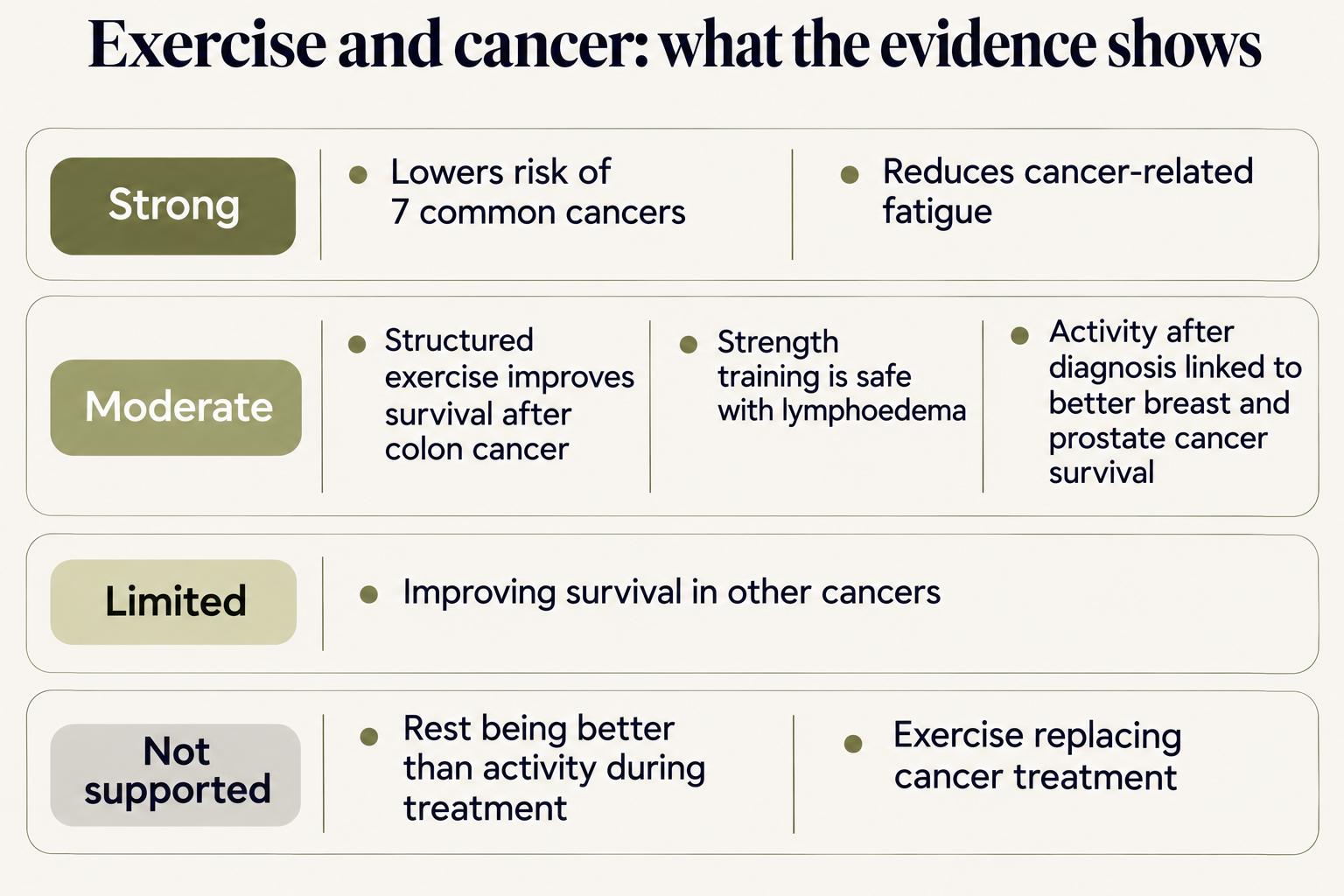
- Physical activity lowering the risk of colon, breast, endometrial, kidney, bladder, oesophageal and stomach cancers: strong.
- Exercise reducing cancer-related fatigue and improving quality of life, physical function, anxiety and depression: strong.
- Structured exercise improving survival after colon cancer: moderate to strong, from one large randomised trial.
- Resistance training being safe with lymphoedema after breast cancer: moderate.
- Physical activity after diagnosis linked to better survival in breast and prostate cancer: moderate, observational.
- Exercise improving survival in other cancers: limited; trials are needed.
- Rest being better than activity for most people during treatment: not supported.
- Exercise replacing cancer treatment: not supported.
Why this matters for longevity
Cancer is one of the leading causes of death worldwide and in Sri Lanka, and many of its risk factors, including inactivity, excess weight, tobacco and alcohol, can be changed. Regular exercise lowers the risk of at least seven common cancers, helps people get through treatment with less fatigue and better function, and for colon cancer has now been shown to improve survival in a randomised trial. Whether you want to lower your risk or are living with cancer, staying active is one of the most powerful things you can do (see The Major Diseases of Ageing).
Recommendations by situation
- To lower your cancer risk: 150 to 300 minutes of moderate activity a week, plus strength training twice a week; less sitting.
- Newly diagnosed: ask your team about exercise before surgery or treatment; staying active can help you recover.
- During chemotherapy or radiotherapy: aim for light to moderate activity most days, adjusting to how you feel; avoid long periods of inactivity.
- After breast cancer or with lymphoedema: supervised, gradually progressed strength training is safe and helpful.
- After colon cancer treatment: aim to build up to at least 2.5 hours of moderate exercise a week, ideally with professional support.
- With bone metastases, low blood counts or heart effects from treatment: exercise with specialist guidance.
- Older adults with cancer: include strength and balance training to protect muscle and prevent falls (see Building Your Weekly Exercise Mix).
Practical notes
Exercise is now part of cancer prevention and cancer care. To lower your risk, aim for 150 to 300 minutes of moderate activity a week plus strength training twice a week. If you have cancer, staying active during treatment reduces fatigue and helps you keep your strength, and after colon cancer, a structured exercise programme has been shown to reduce recurrence and improve survival. Start gently, adjust to your treatment, combine aerobic and strength exercise, and get advice if you have low blood counts, bone metastases, nerve damage, heart effects or lymphoedema. Exercise works alongside cancer treatment, not instead of it. Our Longevity Doctors can assess your fitness, review your cancer risk factors and, if you're living with or after cancer, work with your oncology team to design a safe, personalised exercise programme, starting with the free longevity assessment.
- Moore SC, et al. Association of leisure-time physical activity with risk of 26 types of cancer in 1.44 million adults. JAMA Internal Medicine, 2016;176(6):816-825.
- Matthews CE, et al. Amount and intensity of leisure-time physical activity and lower cancer risk. Journal of Clinical Oncology, 2020;38(7):686-697.
- Campbell KL, et al. An executive summary of reports from an international multidisciplinary roundtable on exercise and cancer: evidence, guidelines, and implementation. Rehabilitation Oncology, 2019;37(4):144-152.
- Cramp F, Byron-Daniel J. Exercise for the management of cancer-related fatigue in adults. Cochrane Database of Systematic Reviews, 2012;(11):CD006145.
- Mustian KM, et al. Comparison of pharmaceutical, psychological, and exercise treatments for cancer-related fatigue: a meta-analysis. JAMA Oncology, 2017;3(7):961-968.
- Schmitz KH, et al. Weight lifting in women with breast-cancer-related lymphedema. New England Journal of Medicine, 2009;361(7):664-673.
- Courneya KS, et al. Structured exercise after adjuvant chemotherapy for colon cancer. New England Journal of Medicine, 2025;393(1):13-25.
- American College of Sports Medicine. Consolidated infographic for the ACSM roundtable on cancer and exercise. 2019.
Free longevity assessment
Want a safe exercise plan
before, during or after cancer?
Take the free Aevum Protocol assessment to see how your movement & strength and 6 other longevity domains are performing — and get a personalised 90-day plan.
Take the free assessment