Nutrition & Metabolism
Choline:
The Overlooked Nutrient for Your Brain, Liver and a Healthy Pregnancy
Choline is an essential nutrient that most people have never heard of, yet the body needs it to build cell membranes, make the memory and muscle-control messenger acetylcholine, move fat out of the liver, and supply methyl groups for gene regulation. The liver makes some choline, but not enough, so we need it from food. Eggs, liver, meat, fish and soybeans are the richest sources: one large egg provides about 147 mg. Most people fall short. In US national surveys, only about 8% of adults and 8.5% of pregnant women met the recommended intake, compared with 57% of people who regularly ate eggs. When healthy adults were fed a very low-choline diet, 77% of men and 80% of postmenopausal women developed fatty liver or muscle damage. Choline matters most in pregnancy: in a controlled feeding trial, children whose mothers ate about double the recommended choline in late pregnancy had faster information processing as infants and better sustained attention at age 7. In older adults, higher choline intake has been linked to better memory and a lower risk of dementia, although these studies are observational. The main controversy is TMAO, a compound gut bacteria make from choline that has been linked to heart disease. This article explains what choline does, how much you need, the best Sri Lankan food sources and who might benefit from a supplement.
Key numbers
| Finding | Detail |
|---|---|
| Adequate Intake, US (adults) | Men 550 mg/day; women 425 mg/day |
| Adequate Intake, US (pregnancy and breastfeeding) | 450 mg/day in pregnancy; 550 mg/day when breastfeeding |
| Adequate Intake, Europe (adults) | 400 mg/day; 480 mg in pregnancy; 520 mg when breastfeeding |
| Upper limit for adults | 3,500 mg/day |
| One large egg | About 147 mg |
| US adults meeting the target | About 8% overall; 57% of regular egg eaters; 2.4% of people who eat no eggs |
| Low-choline diet in healthy adults (57 people) | Organ dysfunction in 77% of men, 80% of postmenopausal women and 44% of premenopausal women |
| Phosphatidylcholine intake and dementia (about 2,500 Finnish men, 22 years) | 28% lower risk with the highest intake |
What choline is
Choline is a water-soluble nutrient often grouped with the B vitamins, although it isn't strictly a vitamin. It was recognised as an essential nutrient in 1998, when the US Institute of Medicine set the first intake targets. In food, most choline is found as phosphatidylcholine, also known as lecithin, a fatty molecule that forms part of every cell membrane.
The liver can make choline through an enzyme called PEMT, and oestrogen boosts this enzyme. That's one reason premenopausal women seem to need less dietary choline than men and postmenopausal women. But the body can't make enough to meet its needs, so dietary choline is essential.
What choline does
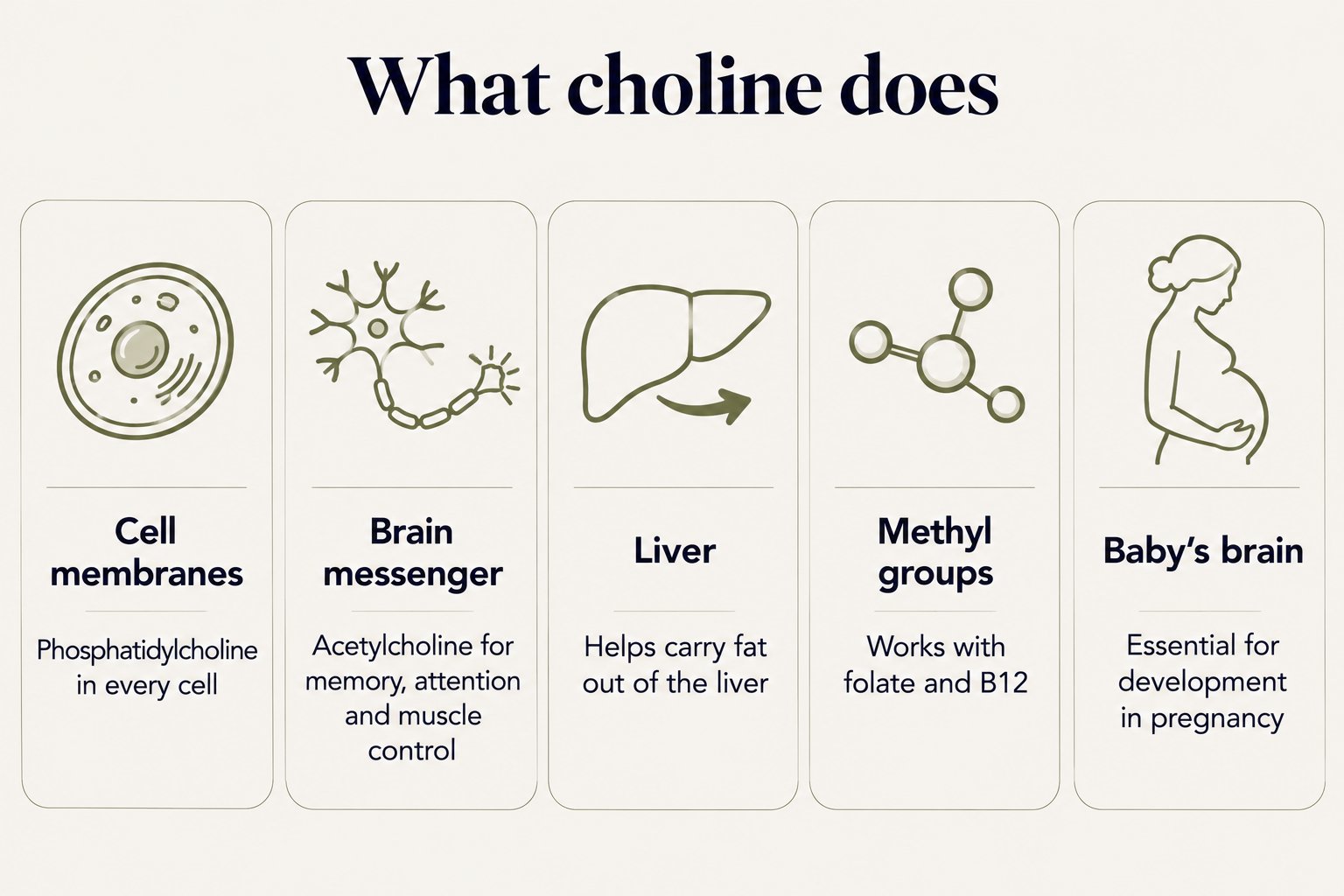
- Builds cell membranes: phosphatidylcholine and sphingomyelin are key components of every cell membrane, including the myelin that insulates nerves.
- Makes acetylcholine: a brain and nerve messenger involved in memory, attention, mood and muscle control.
- Moves fat out of the liver: choline is needed to package fat into particles (VLDL) that carry it out of the liver. Without enough, fat builds up.
- Supplies methyl groups: choline is converted to betaine, which helps recycle homocysteine and supports the methylation reactions that regulate genes. This links choline closely with folate and vitamin B12 (see B Vitamins, Homocysteine, and Brain Aging).
- Supports brain development: the developing baby's brain draws heavily on choline in pregnancy and early life.
How much do you need?
US targets, set as Adequate Intakes because there wasn't enough evidence for a precise requirement:
| Age group | Choline per day |
|---|---|
| Babies 0 to 6 months | 125 mg |
| Babies 7 to 12 months | 150 mg |
| Children 1 to 3 years | 200 mg |
| Children 4 to 8 years | 250 mg |
| Children 9 to 13 years | 375 mg |
| Teenagers 14 to 18 years | Boys 550 mg; girls 400 mg |
| Adults | Men 550 mg; women 425 mg |
| Pregnancy | 450 mg |
| Breastfeeding | 550 mg |
The European Food Safety Authority set slightly lower targets in 2016: 400 mg for adults, 480 mg in pregnancy and 520 mg when breastfeeding. The upper limit for adults is 3,500 mg a day, well above what food provides.
These targets were based mainly on preventing liver damage in adults, not on what a developing baby's brain needs, and some researchers believe they may be too low for pregnancy.
Food sources
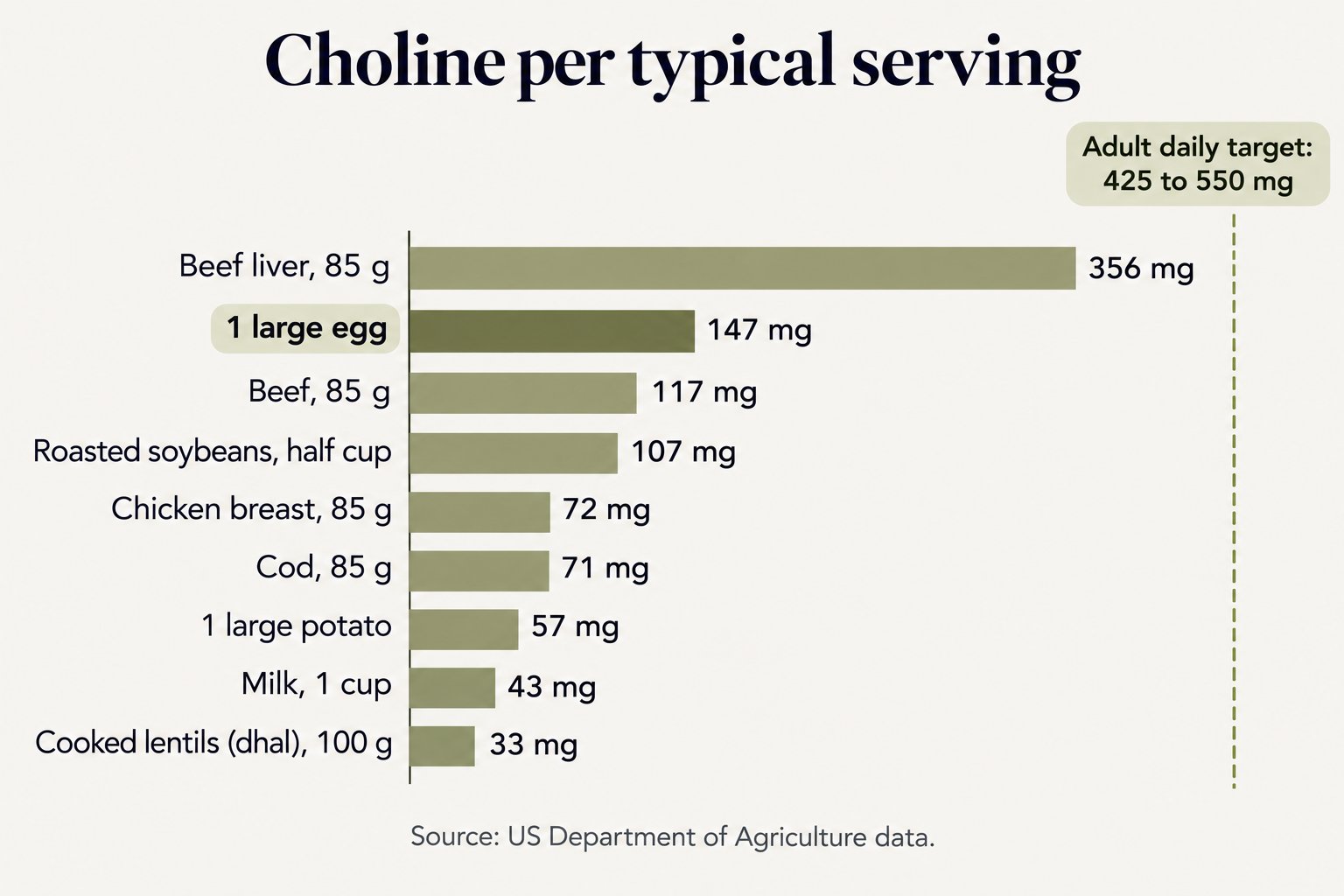
Choline content of common foods (US Department of Agriculture data):
| Food | Serving | Choline |
|---|---|---|
| Beef liver, pan-fried | 85 g | 356 mg |
| Egg, hard-boiled | 1 large | 147 mg |
| Beef, braised | 85 g | 117 mg |
| Soybeans, roasted | Half cup | 107 mg |
| Chicken breast, roasted | 85 g | 72 mg |
| Cod, cooked | 85 g | 71 mg |
| Potato, baked | 1 large | 57 mg |
| Kidney beans | Half cup | 45 mg |
| Milk | 1 cup | 43 mg |
| Lentils (dhal), cooked | 100 g | 33 mg |
| Broccoli, boiled | Half cup | 31 mg |
| Peanuts, roasted | Quarter cup | 24 mg |
| Brown rice, cooked | 1 cup | 19 mg |
Most of the choline in an egg is in the yolk. Plant foods contain choline too, but in smaller amounts, so vegetarians and vegans need to plan more carefully.
A Sri Lankan day.
- With eggs: one egg (147 mg), a serving of chicken or fish curry (about 70 mg), a cup of milk (43 mg), dhal (about 33 mg per 100 g) and a potato curry (about 57 mg) add up to roughly 350 mg.
- Without eggs or meat: dhal twice a day (about 66 mg), two cups of milk (86 mg), half a cup of roasted soybeans (107 mg) and a potato (57 mg) reach roughly 300 mg, still short of the target.
- The easiest boost: one or two eggs a day brings most adults close to their target.
No national data on choline intake in Sri Lanka has been published, but rice-based diets with modest amounts of eggs, meat and fish, and vegetarian diets, are likely to fall short.
Who gets too little?
- Most people: in a 2017 analysis of US national survey data, only about 8% of adults met the Adequate Intake. Among regular egg eaters, 57% met it, compared with 2.4% of people who ate no eggs.
- Pregnant and breastfeeding women: only about 8.5% of pregnant women met the target, and more than 90% fall short. Most prenatal vitamins contain little or no choline; in 2016, none of the top 25 US prenatal vitamins provided the full 450 mg.
- Vegetarians and vegans: especially those who don't eat eggs.
- Postmenopausal women: less oestrogen means less of the body's own choline production.
- People with common gene variants: variants in the PEMT gene and other choline-related genes increase dietary needs.
- People with heavy alcohol use or liver disease.
- People on long-term intravenous feeding: choline isn't routinely added to these solutions.
What the research shows
Too little choline damages the liver and muscles. In a 2007 study in the American Journal of Clinical Nutrition, 57 healthy adults ate a diet with 550 mg of choline a day for 10 days, then less than 50 mg a day for up to 42 days. On the low-choline diet, 77% of men, 80% of postmenopausal women and 44% of premenopausal women developed fatty liver or muscle damage, which reversed when choline was restored. Some participants showed signs of damage even at 550 mg a day, and 19% needed as much as 825 mg a day to prevent it.
Choline and fatty liver disease. In a 2012 study in the American Journal of Clinical Nutrition of 664 children and adults with fatty liver disease who had liver biopsies, postmenopausal women eating less than half the recommended choline were much more likely to have advanced liver scarring: nearly half, compared with 30% of those eating more. The link wasn't seen clearly in men, younger women or children. None of the participants met the full choline target. The researchers cautioned that adding choline may not halt disease progression (see Fatty Liver Disease).
Pregnancy and the developing brain.
- Neural tube defects: in a 2009 study in Epidemiology of blood samples from pregnant women in California, women with the lowest choline levels in mid-pregnancy had 2.4 times the risk of a baby with a neural tube defect, such as spina bifida, as women with average levels. Choline was the only one of 13 nutrients linked to this risk. Other studies haven't always confirmed the link.
- Infant and child brain development: in a controlled feeding trial at Cornell University, women in the third trimester ate a diet with either 480 mg or 930 mg of choline a day. Babies of mothers in the higher-choline group had faster information processing through their first year. At age 7, children in the higher-choline group stayed accurate throughout a demanding attention task, while those in the lower group became less accurate over time. The trial was small, but the authors concluded that their findings "suggest population-wide benefits of adding choline to a standard prenatal vitamin regimen".
- Professional advice: in 2017, the American Medical Association adopted a policy supporting more choline in prenatal vitamins (see Preconception Health Guide).
Brain ageing and dementia.
- Memory and brain scans: in the Framingham Offspring Study, published in 2011, nearly 1,400 adults aged 36 to 83 with higher choline intake performed slightly better on memory tests and were less likely to have white-matter changes on MRI, a sign of small-vessel disease. The differences were small.
- Dementia: in a 2019 study in the American Journal of Clinical Nutrition, about 2,500 Finnish men aged 42 to 60 were followed for an average of 22 years. Those with the highest phosphatidylcholine intake had a 28% lower risk of dementia than those with the lowest. Eggs (39%) and meat (37%) were the main sources. Higher intake was also linked to better memory and language test results.
- Supplements: reviews have found no clear benefit from choline supplements for memory in healthy adults or for people with Alzheimer's disease (see Nootropics and Cognitive Enhancers).
Heart health and TMAO. Gut bacteria convert some dietary choline, along with carnitine from red meat, into a compound called trimethylamine, which the liver turns into TMAO (trimethylamine N-oxide).
- TMAO and heart events: in a 2013 study in the New England Journal of Medicine, 4,007 patients having coronary angiography were followed for 3 years. Those with the highest TMAO levels had about 2.5 times the risk of heart attack, stroke or death as those with the lowest. Eating two hard-boiled eggs raised TMAO in healthy volunteers, and antibiotics that suppressed gut bacteria blocked this rise.
- Choline intake and heart disease: several large studies found no link between dietary choline and heart disease, and up to one egg a day hasn't been linked to higher cardiovascular risk (see Meat, Fish and Eggs).
- What this means: TMAO may be a marker of risk as much as a cause, and it's strongly affected by kidney function, gut bacteria and overall diet. Fish naturally contain TMAO and are linked to lower heart risk. Getting choline from a varied diet of eggs, fish, pulses and vegetables isn't a concern, but very high-dose supplements may be different (see The Gut Microbiome and Fermented Foods).
Choline supplements
Common forms.
- Choline bitartrate and choline chloride: inexpensive forms, often used in prenatal supplements and multivitamins.
- Phosphatidylcholine (lecithin): the main form found in food; lecithin supplements are only partly phosphatidylcholine.
- Citicoline (CDP-choline): marketed as a "nootropic"; also a prescription medicine in some countries for stroke and cognitive problems.
- Alpha-GPC: another "brain" supplement, with a caution noted below.
Safety.
- Upper limit: 3,500 mg a day for adults.
- Side effects at high doses: a fishy body odour, sweating, excess saliva, vomiting, diarrhoea and low blood pressure.
- Alpha-GPC and stroke: in a 2021 study in JAMA Network Open of about 12 million South Korean adults aged 50 and over, the 108,877 people prescribed alpha-GPC had a 46% higher risk of stroke over about 9 years, with higher risk at longer use. The study was observational and can't prove cause, but it's a reason for caution with high-dose choline supplements in people without a clear need.
- Interactions: choline is generally safe with medicines, but discuss supplements with your doctor if you have kidney disease, a history of stroke, or are taking several supplements.
Evidence strength
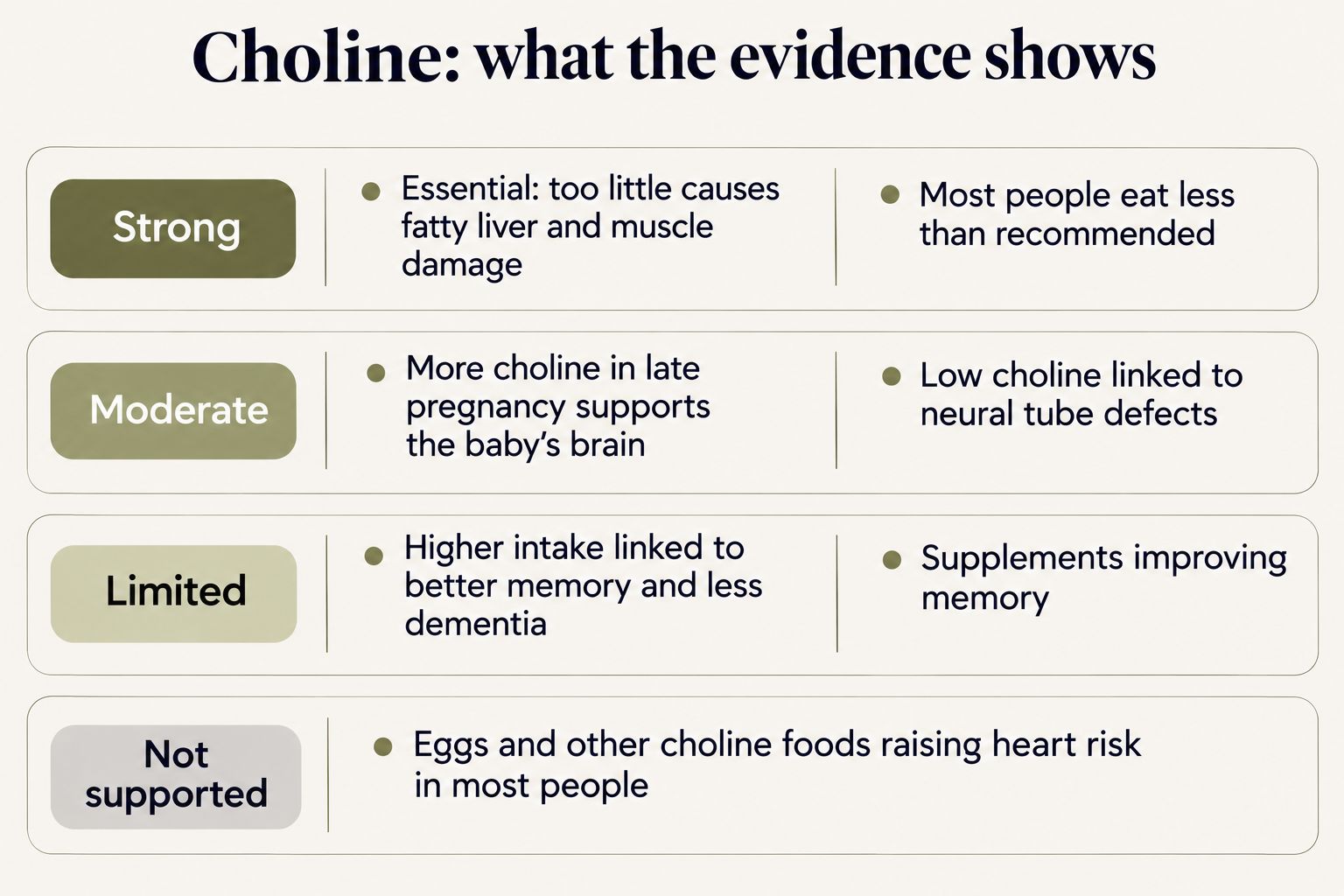
Strong.
- Choline is essential, and too little causes fatty liver and muscle damage in most men and postmenopausal women.
- Most people eat less than the recommended amount, especially those who don't eat eggs.
Moderate.
- Higher choline in late pregnancy supports infant and child brain development, based on a small controlled feeding trial and extensive animal research.
- Low choline levels in early pregnancy are linked to neural tube defects, although not all studies agree.
- Low choline intake is linked to worse liver scarring in postmenopausal women with fatty liver disease.
Limited.
- Higher choline intake and better memory or lower dementia risk: observational studies only.
- Choline supplements improving memory in healthy adults or people with dementia: reviews found no clear benefit.
- Choline supplements treating fatty liver disease: not well tested.
Not supported.
- Choline from foods such as eggs raising heart disease risk in most people: large studies haven't found this, although TMAO remains an area of active research.
Important limitations.
- Intake targets are uncertain: they're Adequate Intakes based on limited evidence, not precise requirements.
- Food databases are incomplete: choline content of many Sri Lankan foods hasn't been measured.
- Genetics vary: some people need considerably more choline than others.
Food or supplement?
For most people, food is the best source. One or two eggs a day, plus fish, chicken, pulses, milk and vegetables, can bring most adults close to their target. A supplement is worth considering if:
- You're pregnant, planning a pregnancy or breastfeeding, especially if you eat few eggs or no meat; check whether your prenatal vitamin contains choline, as most contain little or none.
- You're vegan or vegetarian and don't eat eggs.
- Your doctor has identified a specific need, such as long-term intravenous feeding.
Prenatal choline supplements usually contain choline bitartrate or choline chloride; discuss the right dose for you with your doctor. Avoid high-dose "brain" supplements unless your doctor recommends them.
Why this matters for longevity
Choline supports three things that matter for healthy ageing: a healthy liver, a well-functioning brain and, for the next generation, healthy brain development before birth. Most people eat less than recommended without knowing it, and the shortfall is greater for vegetarians, postmenopausal women and pregnant women. Getting enough choline from eggs, fish, meat, pulses and vegetables is simple, cheap and safe, and fits naturally within a healthy Sri Lankan diet (see Nutrition by Life Stage).
Recommendations by situation
- Most adults: aim for 425 to 550 mg a day from food; one or two eggs plus fish, chicken or pulses most days is usually enough.
- Pregnant or planning a pregnancy: aim for at least 450 mg a day from food, and check your prenatal vitamin; ask your doctor about a choline supplement if you eat few eggs.
- Breastfeeding: aim for about 550 mg a day.
- Vegetarians who eat eggs: eggs are your simplest source; add dhal, chickpeas, soybeans, milk and vegetables.
- Vegans: combine soybeans, other pulses, nuts, potatoes and vegetables, and consider a supplement, particularly in pregnancy.
- Postmenopausal women and people with fatty liver disease: pay attention to choline intake as part of a healthy diet.
- People with high cholesterol or heart disease: eggs in moderation are fine for most people; focus on overall diet quality.
- People considering "brain" supplements: food-based choline is preferred; be cautious with high-dose alpha-GPC.
Practical notes
Choline is an essential nutrient for cell membranes, the brain, the liver and a healthy pregnancy, and most people eat less than they need. Eggs are the easiest source, with about 147 mg each, and fish, chicken, meat, soybeans, dhal, milk and potatoes add more. Vegetarians who don't eat eggs, vegans, postmenopausal women and pregnant women are most likely to fall short. If you're pregnant or planning a pregnancy, check whether your prenatal vitamin contains choline and ask your doctor about a supplement. Our Longevity Doctors can review your diet, liver health and nutrient needs, and help you plan meals or supplements that cover choline and other key nutrients, starting with the free longevity assessment.
- Institute of Medicine. Dietary Reference Intakes for Thiamin, Riboflavin, Niacin, Vitamin B6, Folate, Vitamin B12, Pantothenic Acid, Biotin, and Choline. National Academies Press, 1998.
- National Institutes of Health Office of Dietary Supplements. Choline: fact sheet for health professionals. Accessed November 2026.
- EFSA Panel on Dietetic Products, Nutrition and Allergies. Dietary reference values for choline. EFSA Journal, 2016;14(8):4484.
- Wallace TC, Fulgoni VL. Usual choline intakes are associated with egg and protein food consumption in the United States. Nutrients, 2017;9(8):839.
- Fischer LM, et al. Sex and menopausal status influence human dietary requirements for the nutrient choline. American Journal of Clinical Nutrition, 2007;85(5):1275-1285.
- Guerrerio AL, et al. Choline intake in a large cohort of patients with nonalcoholic fatty liver disease. American Journal of Clinical Nutrition, 2012;95(4):892-900.
- Shaw GM, et al. Choline and risk of neural tube defects in a folate-fortified population. Epidemiology, 2009;20(5):714-719.
- Caudill MA, et al. Maternal choline supplementation during the third trimester of pregnancy improves infant information processing speed: a randomized, double-blind, controlled feeding study. FASEB Journal, 2018;32(4):2172-2180.
- Bahnfleth CL, et al. Prenatal choline supplementation improves child sustained attention: a 7-year follow-up of a randomized controlled feeding trial. FASEB Journal, 2022;36(1):e22054.
- Poly C, et al. The relation of dietary choline to cognitive performance and white-matter hyperintensity in the Framingham Offspring Cohort. American Journal of Clinical Nutrition, 2011;94(6):1584-1591.
- Ylilauri MPT, et al. Associations of dietary choline intake with risk of incident dementia and with cognitive performance: the Kuopio Ischaemic Heart Disease Risk Factor Study. American Journal of Clinical Nutrition, 2019;110(6):1416-1423.
- Tang WHW, et al. Intestinal microbial metabolism of phosphatidylcholine and cardiovascular risk. New England Journal of Medicine, 2013;368(17):1575-1584.
- Lee G, et al. Association of L-α glycerylphosphorylcholine with subsequent stroke risk after 10 years. JAMA Network Open, 2021;4(11):e2136008.
Free longevity assessment
Not sure if your diet covers
your key nutrients?
Take the free Aevum Protocol assessment to see how your nutrition & metabolism and 6 other longevity domains are performing — and get a personalised 90-day plan.
Take the free assessmentKeep reading
Related articles
Nutrition & Metabolism
Nutrition by Life Stage: What to Prioritise From Childhood to Your 70s and Beyond
Nutrition & Metabolism
Meat, Fish and Eggs: What the Evidence Says About Animal Proteins and Long-Term Health
Cardiovascular & Metabolic Health