Nutrition & Metabolism
Beta-Alanine:
How It Works, What It Does and Who Might Benefit
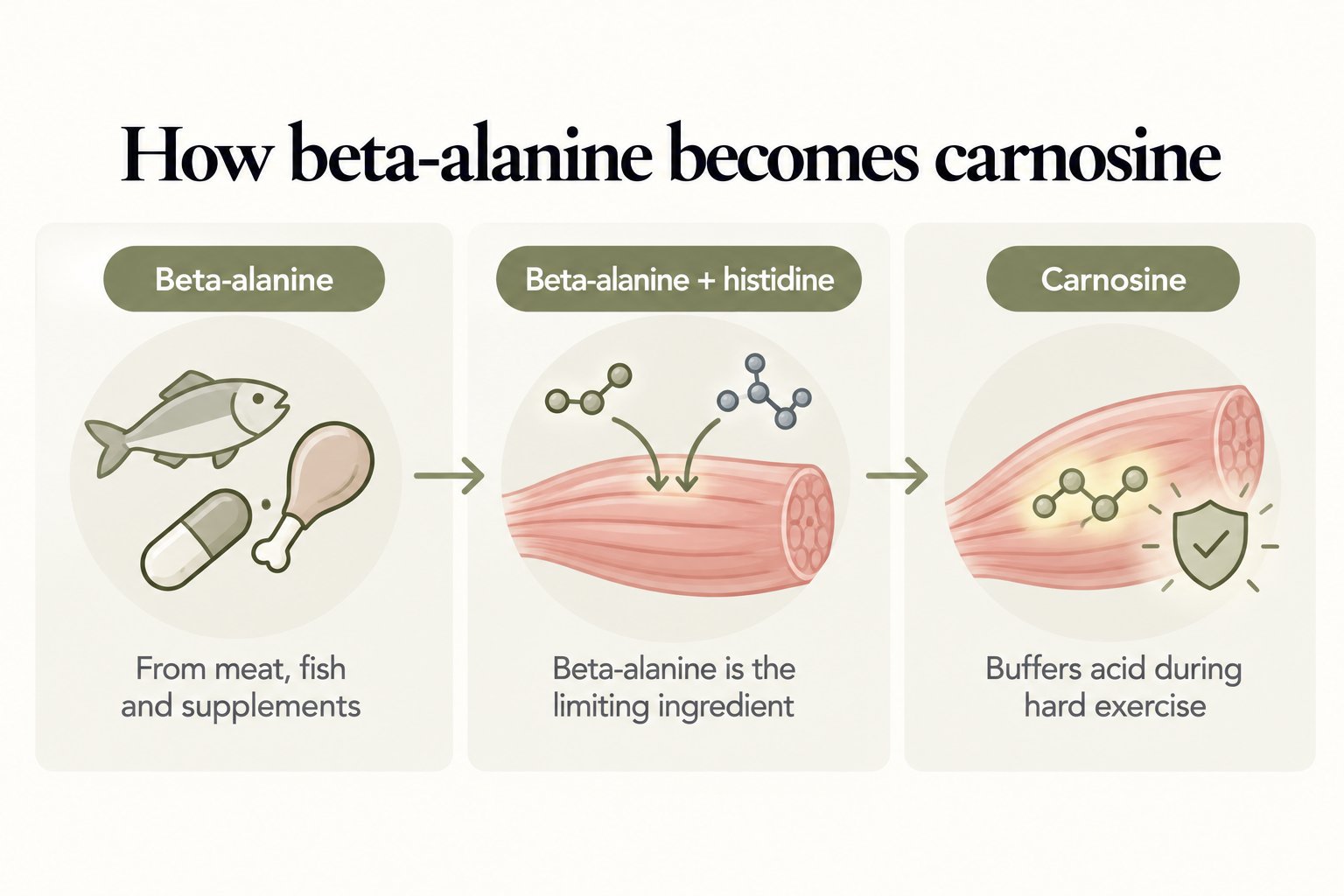
Beta-alanine is a naturally occurring amino acid and one of the best-researched sports supplements. On its own it does little; its value comes from what the body makes with it. In muscle, beta-alanine combines with another amino acid, histidine, to form carnosine, a compound that helps neutralise the acid that builds up during hard exercise and contributes to the burning feeling and fatigue of a hard effort. Beta-alanine is the limiting ingredient, so taking it raises muscle carnosine: by about 20-30% after two weeks and 40-60% after four weeks at 4-6 g a day, according to the International Society of Sports Nutrition. A 2017 meta-analysis of 40 studies and 1,461 people found a small but real improvement in exercise performance, mainly in hard efforts lasting about 30 seconds to 10 minutes, such as sprints, intervals, rowing or middle-distance running. In older adults, small trials found improved endurance and less muscle fatigue, though not better grip strength or chair-rise performance. The main side effect is a harmless tingling of the skin, which can be reduced by splitting doses or using a slow-release form. Beta-alanine won't build muscle on its own and doesn't help short bursts or long, steady exercise much. But for people doing high-intensity training, and possibly for older adults working on endurance, it's a safe, modestly effective option. This article explains how it works, what the evidence shows, how to take it and who might benefit.
Key numbers
| Finding | Detail |
|---|---|
| Muscle carnosine with 4-6 g a day | About 20-30% higher after 2 weeks; 40-60% after 4 weeks |
| Performance (meta-analysis of 40 studies, 1,461 people) | Small, significant benefit (effect size 0.18) |
| Exercise that benefits most | Hard efforts lasting about 30 seconds to 10 minutes |
| Older adults aged 60-80 (12 weeks, 3.2 g a day) | Muscle carnosine up 85%; time to exhaustion up 36.5% vs 8.6% with placebo |
| Older adults aged 55-92 (90 days, 2.4 g a day) | Work capacity before fatigue up 28.6% |
| Washout after stopping | Carnosine falls slowly, about 2% a week |
What beta-alanine is
Beta-alanine is a non-essential amino acid, meaning the body can make small amounts itself, mainly in the liver. Unlike most amino acids, it isn't used to build proteins. Its main job is to combine with histidine to make carnosine, which is stored mostly in skeletal muscle, with smaller amounts in the brain and heart.
Where it comes from.
- Made by the body: in small amounts.
- From food: carnosine and related compounds in meat, poultry and fish are broken down during digestion, releasing beta-alanine. Chicken breast, beef, pork and fish are the richest sources.
- From supplements: usually as powder, capsules or slow-release tablets.
Taking carnosine itself isn't an effective shortcut: most is broken down before it reaches muscle, so beta-alanine is the more efficient way to raise muscle carnosine.
Vegetarians and vegans tend to have lower muscle carnosine because they don't eat meat or fish, and their levels tend to rise more with supplements (see Vegetarian Protein in the Sri Lankan Diet).
What carnosine does
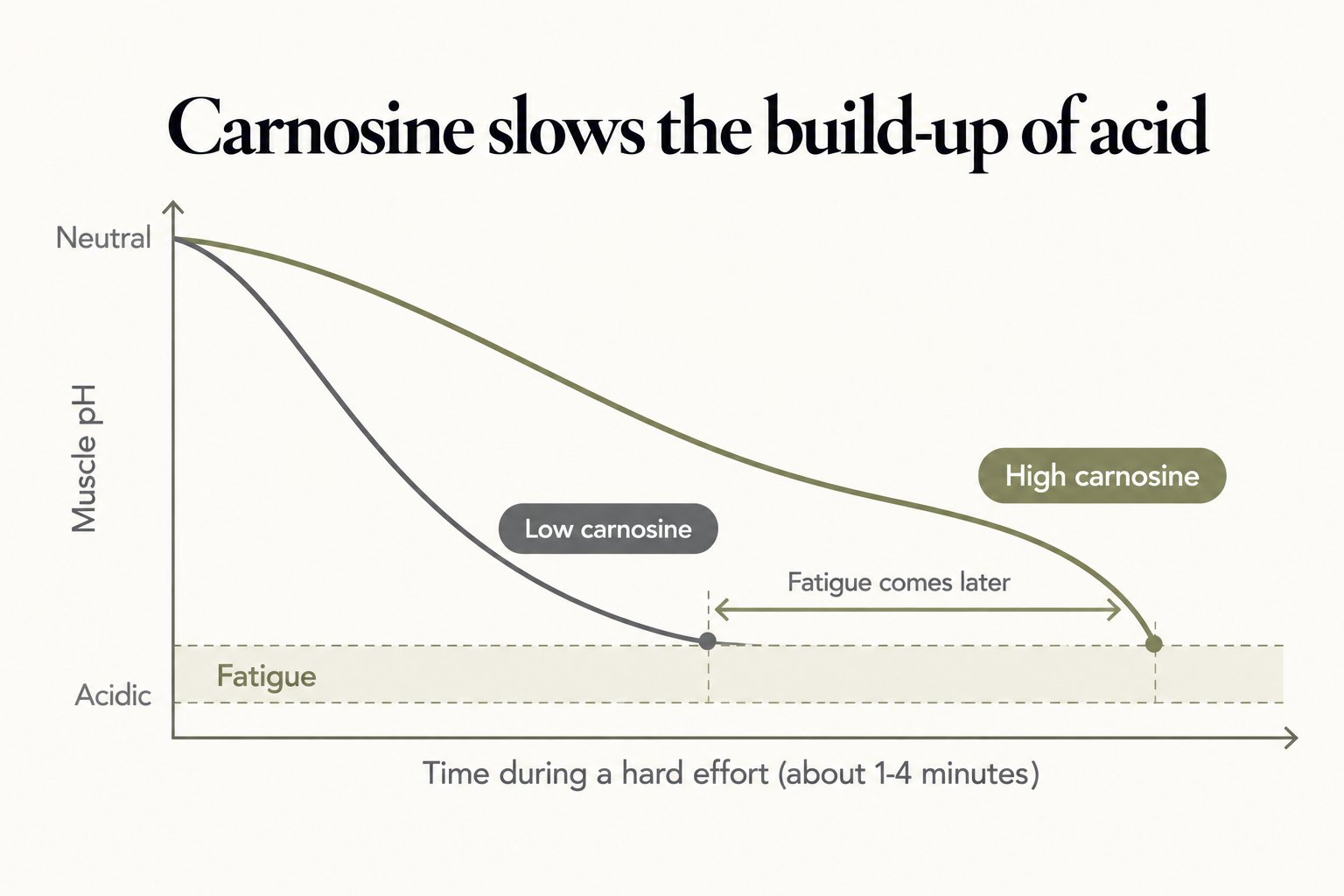
Buffering acid during hard exercise. During intense exercise, muscles break down glucose for energy so quickly that hydrogen ions (acid) build up. As the muscle becomes more acidic, the enzymes that produce energy and the processes that make muscle contract start to fail. That's part of the burning feeling and the drop in power during a hard sprint or interval.
Carnosine acts as a buffer inside muscle cells, mopping up hydrogen ions and slowing the drop in pH. More carnosine means muscles can keep working hard for a little longer before fatigue sets in.
That's why beta-alanine helps most in efforts that are hard enough to produce a lot of acid but long enough for acid to limit performance: roughly 30 seconds to 10 minutes. It does little for very short efforts, such as a single lift or a 10-second sprint, which are limited by other factors, or for long, steady exercise.
Other possible roles. Carnosine also acts as an antioxidant and helps prevent glycation, a process in which sugars damage proteins, in laboratory studies. Carnosine is also found in the brain. These effects have generated interest in beta-alanine for ageing and brain health, but human evidence is limited.
What the evidence shows
Exercise performance. The International Society of Sports Nutrition's 2015 position stand concluded that four weeks of 4-6 g a day significantly raises muscle carnosine and improves performance, with the greatest effects in exercise lasting about 1-4 minutes.
In a 2017 meta-analysis in the British Journal of Sports Medicine, Bryan Saunders and colleagues pooled 40 studies, 65 exercise protocols and 1,461 participants. Beta-alanine had a small but significant effect on exercise (effect size 0.18). The benefit was clearest in efforts lasting 30 seconds to 10 minutes and in "capacity" tests, such as how long you can keep going, rather than time trials. There was no benefit for efforts under a minute. Trained athletes still benefited, though slightly less. Combining beta-alanine with sodium bicarbonate, another acid buffer, gave the largest effect, though only in six studies.
Older adults. Muscle mass, strength and endurance decline with age, and muscle carnosine may fall too. Several small trials have tested beta-alanine in older people:
- Physical working capacity: in a 2008 trial in 26 adults aged 55-92, 2.4 g a day for 90 days increased physical working capacity at the fatigue threshold, the amount of work possible before muscle fatigue sets in, by 28.6%.
- Endurance: in a 2012 trial in 18 healthy adults aged 60-80, 3.2 g a day of slow-release beta-alanine for 12 weeks raised calf muscle carnosine by 85% (vs 7% with placebo), and increased time to exhaustion on a constant-load cycling test by 36.5% (vs 8.6%) and on an incremental test by 12.2% (vs 0.1%). Quality of life scores didn't change.
- Strength, mood and cognition: in a 2023 trial in 100 adults aged 60-80, 2.4 g a day for 10 weeks didn't improve grip strength or chair-rise performance. Those taking beta-alanine had higher scores on a cognitive screening test (MoCA) than those on placebo, especially those with below-normal scores at the start, and lower depression scores. This trial was funded by the manufacturer, and a fifth of participants dropped out.
Together, these suggest beta-alanine may help older adults keep going for longer, but it's unlikely to make them stronger by itself. It works best alongside exercise, not instead of it (see Exercise Across the Decades).
Evidence strength
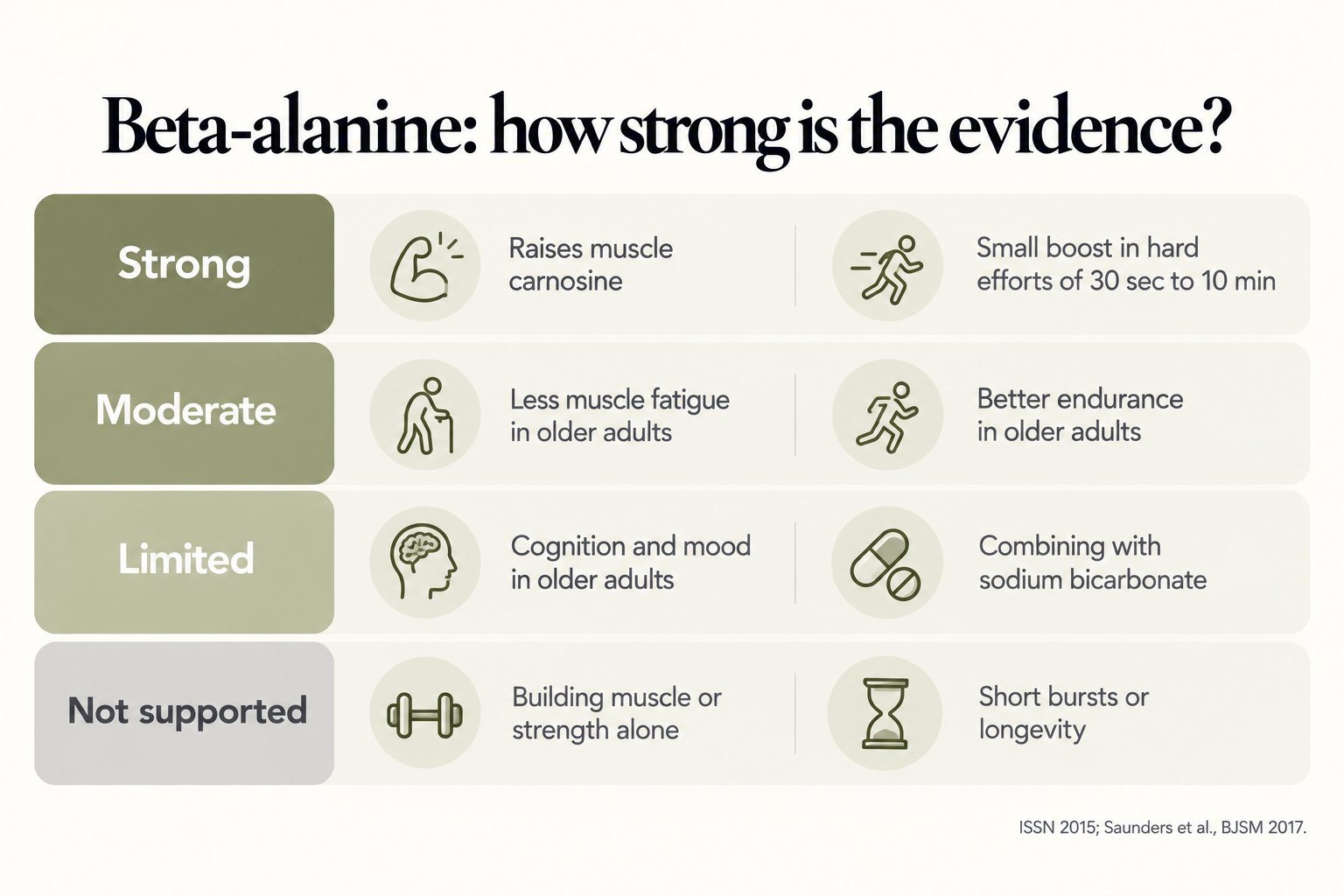
Strong.
- Raises muscle carnosine: consistently, in a dose-dependent way.
- Improves high-intensity performance: a small but reliable benefit in efforts lasting about 30 seconds to 10 minutes, including in trained athletes.
Moderate.
- Reduces muscle fatigue in older adults: consistent findings in small trials, with better endurance and work capacity.
Limited.
- Cognition and mood in older adults: one trial, with benefits mainly in those with lower baseline cognition.
- Combining with sodium bicarbonate: larger effects in a small number of studies.
- Longer endurance events: may help hard efforts within or at the end of long events, such as a sprint finish, but evidence for exercise longer than about 25 minutes is limited.
Not supported.
- Building muscle or strength on its own: effects on strength are small or absent.
- Short bursts under a minute: no benefit.
- A single dose before exercise: doesn't work; carnosine needs weeks to build up.
- Longer life or fewer diseases: antioxidant and anti-glycation effects of carnosine haven't been shown to translate into human health outcomes.
Important limitations.
- Most studies are small and short, many in young, white men, and several older-adult trials were funded by the manufacturer.
- Long-term safety data beyond about a year is limited.
- There's no research specific to South Asian populations.
How to take it
- Dose: 3.2-6.4 g a day. Lower doses (2.4-3.2 g) have been used in older adults.
- Split doses: take it in doses of about 0.8-1.6 g, several times a day, to reduce tingling. The Australian Institute of Sport suggests 1.6 g with each of three main meals and a snack.
- With meals: taking it with food increased carnosine more than taking it between meals (64% vs 41%) in one study.
- Duration: take it daily for at least four weeks before expecting benefits; carnosine keeps rising for months.
- Timing: time of day doesn't matter; what matters is taking it consistently every day.
- Maintenance: about 1.2 g a day may keep carnosine levels up once they've been raised.
- Stopping: carnosine falls slowly, by about 2% a week, taking several months to return to baseline.
- Form: slow-release tablets reduce tingling; choose third-party tested products, especially if you compete in drug-tested sport.
Safety and side effects
- Tingling (paraesthesia): a harmless pins-and-needles feeling, usually in the face, neck and hands, starting 10-20 minutes after a dose and lasting up to an hour. It's more likely with doses above about 800-1,600 mg taken at once. Splitting doses or using a slow-release form helps.
- Histidine and taurine: some studies show lower muscle histidine, and beta-alanine competes with taurine for uptake, but the significance of these changes is unclear.
- Long-term safety: studies up to about a year show no serious harms in healthy people.
- Not studied: in pregnancy, breastfeeding or children.
- Medical conditions: people with kidney or liver disease, or taking several medicines, should check with their doctor first.
- Sport: beta-alanine isn't prohibited in sport, but supplements can be contaminated, so competitive athletes should choose batch-tested products.
Why this matters for longevity
Endurance and the ability to sustain effort are central to healthy ageing: climbing stairs, walking uphill, carrying shopping, keeping up with grandchildren. High-intensity training is one of the most effective ways to maintain fitness with age (see HIIT vs. Steady-State Cardio). Beta-alanine can modestly increase how long you can sustain hard efforts, which may help you train a little harder or longer. It's not an anti-ageing supplement in itself, and it can't replace exercise, protein and strength training. It's best seen as a small, safe add-on for people already training regularly (see Longevity Supplements).
Recommendations by situation
| Situation | What to consider |
|---|---|
| Doing HIIT, interval or circuit training | 3.2-6.4 g a day in split doses for at least 4 weeks may modestly help |
| Competitive rower, swimmer, middle-distance runner or cyclist | Well supported; use batch-tested products |
| Team or racquet sports | May help repeated sprints; benefits modest |
| Mainly lifting heavy weights | Little benefit for maximal strength |
| Long, steady endurance exercise | Little benefit, except for hard finishes |
| Older adult working on endurance | 2.4-3.2 g a day may reduce fatigue; combine with exercise |
| Vegetarian or vegan athlete | Lower starting carnosine; may benefit more |
| Pregnant, breastfeeding or under 18 | Avoid; not studied |
| Kidney or liver disease, or several medicines | Check with your doctor first |
Practical notes
If you train hard several times a week, beta-alanine is one of the few supplements with consistent evidence behind it, but the gains are small. Start with the basics: a good training plan, enough protein, sleep and recovery (see Progressive Overload). If you do try it, take about 3-6 g a day in small doses with meals for at least four weeks, and don't be alarmed by tingling. If you're older and want to improve stamina, beta-alanine may help modestly, but regular walking, strength training and interval work matter far more. Our Longevity Doctors assess fitness, strength and muscle health as part of every assessment and can help you decide whether supplements make sense for you, starting with the free longevity assessment.
- Trexler ET, et al. International Society of Sports Nutrition position stand: beta-alanine. Journal of the International Society of Sports Nutrition, 2015;12:30.
- Saunders B, et al. β-alanine supplementation to improve exercise capacity and performance: a systematic review and meta-analysis. British Journal of Sports Medicine, 2017;51(8):658-669.
- Stout JR, et al. The effect of beta-alanine supplementation on neuromuscular fatigue in elderly (55-92 years): a double-blind randomized study. Journal of the International Society of Sports Nutrition, 2008;5:21.
- del Favero S, et al. Beta-alanine (Carnosyn™) supplementation in elderly subjects (60-80 years): effects on muscle carnosine content and physical capacity. Amino Acids, 2012;43(1):49-56.
- Ostfeld I, et al. The role of β-alanine supplementation on cognitive function, mood and physical function in older adults: a double-blind randomized controlled study. Nutrients, 2023;15(4):923.
- Australian Institute of Sport. Sports Supplement Framework fact sheet: β-alanine.
- Hobson RM, et al. Effects of β-alanine supplementation on exercise performance: a meta-analysis. Amino Acids, 2012;43(1):25-37.
Free longevity assessment
Wondering if beta-alanine
fits your training?
Take the free Aevum Protocol assessment to see how your nutrition & metabolism and 6 other longevity domains are performing — and get a personalised 90-day plan.
Take the free assessmentKeep reading