Longevity 101
Your First 90 Days:
A Practical Starter Plan for Healthy Longevity
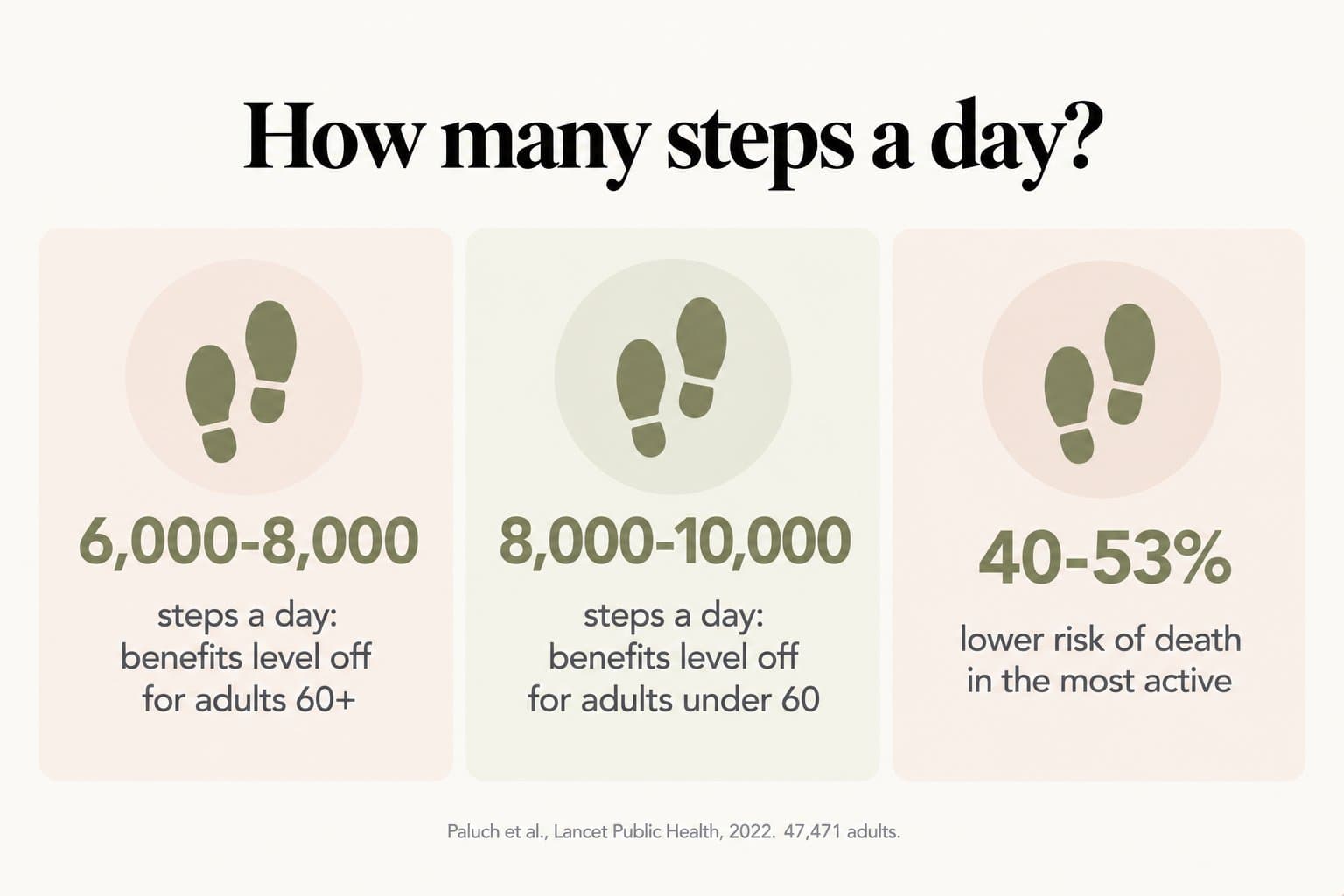
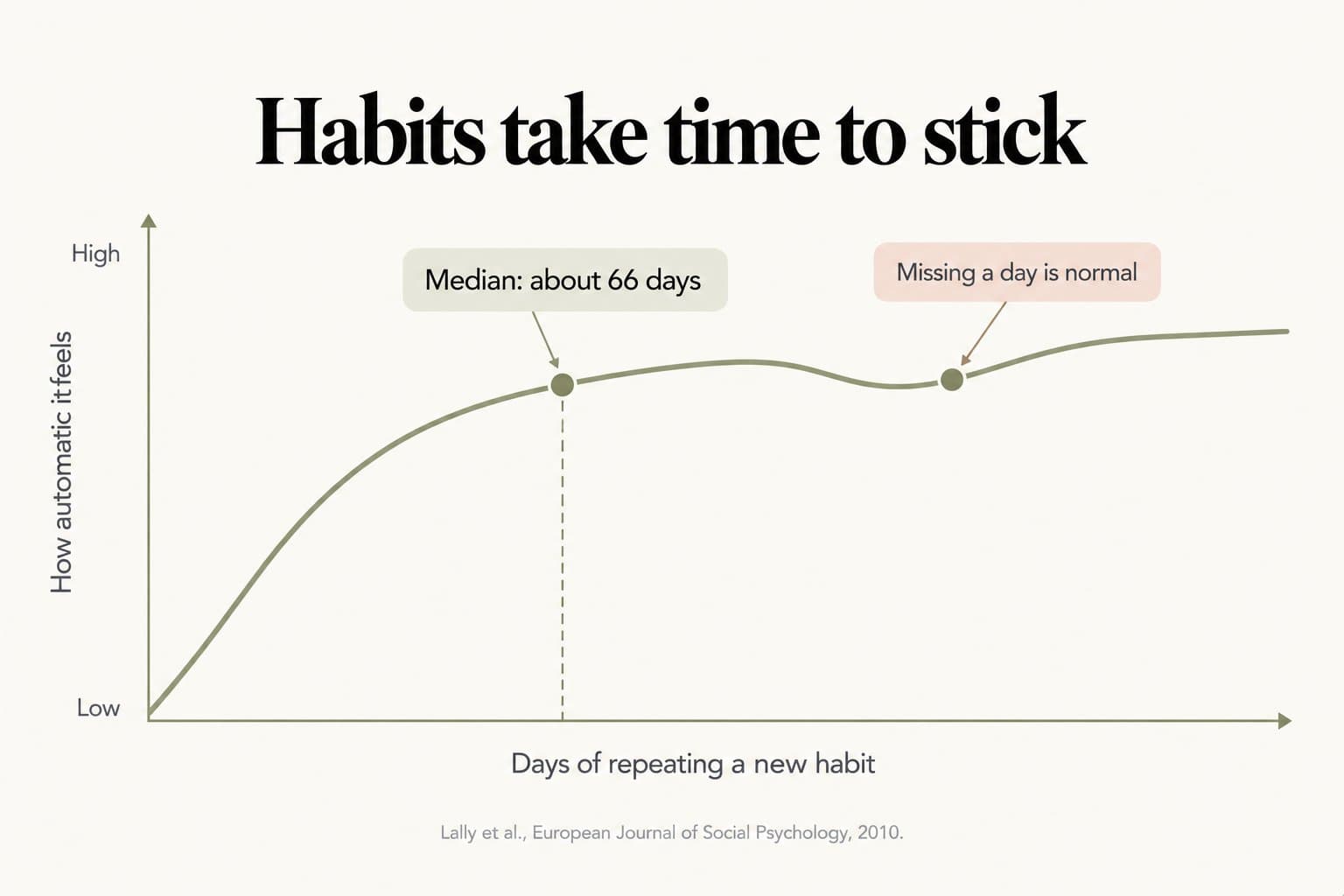
Knowing what's good for you is one thing; changing your routine is another. A 90-day plan works well because it's long enough to see real changes in your numbers and to start forming habits, but short enough to stay motivated. Research on habit formation found that new daily behaviours took a median of 66 days to become automatic, with wide variation between people and habits, so expect the first two months to need conscious effort. Planning helps: a review of 94 studies found that specific "if-then" plans, such as "If it's 6 pm, then I'll walk for 20 minutes", had a medium-to-large effect on reaching goals. And small steps add up: in a meta-analysis of 15 studies with 47,471 adults, mortality benefits levelled off at around 6,000-8,000 steps a day for adults aged 60 and over and 8,000-10,000 for younger adults, and the most active had 40-53% lower risk of death than the least active. This guide gives a simple three-phase plan: measure and choose your priorities in weeks 1-2, build core habits in weeks 3-6, and strengthen and review in weeks 7-12.
Key numbers
| Finding | Detail |
|---|---|
| Habit formation | New daily habits took a median of 66 days to become automatic |
| If-then planning (94 studies) | Medium-to-large effect on reaching goals |
| Daily steps (15 cohorts, 47,471 adults) | Benefits levelled off at 6,000-8,000 steps (60+) and 8,000-10,000 steps (under 60); 40-53% lower risk of death in the most active |
| Weekly activity target (WHO) | 150-300 minutes of moderate activity plus strength training on 2+ days |
| Weight loss for diabetes prevention | About 7% weight loss plus 150 minutes of activity a week cut diabetes risk by 58% |
The 90-day plan at a glance
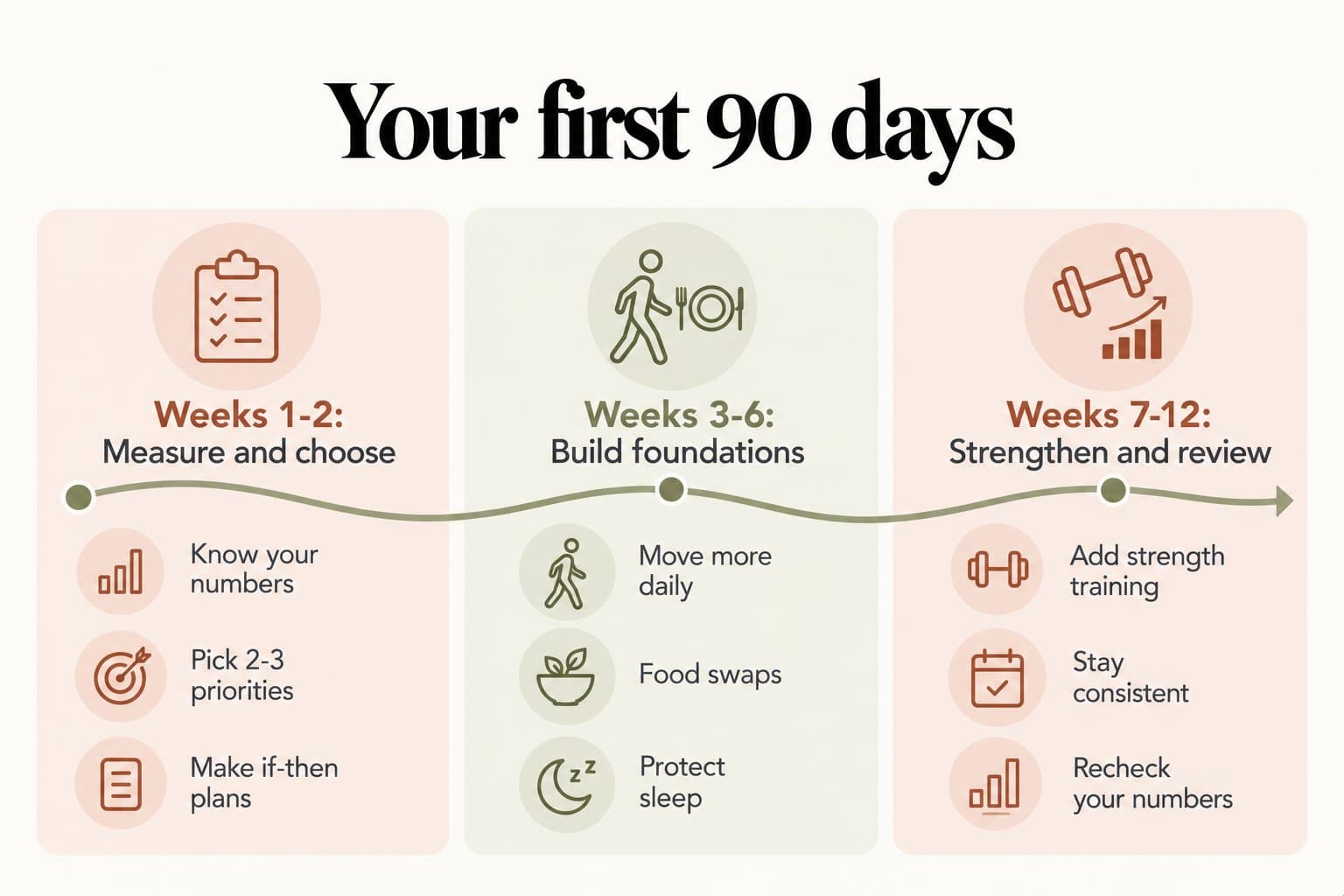
- 1. Weeks 1-2: Measure and choose. Know your numbers and pick two or three priorities.
- 2. Weeks 3-6: Build the foundations. Start with movement, food and sleep habits.
- 3. Weeks 7-12: Strengthen and review. Add strength training, build consistency and recheck your numbers.
Weeks 1-2: measure and choose
Know your starting point. Record your blood pressure (ideally home readings twice morning and evening for a week), weight, waist size, recent blood tests (HbA1c, cholesterol, kidney function), average daily steps and typical sleep (see Your Key Longevity Numbers).
Choose two or three priorities. Trying to change everything at once rarely lasts. Pick the areas furthest from target or most important to you, for example "lower my blood pressure", "build strength" or "sleep seven hours".
Make if-then plans. In a meta-analysis of 94 studies, implementation intentions, plans that specify when, where and how you'll act ("If situation Y, then I will do X"), had a medium-to-large effect on achieving goals. Write down a specific plan for each priority.
Weeks 3-6: build the foundations
Move more, every day. Increase your daily steps gradually, by about 1,000 a week if you're starting low. A meta-analysis of 15 studies found that the benefits for survival levelled off at around 6,000-8,000 steps a day in adults aged 60 and over and 8,000-10,000 in younger adults, with 40-53% lower risk of death in the most active groups. Work towards the WHO recommendation of 150-300 minutes of moderate activity a week.
Make two or three food swaps. For example: make rice a quarter of your plate and vegetables half, add dhal or another legume daily, cut the sugar in your tea, and reduce salty extras such as dried fish, pickles and short eats (see Building a Longevity Plate).
Protect your sleep. Aim for at least seven hours, with consistent sleep and wake times and less caffeine late in the day (see Sleep Hygiene).
Weeks 7-12: strengthen and review
Add strength training. Build up to muscle-strengthening exercise on two or more days a week, using body weight, bands or weights. Strength improves at any age (see It's Never Too Late).
Expect habits to take time. In a study of habit formation, new daily behaviours took a median of 66 days to become automatic, and the time varied widely. Missing an occasional day is normal; what matters is getting back on track.
Recheck and review at 90 days. Repeat your measurements and compare them with week 1. Many people see improvements in blood pressure, weight, waist size, fitness and sleep within three months. Celebrate progress, then choose your priorities for the next 90 days.
Recommendations by scenario
| Scenario | What to do |
|---|---|
| Very busy | Start with 10-minute walks after meals and one food swap |
| High blood pressure | Prioritise salt reduction, daily walking and home monitoring |
| Prediabetes | Aim for about 7% weight loss and 150 minutes of activity a week |
| Over 60 or less mobile | Start with walking, chair-based strength and balance exercises |
| Poor sleep | Fix sleep timing first; it makes other changes easier |
| Lost motivation | Shrink the goal, use an if-then plan and track one simple number |
Practical notes
The best plan is one you can follow. Focus on a few changes, make specific if-then plans, track a handful of numbers and review them after 90 days. Expect setbacks, and treat them as part of the process rather than a reason to stop. The habits that matter most for longevity are simple: move every day, eat mostly plants with legumes, whole grains and fish, limit salt, sugar and alcohol, don't smoke, sleep well and stay connected (see From Hallmarks to Habits). Our free longevity assessment gives you a personalised 90-day plan based on your results across all eight domains, and our Longevity Doctors can guide and track your progress (see What to Expect From a Longevity Doctor).
- Lally P, et al. How are habits formed: modelling habit formation in the real world. European Journal of Social Psychology, 2010;40(6):998-1009.
- Gollwitzer PM, Sheeran P. Implementation intentions and goal achievement: a meta-analysis of effects and processes. Advances in Experimental Social Psychology, 2006;38:69-119.
- Paluch AE, et al. Daily steps and all-cause mortality: a meta-analysis of 15 international cohorts. The Lancet Public Health, 2022;7(3):e219-e228.
- Bull FC, et al. World Health Organization 2020 guidelines on physical activity and sedentary behaviour. British Journal of Sports Medicine, 2020;54(24):1451-1462.
- Diabetes Prevention Program Research Group. Reduction in the incidence of type 2 diabetes with lifestyle intervention or metformin. New England Journal of Medicine, 2002;346(6):393-403.
Free longevity assessment
Want a personalised
90-day plan?
Take the free Aevum Protocol assessment to see how your longevity 101 and 6 other longevity domains are performing — and get a personalised 90-day plan.
Take the free assessmentKeep reading