Longevity Science
Ageing Is Not Linear:
What Research on 'Ageing Bursts' at 44 and 60 Really Shows
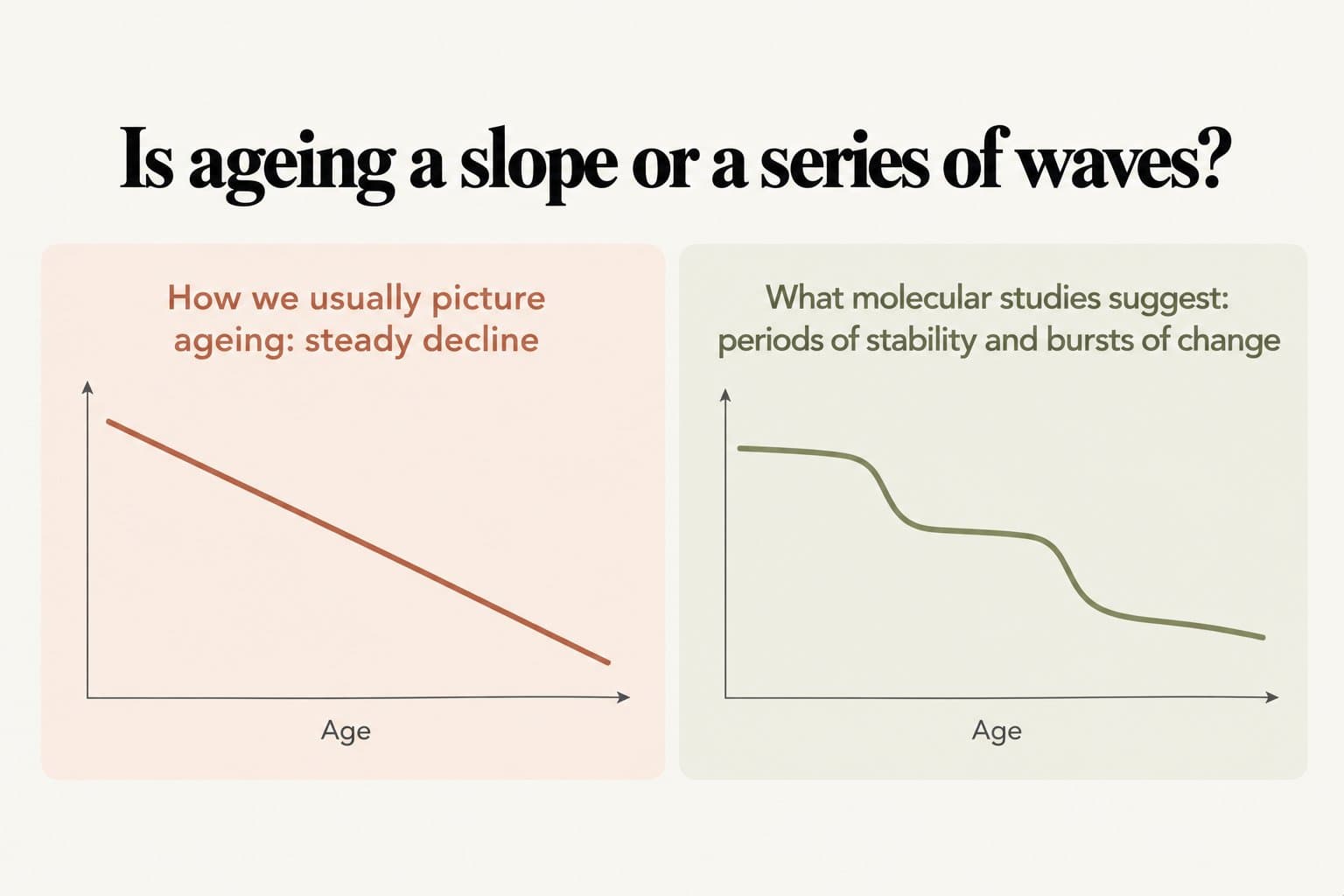
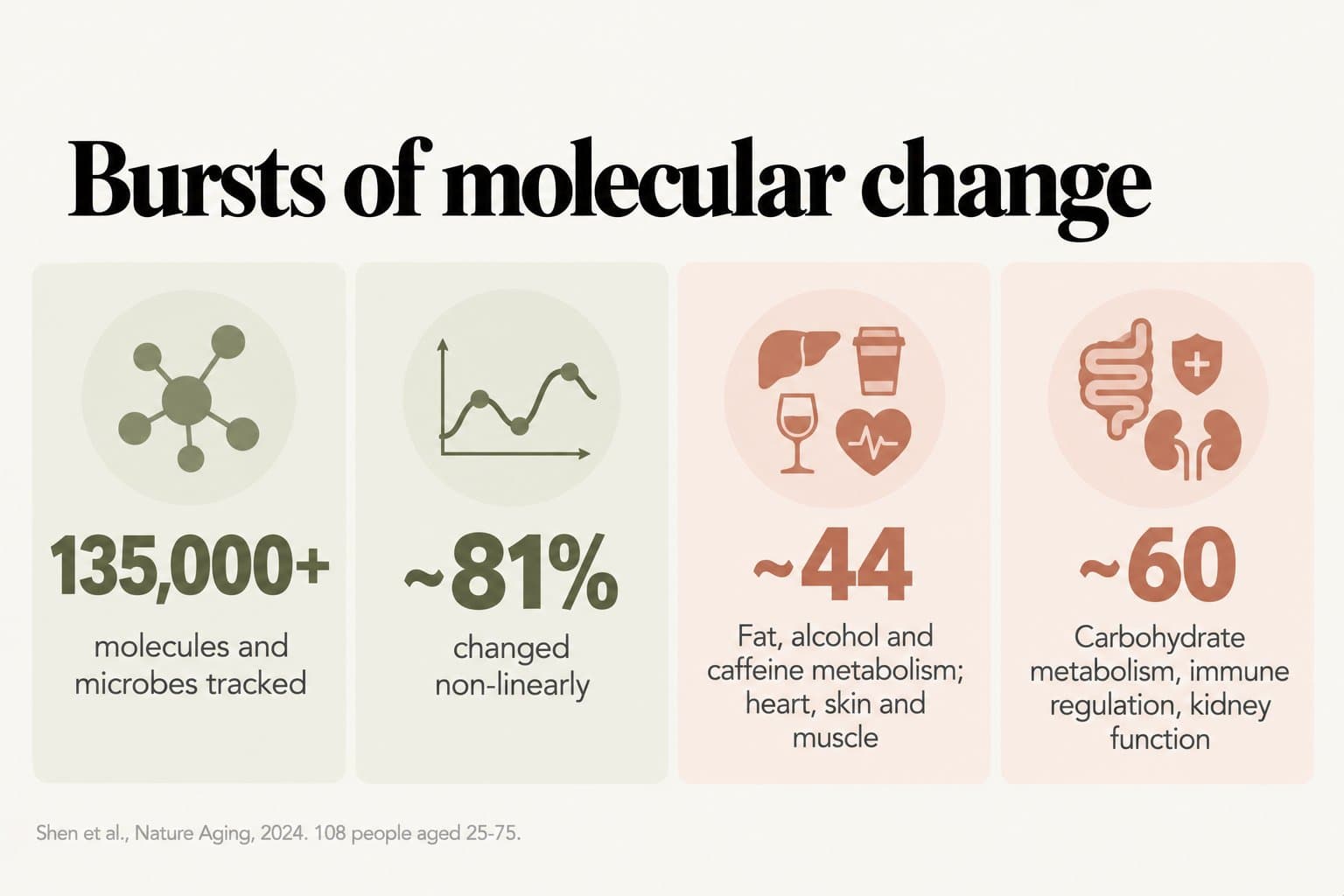
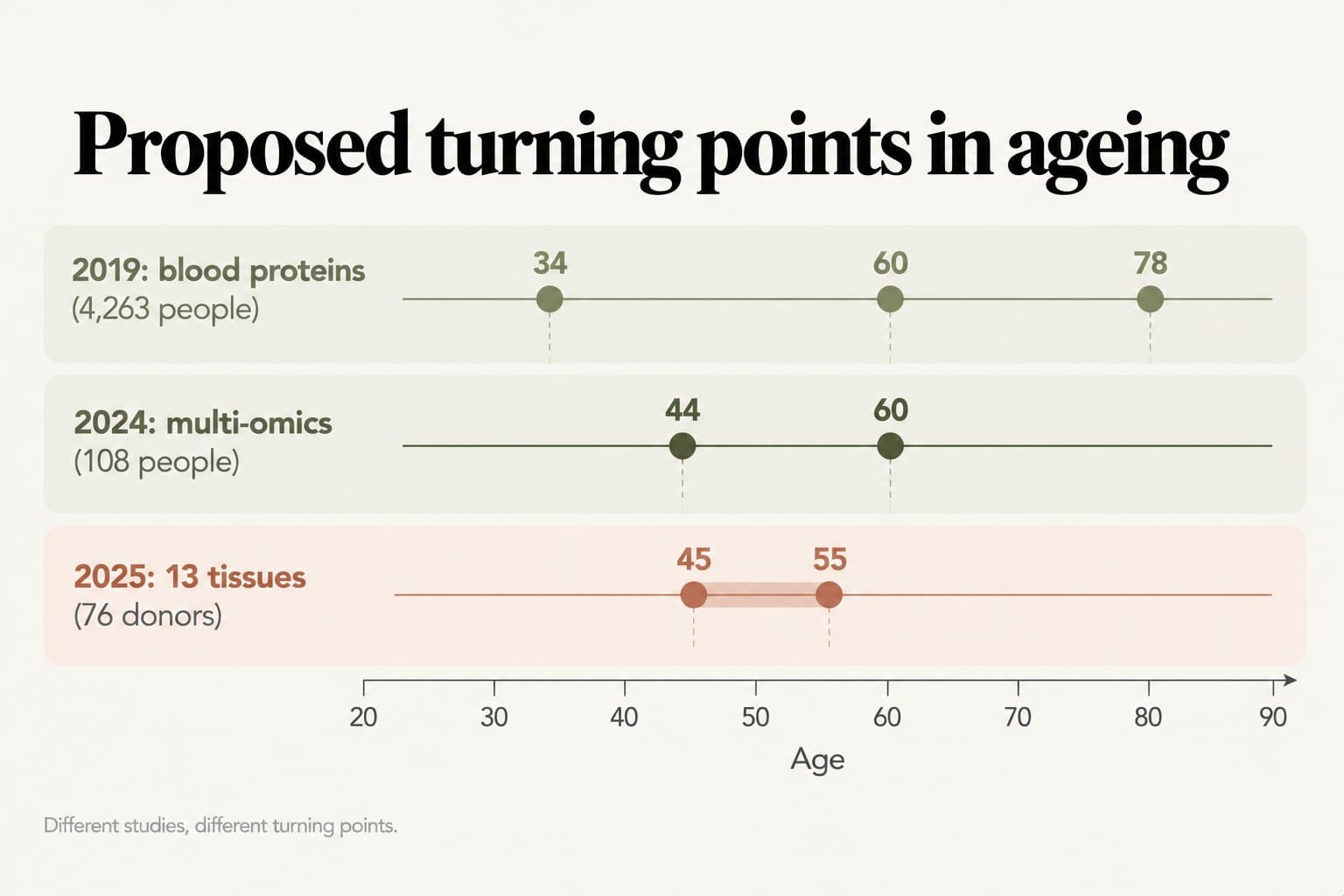
We often picture ageing as a slow, steady decline, but molecular studies suggest it may happen in waves. In a 2019 study of 4,263 people aged 18 to 95, Stanford researchers found that blood proteins changed most sharply at three points: around ages 34, 60 and 78. In 2024, another Stanford team tracked more than 135,000 molecules and microbes in 108 people aged 25 to 75 and found that about 81% changed in a non-linear way, with two major shifts around ages 44 and 60. The mid-40s shift involved molecules linked to alcohol, caffeine and fat metabolism, heart disease, skin and muscle, and it appeared in men as well as women, so menopause alone didn't explain it. The early-60s shift involved carbohydrate metabolism, immune regulation and kidney function. A 2025 study of 13 tissues from 76 organ donors pointed to an inflection between 45 and 55, with blood vessels among the first to change. These studies made headlines, but they're small or cross-sectional, and the exact ages differ between studies. The broader message is that ageing may accelerate at certain life stages, which could mark windows for extra attention to health. This article explains the findings and their limits.
Key numbers
| Finding | Detail |
|---|---|
| Plasma proteins across the lifespan (Lehallier et al., 2019) | 4,263 people aged 18-95; waves of change around ages 34, 60 and 78 |
| Multi-omics ageing bursts (Shen et al., 2024) | 108 people aged 25-75; 135,000+ molecules and microbes; about 81% changed non-linearly; peaks around 44 and 60 |
| Multi-tissue proteome (Chinese Academy of Sciences, 2025) | 13 tissues from 76 donors aged 14-68; sharpest changes at 45-55, especially in the aorta |
| Shen et al. follow-up | Median of about 1.7 years per participant |
The discovery
Most early ageing research compared groups of young and old people and drew a straight line between them. With new technologies that measure thousands of proteins, metabolites and microbes at once, scientists can look at how each molecule changes across the whole age range. When they did, many molecules didn't follow straight lines: they stayed fairly stable for years and then shifted relatively quickly.
What the research shows
2019: three waves in the blood proteome. Benoit Lehallier, Tony Wyss-Coray and colleagues at Stanford measured about 3,000 plasma proteins in 4,263 people aged 18 to 95. Of these, 1,379 changed significantly with age, and the changes clustered in three waves, around ages 34, 60 and 78. A protein-based clock predicted people's ages to within about three years most of the time, and people whose predicted age was lower than their actual age had better grip strength and cognitive function. As Wyss-Coray put it: "Proteins are the workhorses of the body's constituent cells, and when their relative levels undergo substantial changes, it means you've changed, too."
2024: bursts at 44 and 60. In a 2024 study in Nature Aging, Xiaotao Shen, Michael Snyder and colleagues at Stanford collected repeated samples from 108 people aged 25 to 75, tracking more than 135,000 molecules and microbes. About 81% changed non-linearly, with two major clusters of change:
- Around age 44: molecules related to alcohol, caffeine and fat metabolism, cardiovascular disease, and skin and muscle.
- Around age 60: molecules related to carbohydrate and caffeine metabolism, immune regulation, kidney function, cardiovascular disease, and skin and muscle.
The mid-40s shift occurred in men too, so the researchers concluded that menopause alone didn't explain it. "We're not just changing gradually over time; there are some really dramatic changes," Snyder said.
2025: an inflection around 45 to 55. A 2025 study in Cell led by the Chinese Academy of Sciences analysed proteins in 13 tissues from 76 organ donors aged 14 to 68. The sharpest changes occurred between ages 45 and 55, and the aorta, the body's main artery, showed some of the most marked changes. When the researchers gave young mice a protein associated with blood vessel ageing, the mice's physical performance and grip strength declined.
Where it stands: promise vs risks
| Development | What it showed | Stage | Evidence strength |
|---|---|---|---|
| Waves in blood proteins | Changes cluster around 34, 60 and 78 | Large cross-sectional study | Moderate |
| Ageing bursts at 44 and 60 | 81% of molecules change non-linearly | Small study, short follow-up | Limited |
| Tissue inflection at 45-55 | Blood vessels change early | Small donor study plus mouse experiments | Limited |
| Causes of the bursts | Unclear: biology, lifestyle or both | Not yet established | Limited |
| Using bursts to time interventions | Not yet tested | Theoretical | None yet |
Critics have pointed out important limitations of the 2024 study. Participants were tracked for a median of only about 1.7 years and mostly lived near Stanford, so the "bursts" were largely inferred by comparing people of different ages rather than following individuals through their 40s and 60s. The researchers acknowledged that the changes might partly reflect lifestyle, such as changes in alcohol and caffeine intake or physical activity, at those ages. The different studies also identified different turning points, so the exact ages shouldn't be taken too literally.
Why this matters for longevity
If ageing does accelerate at particular life stages, those periods could be windows where attention to health matters most, for example in the mid-40s for heart health and metabolism, and around 60 for blood sugar, immune function and kidneys. It also fits with research showing that organs age at different rates (see Organ Ageing Clocks). But the evidence is still early. These studies show when molecular changes happen, not that targeting those ages improves outcomes.
Practical notes
You don't need to wait for a specific birthday to look after your health, but your 40s and 60s are sensible times to take stock. In your 40s, check blood pressure, cholesterol and blood sugar, build or maintain muscle with strength training, and consider cutting back on alcohol (see Alcohol and Longevity) and late-day caffeine (see Tea, Coffee and Longevity). Around 60, keep up regular health checks, including kidney function and blood sugar, stay active and keep vaccinations up to date. Our Longevity Doctors can help you plan health checks for each stage of life, starting with the free longevity assessment.
- Lehallier B, et al. Undulating changes in human plasma proteome profiles across the lifespan. Nature Medicine, 2019;25(12):1843-1850.
- Shen X, et al. Nonlinear dynamics of multi-omics profiles during human aging. Nature Aging, 2024;4(11):1619-1634.
- Ding Y, et al. Comprehensive human proteome profiles across a 50-year lifespan reveal aging trajectories and signatures. Cell, 2025.
- Stanford Report. Study finds human aging happens in bursts. August 2024.
Free longevity assessment
Is your 40s or 60s
a time to take stock?
Take the free Aevum Protocol assessment to see how your longevity science and 6 other longevity domains are performing — and get a personalised 90-day plan.
Take the free assessmentKeep reading