Longevity Science
Gompertz's Law:
Why Your Risk of Dying Doubles Every Eight Years
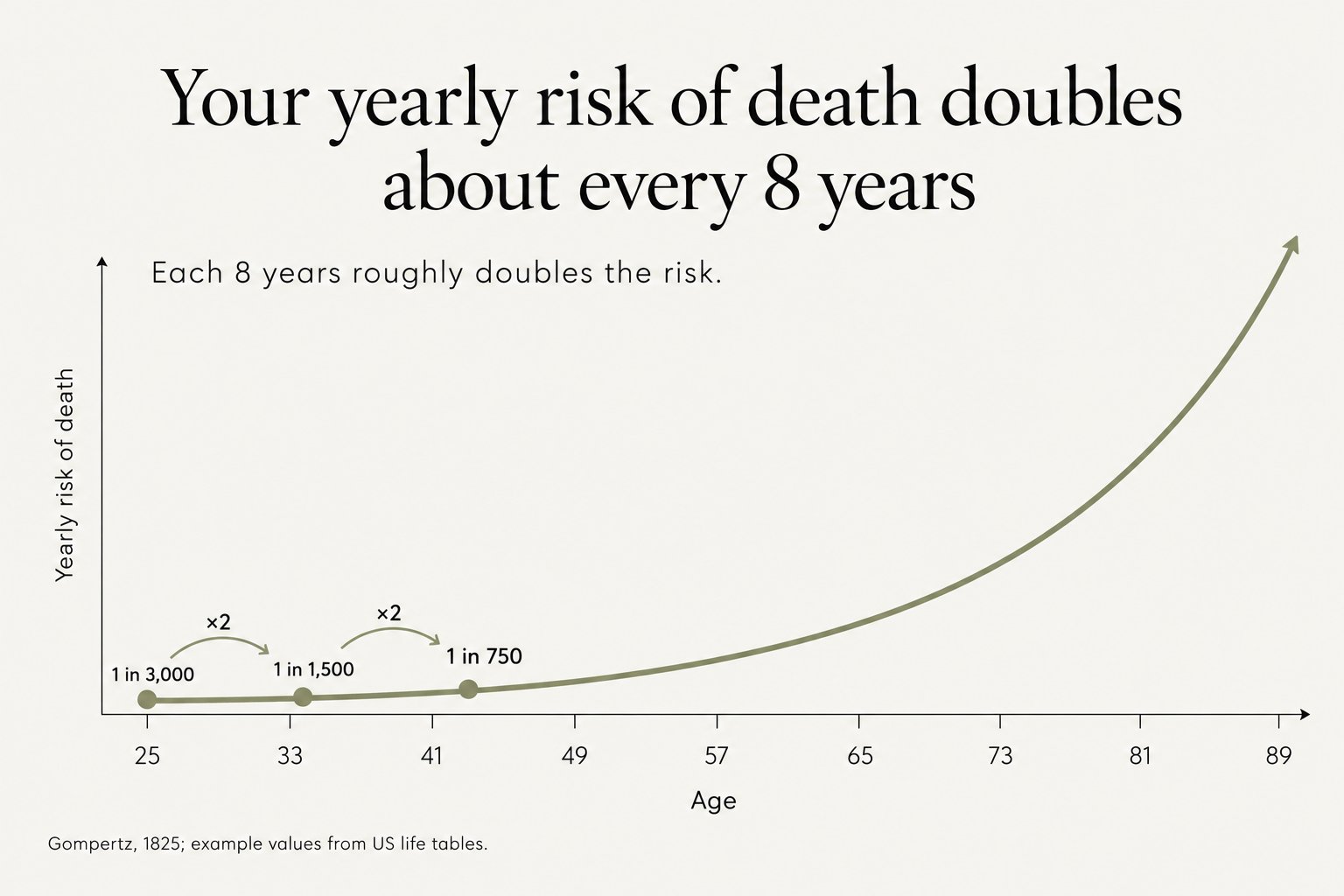
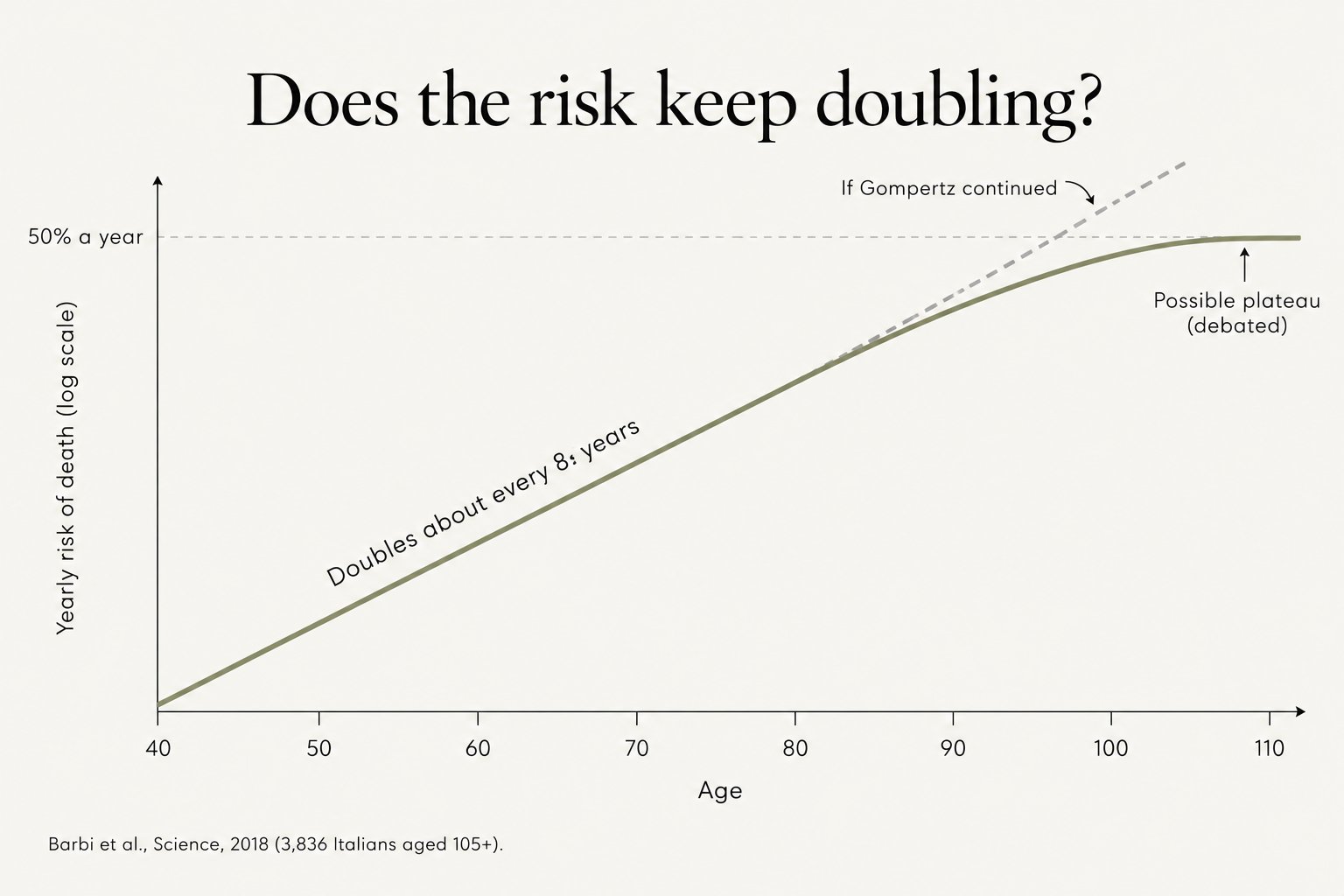
In 1825, a British actuary named Benjamin Gompertz noticed something remarkable in the death records he used to price life insurance: once people reach adulthood, their chance of dying in any given year rises exponentially with age. Today we know that, in adults, the annual risk of death roughly doubles about every eight years. At 25, the chance of dying within a year is tiny, about 1 in 3,000 in one set of US life tables; by 33 it's about 1 in 1,500, and by 41 about 1 in 750, continuing to double through middle and old age. This pattern, called Gompertz's law, holds remarkably well from about age 40 to 90 in modern populations, across countries and eras, and even in many other species. In 1860, William Makeham added a second part: a background risk, from accidents and infections, that doesn't change with age. At the very oldest ages, the curve may level off; a study of 3,836 Italians aged 105 and over found that the yearly chance of dying flattened at about 50%, though this is debated. Gompertz's law is one of the clearest mathematical signatures of ageing itself. It also carries a practical message: lifestyle and medicine mainly lower your starting level of risk rather than slowing the doubling, but because risk doubles every eight years, halving your risk is roughly like turning back your mortality clock by eight years.
Key numbers
| Finding | Detail |
|---|---|
| Gompertz's law (1825) | Adult risk of death rises exponentially with age |
| Doubling time in humans | About every 8 years |
| Example (US life tables) | About 1 in 3,000 at 25, 1 in 1,500 at 33, 1 in 750 at 41 |
| Age range where it fits best | About 40 to 90 in low-mortality populations |
| Makeham's addition (1860) | A constant background risk that doesn't change with age |
| Late-life plateau (3,836 Italians aged 105+) | Yearly risk of death levels off at about 50% (debated) |
What Gompertz discovered
Benjamin Gompertz was an English mathematician and actuary who worked for an insurance company. Insurers needed to predict how long people would live in order to set premiums. Studying mortality tables, Gompertz found that the death rate didn't rise by the same amount each year but by roughly the same proportion, which produces an exponential curve. He published this in 1825 in the Philosophical Transactions of the Royal Society.
In modern terms, the "force of mortality", or hazard, is the risk of dying in the next short period for someone who has survived to a given age. Gompertz's law says this hazard increases exponentially:
- Starting level: a baseline risk in early adulthood.
- Rate of increase: how quickly risk rises with age. In humans, this produces a doubling about every eight years.
Makeham's addition. In 1860, William Makeham added a second component: a background risk that's the same at every age, reflecting deaths from causes such as accidents and some infections. The combined Gompertz-Makeham model is still used by actuaries and demographers today to build life tables and price life insurance and pensions.
What it means in practice
The doubling pattern explains why ageing is the biggest risk factor for most major diseases. Heart disease, stroke, many cancers, dementia and type 2 diabetes all become dramatically more common with age, and together they drive the exponential rise in deaths.
A useful way to see it:
- Young adults: risk is so low that doubling barely matters.
- Midlife: risk is still modest, but each eight years doubles it.
- Later life: the doublings add up quickly, so risk climbs steeply.
Gompertz's law doesn't apply well to childhood: risk is relatively high in infancy, falls to its lowest point around the age of 10, then rises through adolescence and early adulthood, partly from accidents and violence, before the Gompertz pattern takes over.
Does risk keep doubling forever?
Not necessarily. At extreme ages, the increase in risk may slow down.
In a 2018 study in Science, Elisabetta Barbi and colleagues analysed every person in Italy born between 1896 and 1910 who reached age 105 or older: 3,836 people, using Italy's national population registry, considered among the most accurate in the world. They found that the risk of dying rose until about age 80, slowed, and then levelled off between 105 and 110 at about 50% a year, roughly a coin toss each year. If true, this suggests there may be no fixed upper limit to human lifespan.
Not everyone agrees. Some researchers argue that the error bars are wide enough to fit a continued rise, and that mistakes in recorded ages, which are common in very old people, can create a false plateau. The question remains open (see The Limits of Human Lifespan).
Can we change the curve?
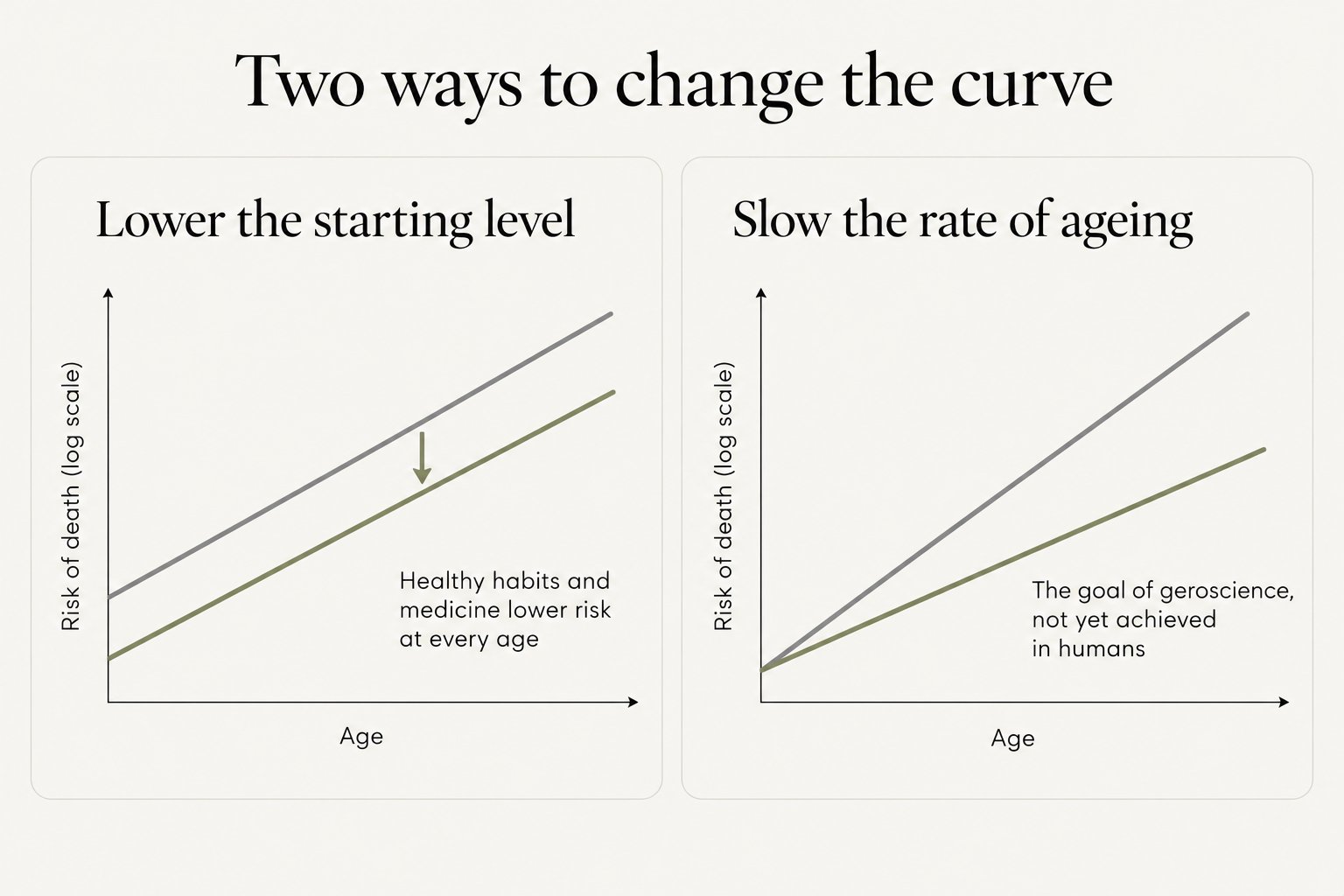
There are two ways to change a Gompertz curve:
- 1. Lower the starting level: reduce risk at every age, shifting the whole curve down.
- 2. Slow the rate of increase: make the curve less steep, which would mean slowing ageing itself.
Most of the huge gains in human life expectancy over the past two centuries have come from the first: fewer deaths in infancy, childhood and early adulthood thanks to clean water, vaccines, antibiotics, better nutrition and safer living conditions. In a 2021 study in Nature Communications, Fernando Colchero and colleagues compared nine human populations and 30 populations of other primates, including chimpanzees, gorillas and baboons. They found that longer lives came mainly from reducing early deaths, while the rate of ageing varied little. As Colchero put it, longer lives are "not because we have slowed our rate of aging." This supports the "invariant rate of ageing" hypothesis: that the speed at which risk rises with age may be biologically constrained.
That's why geroscience, the study of the biology of ageing, aims to target the underlying processes of ageing directly, in the hope of slowing the rate of increase rather than just lowering risk one disease at a time (see The Hallmarks of Ageing).
Why this matters for longevity
Gompertz's law has an encouraging practical message. Because risk doubles about every eight years, anything that halves your risk of death is mathematically similar to being about eight years younger in mortality terms. Not smoking, staying physically active, keeping blood pressure, cholesterol and blood sugar in healthy ranges, sleeping well and maintaining strong social connections each lower the starting level of your curve. Combined, they can add up to many years of life and, just as importantly, more years in good health. Slowing the rate of ageing itself remains a goal for future science, but lowering your curve is something you can start today (see It's Never Too Late).
Practical notes
You can't change your age, but you can change your risk at every age. Focus on the factors that shift your whole curve down: avoid smoking, move every day, eat a mostly plant-rich diet, manage blood pressure, cholesterol and blood sugar, protect sleep and stay socially connected. Regular health checks help catch problems early, when they're easiest to treat. Our Longevity Doctors assess your key risk factors and biological ageing markers and help you build a plan to lower your curve, starting with the free longevity assessment.
- Gompertz B. On the nature of the function expressive of the law of human mortality, and on a new mode of determining the value of life contingencies. Philosophical Transactions of the Royal Society of London, 1825;115:513-583.
- Makeham WM. On the law of mortality and the construction of annuity tables. Journal of the Institute of Actuaries, 1860;8(6):301-310.
- Barbi E, et al. The plateau of human mortality: demography of longevity pioneers. Science, 2018;360(6396):1459-1461.
- Colchero F, et al. The long lives of primates and the 'invariant rate of ageing' hypothesis. Nature Communications, 2021;12:3666.
Free longevity assessment
Ready to lower
your curve?
Take the free Aevum Protocol assessment to see how your longevity science and 6 other longevity domains are performing — and get a personalised 90-day plan.
Take the free assessmentKeep reading