Cardiovascular & Metabolic Health
Aspirin for Heart Disease Prevention:
Who Benefits and Who Doesn't
For decades, a daily low-dose aspirin was widely taken to prevent heart attacks and strokes. The advice has changed, and the key question is whether you already have cardiovascular disease. For people who've had a heart attack, stroke or stent, aspirin clearly reduces the risk of another event and is usually recommended long term. For people without cardiovascular disease, the picture is very different: the benefit is small and largely cancelled out by a higher risk of serious bleeding. In a large trial of people with diabetes, aspirin prevented 11 serious vascular events per 1,000 people but caused 9 major bleeds. In over 19,000 healthy older adults, aspirin didn't reduce cardiovascular events at all, but did increase major bleeding. As a result, US guidelines now advise against starting aspirin for prevention at 60 or over, and make it an individual decision for higher-risk people aged 40-59. This article explains the evidence so you can have an informed conversation with your doctor.
Key numbers
| Finding | Detail |
|---|---|
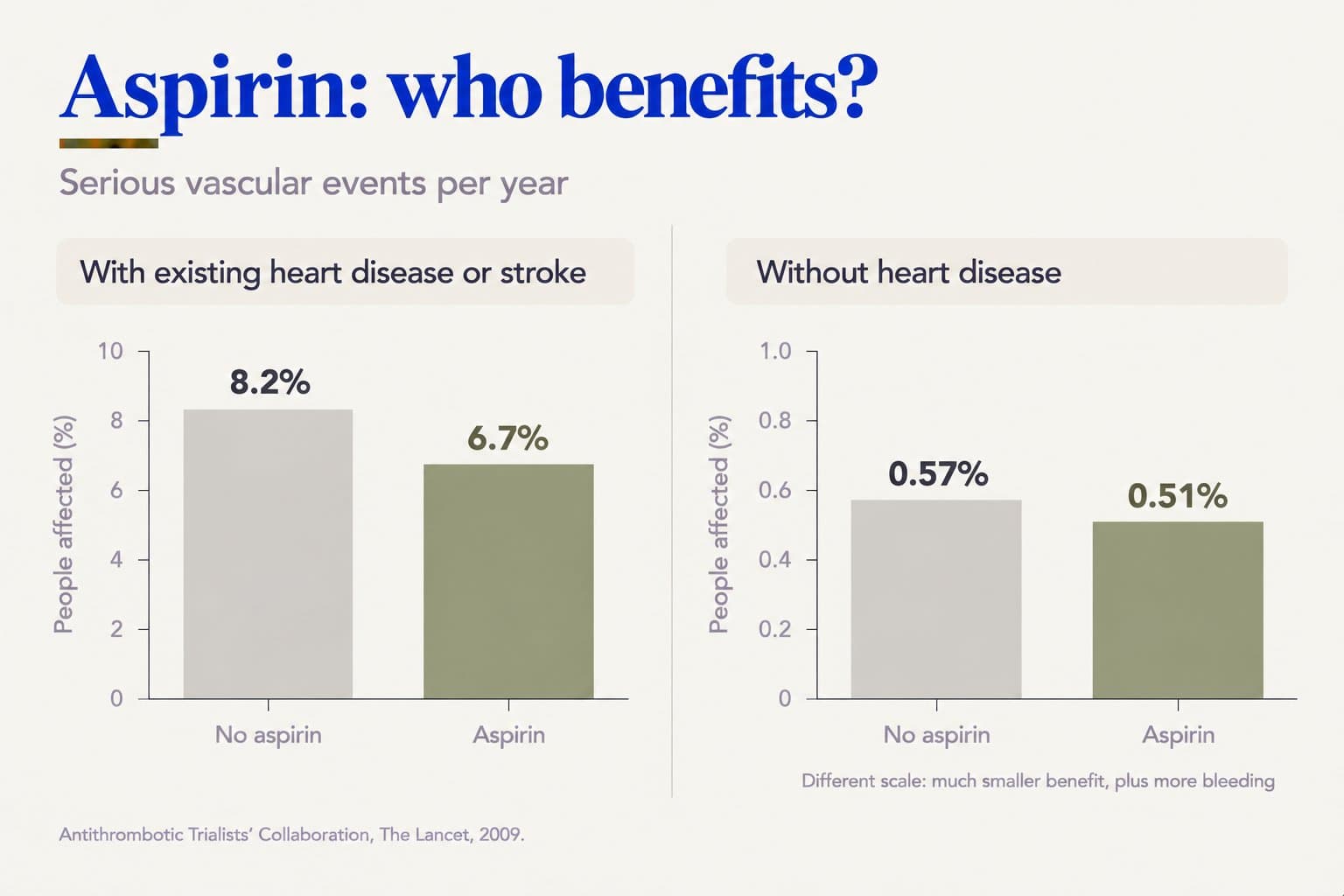
| Aspirin after a heart attack or stroke (secondary prevention trials) | Serious vascular events reduced from 8.2% to 6.7% per year |
| Aspirin in people without cardiovascular disease (primary prevention trials) | Serious vascular events reduced from 0.57% to 0.51% per year; major bleeding increased from 0.07% to 0.10% per year |
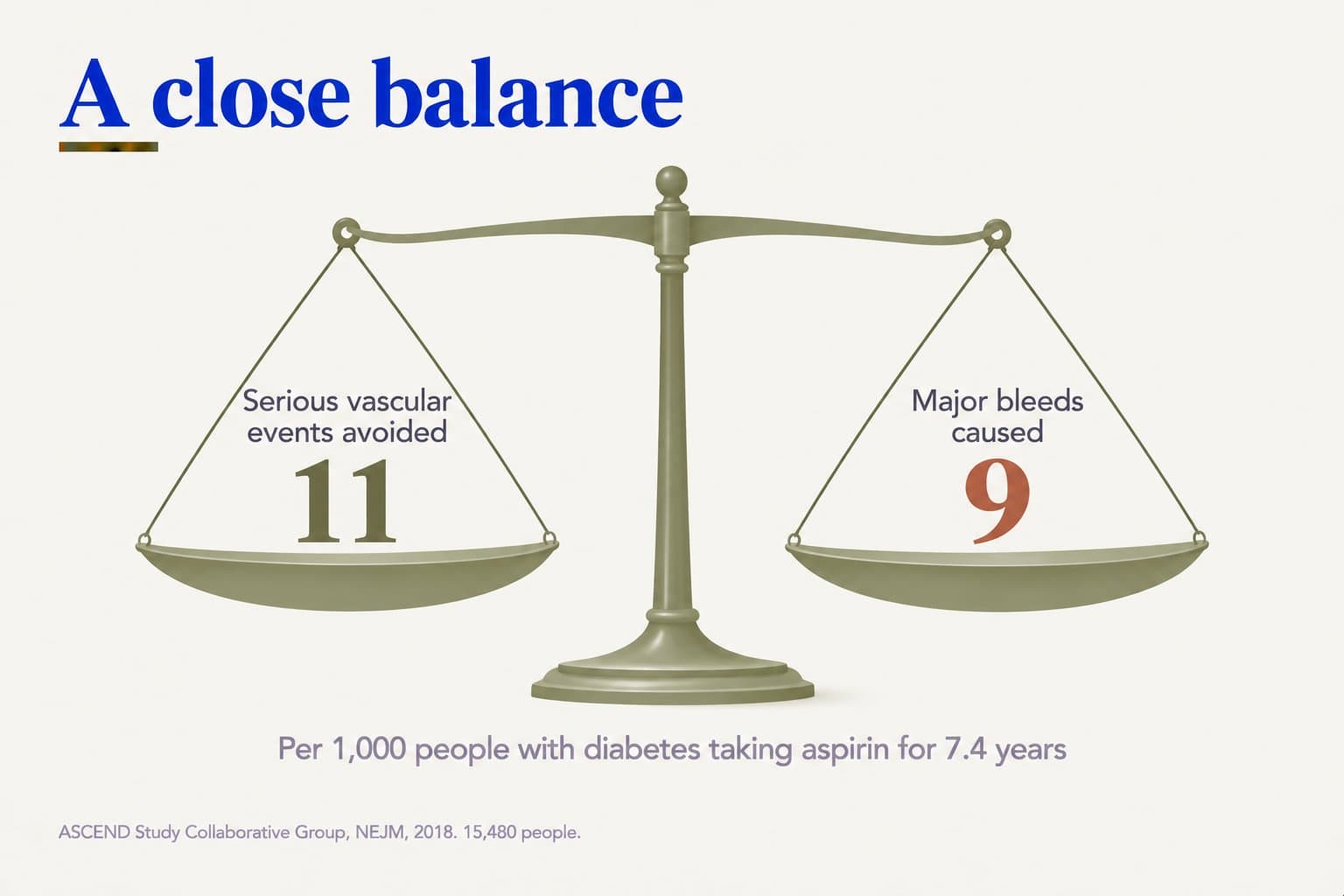
| Aspirin in diabetes without heart disease (ASCEND, 15,480 people, 7.4 years) | 11 serious vascular events avoided but 9 major bleeds caused per 1,000 people |
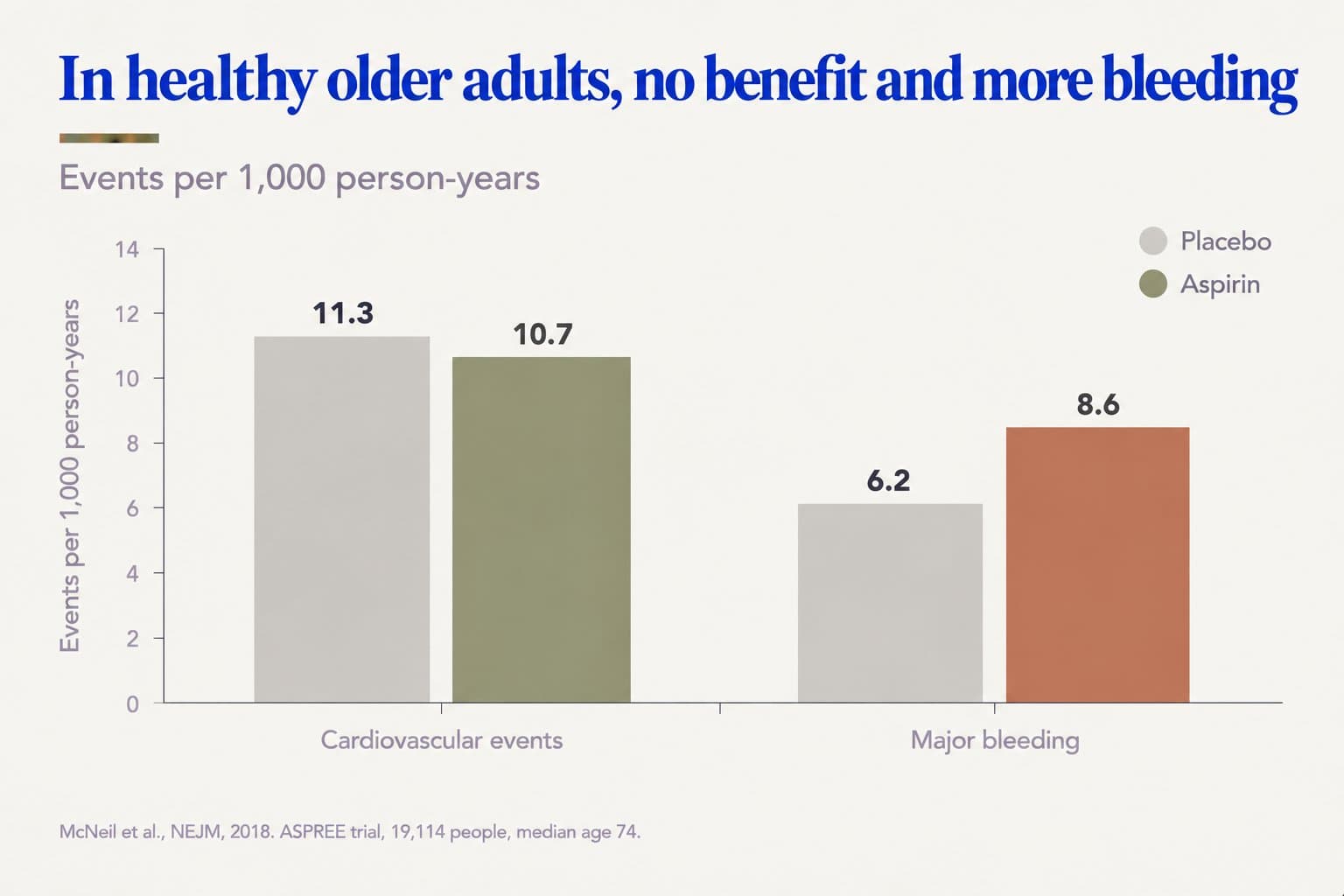
| Aspirin in healthy older adults (ASPREE, 19,114 people aged mostly 70+) | No reduction in cardiovascular events; major bleeding increased from 6.2 to 8.6 per 1,000 person-years |
| US Preventive Services Task Force (2022) | Don't start aspirin for prevention at 60 or over; individual decision at 40-59 with 10% or higher 10-year risk |
How aspirin works, and why it causes bleeding
Most heart attacks and many strokes happen when a clot forms on a ruptured plaque (see How Atherosclerosis Develops). Low-dose aspirin (usually 75-100 mg) makes platelets, the blood cells that start clots, less sticky for their whole lifespan. This reduces clots in arteries, but the same effect makes bleeding more likely, particularly from the stomach and gut, and occasionally in the brain. Whether aspirin helps overall depends on the balance between clots prevented and bleeds caused, and that balance depends on your risk.
Evidence strength
Strong: aspirin prevents repeat events in people with cardiovascular disease. The Antithrombotic Trialists' Collaboration combined data from secondary prevention trials in people who'd already had a heart attack, stroke or similar event. Aspirin reduced serious vascular events from 8.2% to 6.7% per year and total strokes by about a fifth. Because these people are at high risk, the number of events prevented is much larger than the bleeds caused. If you've had a heart attack, stroke, stent or bypass surgery, aspirin (or another antiplatelet medicine) is usually recommended long term.
Strong: without cardiovascular disease, the benefit is small and offset by bleeding. In primary prevention trials, in people without known cardiovascular disease, the same collaboration found aspirin reduced serious vascular events by 12%, but in absolute terms only from 0.57% to 0.51% per year. It had no significant effect on stroke overall and increased major gastrointestinal and other bleeding from 0.07% to 0.10% per year.
Three large trials published in 2018 confirmed this in people on modern treatments such as statins and blood pressure medicines. In ASCEND, 15,480 people with diabetes but no cardiovascular disease took aspirin 100 mg or a placebo for an average of 7.4 years. Serious vascular events occurred in 8.5% on aspirin and 9.6% on placebo, but major bleeds occurred in 4.1% and 3.2%. For every 1,000 people, aspirin prevented 11 serious vascular events but caused 9 major bleeds.
Strong: in healthy older adults, aspirin does more harm than good. The ASPREE trial randomised 19,114 healthy older adults, with a median age of 74, to aspirin 100 mg or a placebo for a median of 4.7 years. Aspirin didn't reduce cardiovascular events (10.7 vs 11.3 per 1,000 person-years, a non-significant difference) or improve disability-free survival, but it increased major bleeding (8.6 vs 6.2 per 1,000 person-years). Unexpectedly, deaths from any cause were slightly higher with aspirin (5.9% vs 5.2%), mainly from cancer, a finding that needs confirming but offers no reassurance.
Guideline consensus: individual decision in younger, higher-risk adults. Based on this evidence, the US Preventive Services Task Force concluded in 2022 that aspirin offers "a small net benefit" for adults aged 40-59 with a 10-year cardiovascular risk of 10% or more, so the decision should be an individual one, and "no net benefit" from starting aspirin at 60 or over. It noted that low-dose aspirin was linked to a 58% increase in major gastrointestinal bleeding and more bleeding in the brain, with harms rising with age. European guidelines similarly don't recommend aspirin for people without cardiovascular disease, except possibly in selected people at very high risk.
Not supported: aspirin as a general "longevity" pill. There's no evidence that healthy people should take aspirin to live longer, and in older adults it may cause net harm.
Who is at higher risk of bleeding
- Age over 60, and especially over 70
- A history of stomach ulcers or gastrointestinal bleeding
- Taking other blood thinners, steroids or regular anti-inflammatory painkillers such as ibuprofen
- Chronic kidney or liver disease, low platelets or a bleeding disorder
- Uncontrolled high blood pressure
Recommendations by situation
| Situation | What the evidence supports |
|---|---|
| Previous heart attack, stroke, stent or bypass | Aspirin or another antiplatelet is usually recommended long term; don't stop without talking to your doctor |
| Atrial fibrillation | Aspirin isn't an effective substitute for anticoagulants to prevent stroke |
| No cardiovascular disease, aged 40-59, 10-year risk 10% or more, low bleeding risk | An individual decision with your doctor; the benefit is small |
| No cardiovascular disease, aged 60 or over | Don't start aspirin for prevention |
| Diabetes without cardiovascular disease | Benefit and bleeding risk are closely balanced; decide individually |
| Already taking aspirin for prevention without heart disease | Review with your doctor whether to continue; don't stop suddenly on your own |
| Any bleeding risk factor above | Aspirin for prevention is usually not advised |
Stroke prevention in atrial fibrillation is covered in Atrial Fibrillation.
Practical notes
Aspirin is valuable for people who already have cardiovascular disease, where it clearly prevents further heart attacks and strokes. For people without cardiovascular disease, the small benefit is largely offset by bleeding, and in adults over 60 starting aspirin isn't recommended. Controlling blood pressure, lowering LDL cholesterol, not smoking and managing blood sugar prevent far more events without the bleeding risk (see Cardiovascular Risk Scores and Heart Age and Statins: What the Evidence Shows About Benefits and Side Effects). If you take aspirin, check with your doctor whether it's still right for you.
- Antithrombotic Trialists' (ATT) Collaboration. Aspirin in the primary and secondary prevention of vascular disease: collaborative meta-analysis of individual participant data from randomised trials. The Lancet, 2009;373(9678):1849-1860.
- ASCEND Study Collaborative Group. Effects of aspirin for primary prevention in persons with diabetes mellitus. New England Journal of Medicine, 2018;379(16):1529-1539.
- McNeil JJ, et al. Effect of aspirin on cardiovascular events and bleeding in the healthy elderly. New England Journal of Medicine, 2018;379(16):1509-1518.
- McNeil JJ, et al. Effect of aspirin on all-cause mortality in the healthy elderly. New England Journal of Medicine, 2018;379(16):1519-1528.
- US Preventive Services Task Force. Aspirin use to prevent cardiovascular disease: US Preventive Services Task Force recommendation statement. JAMA, 2022;327(16):1577-1584.
Free longevity assessment
Are you taking aspirin "just in case"?
It may be time to review it.
Take the free Aevum Protocol assessment to see how your cardiovascular & metabolic health and 6 other longevity domains are performing — and get a personalised 90-day plan.
Take the free assessmentKeep reading
Related articles
Cardiovascular & Metabolic Health
Statins: What the Evidence Shows About Benefits and Side Effects
Cardiovascular & Metabolic Health
Cardiovascular Risk Scores and Heart Age: What Your Numbers Add Up To
Cardiovascular & Metabolic Health