Sleep & Recovery
Sleep and Skin: The Real
Science Behind Beauty Sleep
"Beauty sleep" sounds like a figure of speech, but our Sleep Architecture article's coverage of growth hormone release during deep sleep, and our Sleep and Metabolic Health article's coverage of cortisol, both point directly at real mechanisms connecting sleep to skin. This article covers what controlled research actually shows — objectively measured skin ageing signs, UV damage recovery, and even how other people perceive a sleep-deprived face.
Quick Summary
- →A controlled study of 60 women found that poor sleepers showed measurably worse skin barrier function and slower recovery from UV damage than good sleepers — this wasn't a subjective survey, but objectively measured skin physiology
- →Growth hormone, which peaks during deep sleep as covered in our Sleep Architecture article, plays a direct role in collagen production and tissue repair — giving "beauty sleep" a genuine hormonal mechanism, not just a figure of speech
- →A landmark study found that other people can visibly detect sleep deprivation in a face, and rate sleep-deprived faces as less healthy and less attractive — a controlled, peer-reviewed finding, not a subjective impression
- →Poor sleepers in the same skin-ageing study were significantly more likely to be obese, connecting to the appetite hormone and metabolic effects covered in our Sleep and Metabolic Health article
- →The skin barrier connection runs through cortisol — chronic sleep loss raises cortisol, which independently impairs skin barrier function and accelerates collagen breakdown, on top of the lost restorative benefit of deep sleep itself
Key numbers at a glance
| Measure | Figure |
|---|---|
| Participants in the controlled skin-ageing sleep study | 60 women |
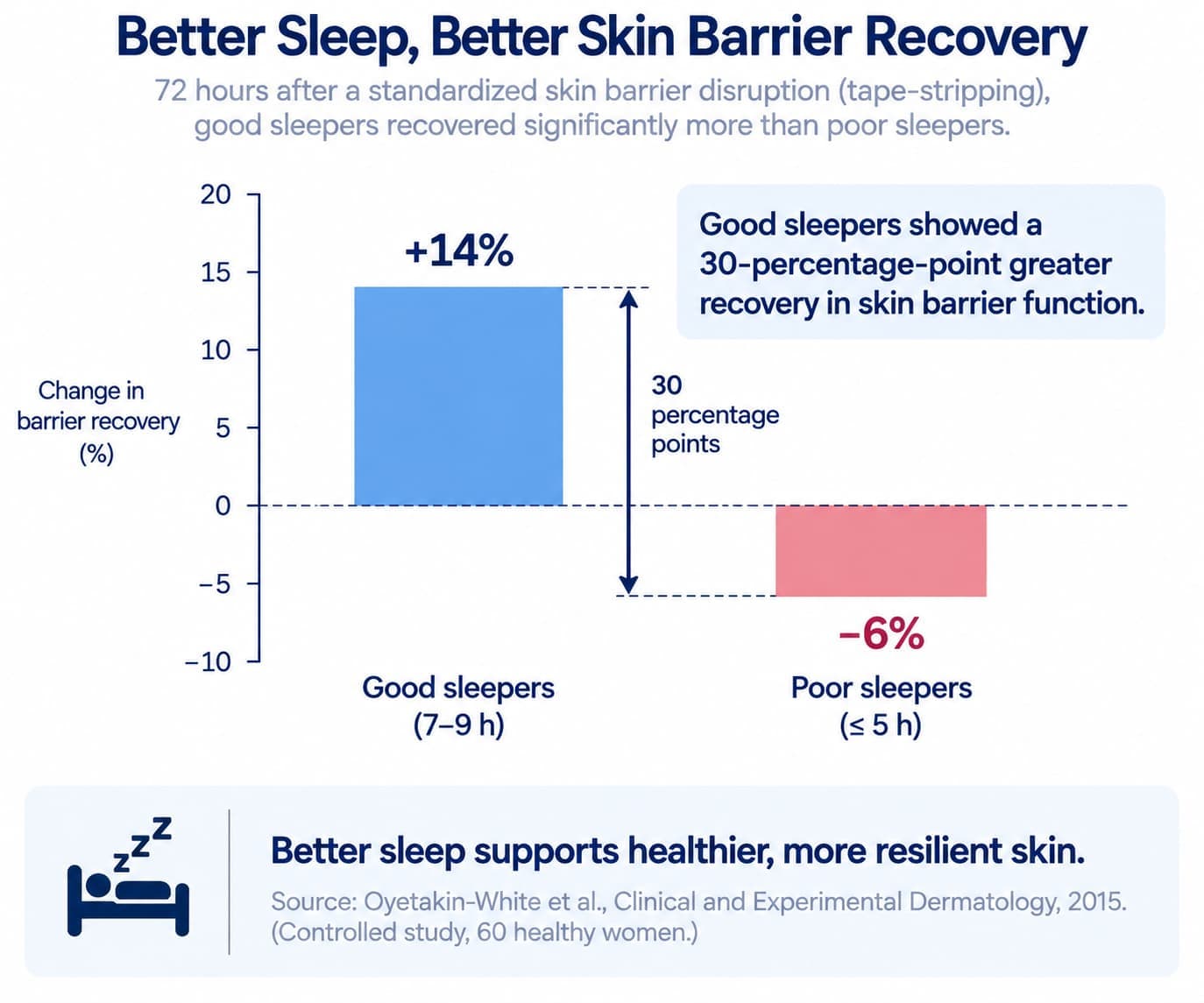
| Skin barrier recovery, 72h after tape-stripping, good vs. poor sleepers | +14% vs. -6% |
| Obesity rate, poor sleepers vs. good sleepers (same study) | 44% vs. 23% |
| Sleep deprivation duration in the "beauty sleep" perception study | 31 hours wakefulness |
| Observers rating photographs in that study | 65 untrained raters |
| Facial features identified as visible sleep-loss cues | Eyes, mouth, skin |
How it works: growth hormone, collagen, and cortisol
Two hormonal pathways, both already covered elsewhere in this series, connect directly to skin health.
Growth hormone, covered in our Sleep Architecture article, peaks during deep sleep (N3) and plays a direct, well-established role in tissue repair and regeneration throughout the body — including stimulating collagen production, the structural protein responsible for skin's firmness and elasticity. Less deep sleep means less of this repair window, giving "beauty sleep" a literal, hormonal basis rather than being purely a figure of speech.
Cortisol, covered in our Sleep and Metabolic Health article, works in the opposite direction. Chronic sleep loss raises cortisol levels, and elevated cortisol independently accelerates collagen breakdown and impairs the skin's barrier function — the outermost layer's ability to retain moisture and protect against environmental damage. This means sleep loss affects skin through two separable pathways simultaneously: reduced repair capacity from lost growth hormone activity, and active breakdown driven by elevated cortisol.
What the research shows
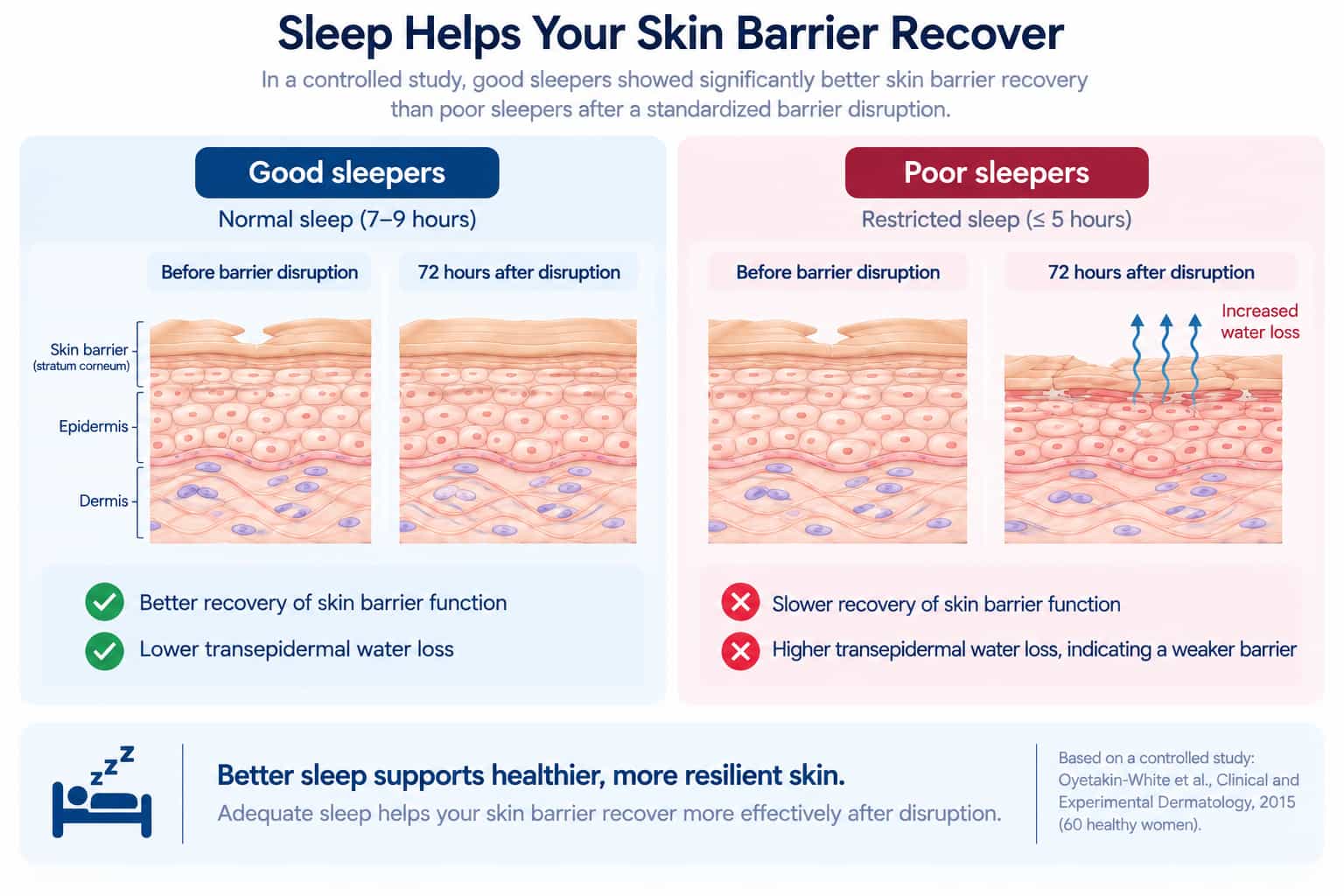
Objectively measured skin ageing. A controlled study published in Clinical and Experimental Dermatology recruited 60 healthy women, categorised as either good-quality sleepers (sleeping 7-9 hours with good sleep quality scores) or poor-quality sleepers (sleeping 5 hours or less with poor sleep quality scores), and measured their skin using objective clinical tools rather than self-report alone. Poor sleepers showed significantly worse recovery from UV light exposure — 24 hours after a standardised UV exposure, good sleepers had recovered noticeably better from the resulting skin redness (erythema) than poor sleepers, indicating a genuine difference in the skin's repair capacity following environmental damage. The study also found impaired skin barrier function among poor sleepers: at baseline, poor sleepers had significantly higher transepidermal water loss (moisture escaping through the skin more readily), and 72 hours after a standardised skin barrier disruption, good sleepers showed roughly 30 percentage points greater recovery than poor sleepers (about +14% versus -6%). Poor sleepers were also significantly more likely to be obese — 44% compared to 23% among good sleepers — a finding that connects directly to the appetite hormone disruption covered in our Sleep and Metabolic Health article. Self-reported satisfaction with appearance and perceived attractiveness were also significantly lower among poor sleepers.
Other people can see it too. A separate, widely cited study published in the British Medical Journal took this further by testing whether sleep deprivation is actually visible to others. Researchers photographed 23 healthy adults after a normal night's sleep and again after 31 hours of wakefulness, then had 65 untrained observers rate the photographs without knowing which was which. Sleep-deprived faces were rated as significantly less healthy, less attractive, and more tired than the same faces after normal sleep. Follow-up research by the same group identified specific facial regions — the eyes, mouth, and skin — that function as visible cues of sleep loss to other people, and a later study found that sleep-deprived faces also reduced observers' willingness to socially engage with the person in the photograph. This is a genuinely well-designed body of research: a controlled experiment, blinded raters, and a replicated finding across follow-up studies, not a single isolated result.
Recommendations by population group
- 1Anyone focused on skin health or visible ageing
Given the hormonal mechanisms and the objectively measured findings above, sleep deserves to be treated as a genuine, modifiable input to skin health — comparable in evidence quality to more commonly discussed factors like sun protection and skincare routine, not a secondary or soft consideration.
- 2Anyone with significant sun exposure or outdoor lifestyles
The UV recovery finding is particularly relevant here — given that good sleepers showed measurably better recovery from UV-induced skin damage, adequate sleep is a reasonable, underappreciated complement to sun protection itself.
- 3Shift workers and anyone with chronically disrupted sleep
The combination of reduced growth hormone activity and elevated cortisol described above compounds over time — this population carries genuine, mechanistically-explained skin health stakes beyond the more commonly discussed fatigue and metabolic effects covered elsewhere in this series.
- 4Anyone managing weight alongside skin concerns
The obesity association found in the same study connects directly to the appetite hormone disruption covered in our Sleep and Metabolic Health article — sleep may be a genuinely shared, modifiable factor behind both concerns rather than two unrelated issues.
- 5General / longevity-focused
Skin is often treated as a purely cosmetic concern, but the mechanisms covered in this article — collagen production, barrier function, UV damage repair — are genuine physiological processes with real longevity relevance, not just appearance.
Practical notes
- →"Beauty sleep" has a real, demonstrated hormonal basis — growth hormone-driven collagen production and cortisol-driven barrier breakdown are both genuine, well-established mechanisms, not marketing language
- →The UV recovery finding is a genuinely practical takeaway — adequate sleep appears to measurably support the skin's ability to recover from sun exposure, worth considering alongside sunscreen and other sun protection habits
- →Sleep deprivation is visible to others, not just something you feel — the controlled perception research confirms this isn't a subjective self-consciousness, but a genuine, externally observable effect
- →This connects to metabolic health, not just skin in isolation — the same study found a clear link between poor sleep and obesity, tying skin health back to the broader hormonal picture covered elsewhere in this series
- →None of this requires perfect sleep every night — the research reflects chronic patterns (habitual short or poor-quality sleep) rather than the occasional late night
The evidence behind "beauty sleep" is more substantial than the phrase suggests — objectively measured skin barrier function, UV recovery capacity, and even how a face is perceived by others all connect back to real, demonstrated sleep mechanisms. For the underlying hormonal pathways behind this, see our Sleep Architecture and Sleep and Metabolic Health articles. If you'd like a clearer picture of your own sleep and skin health, our Longevity Doctors offer a free longevity assessment as a starting point.
How does your sleep
score on your longevity assessment?
Take the free Aevum Protocol assessment to see how your sleep & recovery and 6 other longevity domains are performing — and get a personalised 90-day plan.
Take the Free Assessment →