Sleep & Recovery
Sleep and Immune Function: Infection
Risk, Vaccine Response, and Natural Killer Cells
Our Sleep Architecture article briefly noted that immune activity concentrates during deep sleep, and our Sleep and Cardiovascular Health article covered how chronic sleep loss raises inflammatory markers like CRP. This article focuses specifically on the immune system itself — the cellular mechanisms sleep supports, and what happens to infection risk and vaccine effectiveness when sleep falls short.
Quick Summary
- →Just a few hours of sleep loss measurably impairs T cells' ability to bind to infected cells — a 2019 study found this adhesion capacity was reduced after as little as one night of partial sleep deprivation, through a specific, identified hormonal mechanism
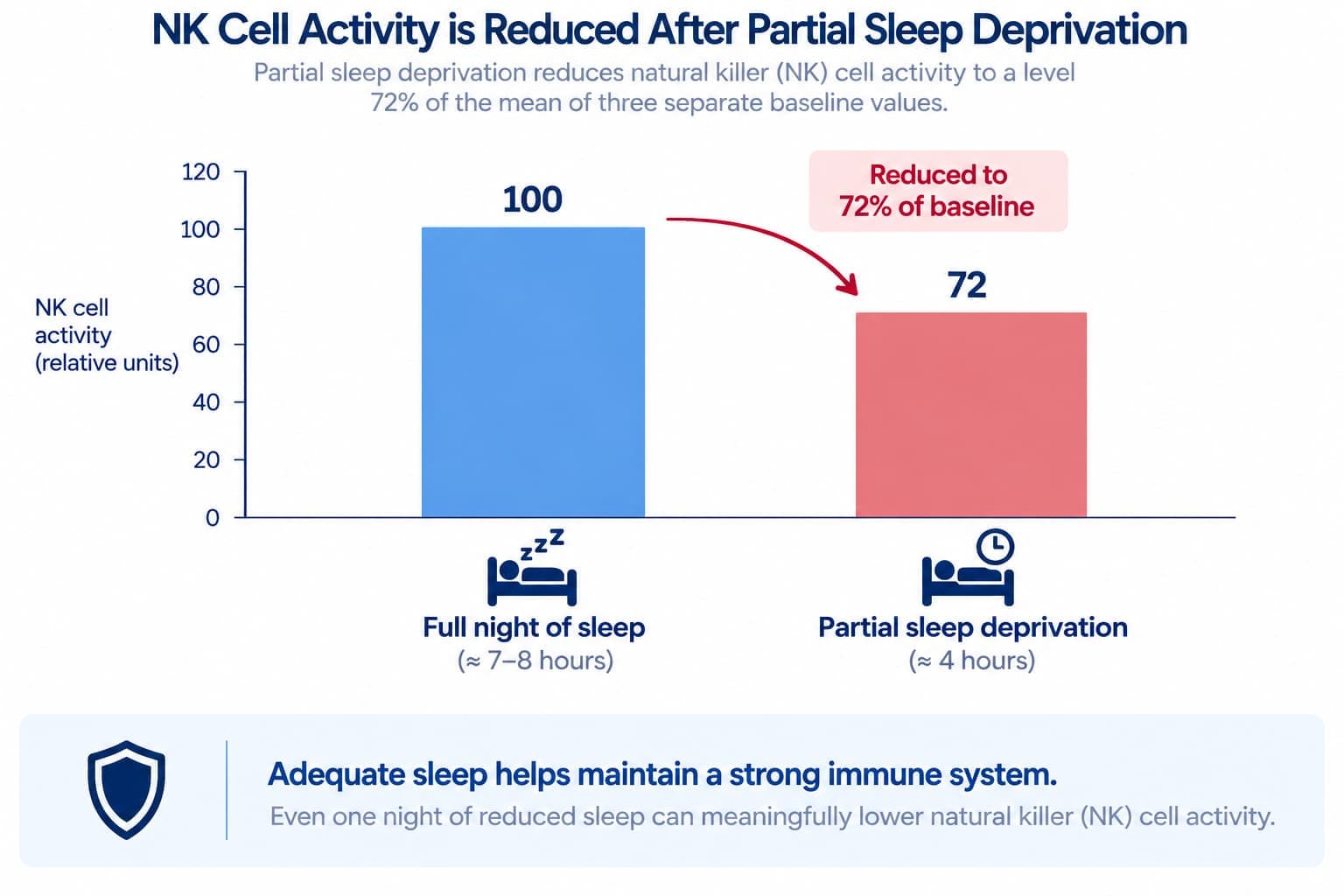
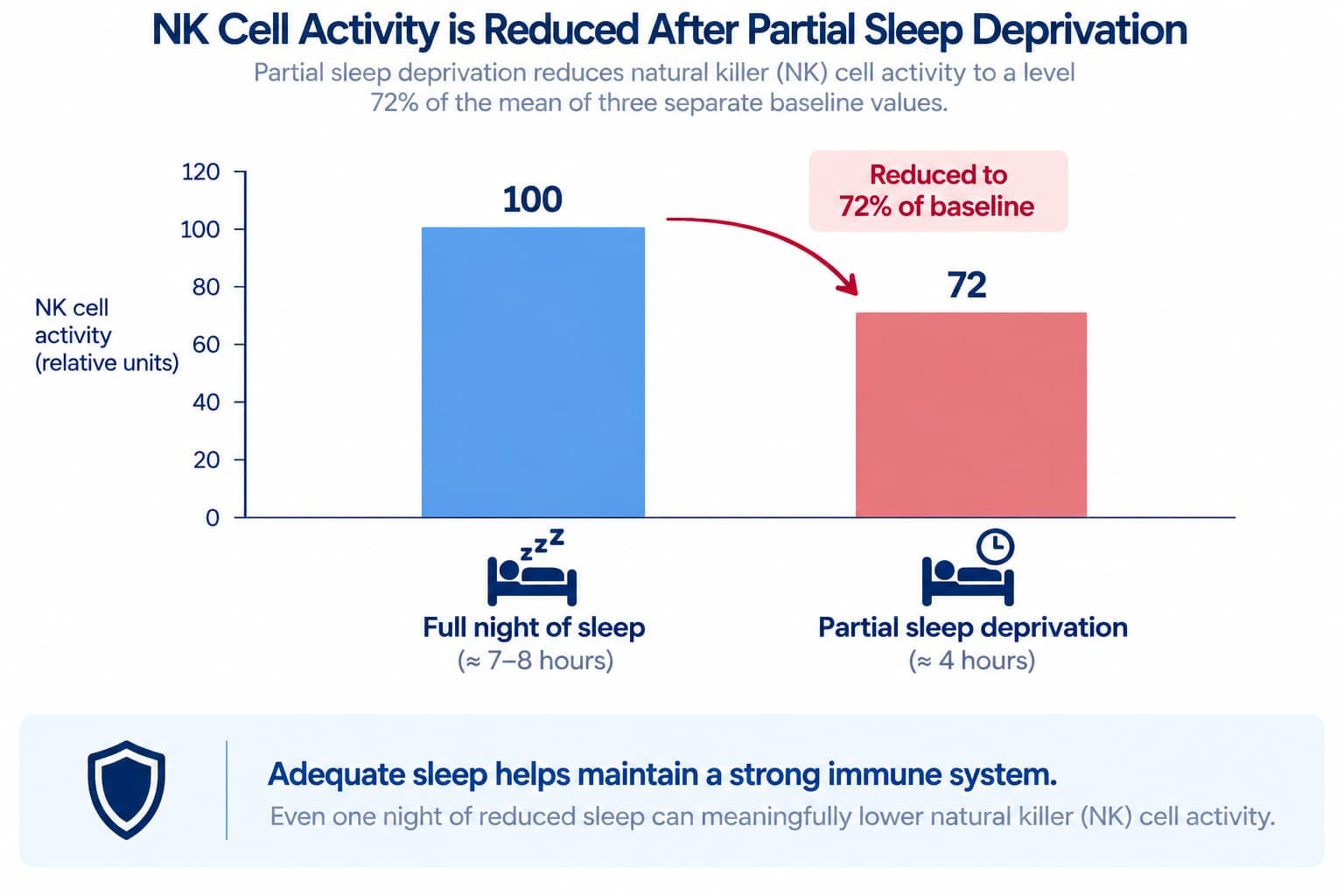
- →A single night of partial sleep deprivation reduced natural killer (NK) cell activity to roughly 72% of normal in a classic controlled study — NK cells are a frontline defence against both viral infection and, notably, cancerous cells
- →People sleeping under 7 hours a night were found to be roughly 3 times more likely to develop a cold after controlled viral exposure than those sleeping 8+ hours, in a landmark study — a follow-up using objective sleep tracking rather than self-report found an even larger effect
- →Short sleep around the time of vaccination measurably weakens antibody response — shown for both hepatitis B and influenza vaccines, meaning sleep quality in the days around a vaccination genuinely matters, not just general health
- →This is a case where the acute, nightly immune function sleep supports is genuinely different from the chronic inflammation covered in our Cardiovascular Health article — one is immune surveillance working as intended, the other is a harmful stress response to insufficient sleep
Key numbers at a glance
| Measure | Figure |
|---|---|
| Reduction in NK cell activity after 1 night of partial sleep deprivation | To ~72% of baseline |
| Time to measurable T-cell adhesion impairment | As little as one night / a few hours |
| Increased cold risk with <7h sleep vs. 8h+ (Cohen et al., 2009) | ~3x more likely |
| Hepatitis B vaccine protection at 6 months, short vs. adequate sleepers | Meaningfully lower |
| Influenza antibody titres, short sleep before vaccination | Lower at 1 and 4 months |
How it works: what sleep does for immune cells
Two specific, well-studied mechanisms explain much of sleep's role in immune function.
T cells need to physically "stick" to their targets to do their job, using surface proteins called integrins to bind to infected or abnormal cells. A 2019 study found that sleep itself actively supports this process: T cells from well-rested participants showed significantly stronger integrin activation — better "stickiness" — than T cells exposed to plasma from sleep-deprived participants. The mechanism was traced to specific stress-related signalling molecules (including adrenaline and certain prostaglandins) that rise during wakefulness and directly suppress integrin activation; sleep's low levels of these molecules is what allows T cells to bind effectively. Strikingly, the researchers found this adhesion capacity was measurably impaired after just a few hours of sleep loss — not a gradual, weeks-long decline, but an effect appearing within a single disrupted night.
Natural killer (NK) cells, a frontline part of the innate immune system that can destroy virus-infected and cancerous cells without needing prior exposure to a specific pathogen, are similarly sensitive to sleep loss. A classic controlled study found that after a single night of partial sleep deprivation, NK cell activity dropped to roughly 72% of its level following a full night's sleep — a meaningful, same-day reduction in one of the body's primary rapid-response defences, not a subtle change.
What the research shows
The common cold study. A landmark 2009 study by Cohen and colleagues gave 153 healthy volunteers a standardised dose of rhinovirus (the common cold virus) after monitoring their sleep for two weeks beforehand. Participants sleeping less than 7 hours a night were nearly 3 times more likely to develop a cold than those sleeping 8 or more hours — a relationship that held after accounting for age, stress, smoking, and other health factors. A 2015 follow-up study by the same research group used wrist actigraphy for objective sleep measurement rather than self-report, and found an even stronger effect, with short sleepers roughly 4 times more likely to catch a cold — addressing the natural concern that people simply over- or under-report their own sleep. As the lead researcher put it, short sleep predicted illness risk more strongly than any other factor measured, including age, stress levels, and smoking status.
Vaccine response. Sleep's effect on immune function extends to how well the body responds to vaccination, not just infection risk. A study following adults through a full hepatitis B vaccination series found that shorter sleep duration, measured objectively, predicted a lower antibody response and a reduced likelihood of being clinically protected six months later. A separate study on influenza vaccination found that shorter sleep specifically in the two nights before vaccination was associated with lower antibody levels at both one and four months afterward, independent of age and baseline antibody status. Together, these findings suggest sleep quality around the time of vaccination isn't incidental — it appears to genuinely affect how well the immune system learns to recognise and respond to the pathogen being vaccinated against.
It's worth being precise about something that could otherwise sound contradictory: our Cardiovascular Health article covered how chronic sleep restriction raises inflammatory markers like CRP and IL-6 — a harmful, dysregulated stress response. The immune functions covered in this article — NK cell activity, T-cell adhesion, antibody response — are different: this is the immune system's normal, healthy surveillance and defence capability, which sleep supports and sleep loss undermines. Both things are true simultaneously: sleep loss can raise harmful background inflammation while also weakening the immune system's actual ability to fight off a real infection — a genuinely unfavourable combination, not two separate contradictory findings.
Recommendations by population group
- 1Anyone getting vaccinated
Given the hepatitis B and influenza findings, prioritising good sleep in the days before and after a vaccination is a genuinely evidence-supported, low-effort way to support a stronger immune response — worth planning around where possible, rather than treating vaccination timing and sleep as unrelated.
- 2Older adults
Immune function naturally declines with age (a pattern called immunosenescence, covered in our Minerals article's zinc section) — layering insufficient sleep on top of this age-related decline is a genuinely compounding risk, making sleep protection more consequential for this group, not less.
- 3Anyone frequently exposed to illness (healthcare workers, teachers, parents of young children, frequent travellers)
Given how directly sleep affects infection susceptibility in controlled research, treating adequate sleep as part of illness prevention — alongside more commonly discussed measures like hand hygiene — is a reasonable, evidence-backed addition to a prevention routine.
- 4Anyone immunocompromised or managing a chronic illness
Sleep's effect on immune function is worth discussing directly with a treating doctor, given how much research now connects sleep quality to the same cellular immune mechanisms relevant to infection and, in some research, cancer surveillance specifically.
- 5General / longevity-focused
The speed of these effects — same-night NK cell changes, single-night T-cell impairment — makes immune function one of the clearer examples in this entire sleep series of how quickly sleep loss translates into a measurable, mechanistic health cost, not a slow abstraction.
Practical notes
- →Immune impairment from poor sleep happens fast — same-night NK cell reductions and rapid T-cell adhesion changes show this isn't a slow-building effect requiring weeks of poor sleep
- →Sleep quality around vaccination timing genuinely matters — prioritising good sleep in the days surrounding a vaccine is a reasonable, low-effort way to support a stronger response
- →"Getting sick" and "chronic inflammation" are related but distinct sleep effects — one is a weakened defence system, the other is an ongoing harmful stress response; sleep loss worsens both simultaneously
- →The cold-susceptibility research is unusually strong evidence — it directly exposed participants to a virus under controlled conditions, rather than just observing natural illness rates, strengthening the case for causation over simple correlation
- →Older adults face a double burden — natural immune decline with age, compounded by any additional sleep loss, making sleep protection increasingly relevant rather than less as people get older
Sleep's role in immune function is one of the more directly demonstrated connections in this entire series — controlled studies exposing people to real viruses, measuring real antibody responses, and tracking real immune cell activity, rather than relying on population associations alone. For how sleep architecture, duration, and cardiovascular health connect to this same picture, see our Sleep Architecture, Sleep Duration, and Sleep and Cardiovascular Health articles. If you'd like a clearer picture of your own sleep and immune health, our Longevity Doctors offer a free longevity assessment as a starting point.
How does your sleep
score on your longevity assessment?
Take the free Aevum Protocol assessment to see how your sleep & recovery and 6 other longevity domains are performing — and get a personalised 90-day plan.
Take the Free Assessment →