Sleep & Recovery
Sleep Across a Woman's Lifespan:
Hormones, Pregnancy, and Menopause
Throughout this sleep series, several articles have noted sex differences in passing — obstructive sleep apnea's higher prevalence in men, for instance, covered in our Sleep Apnea article. This article addresses why that picture shifts substantially across a woman's life, driven by genuine, well-documented hormonal mechanisms across the menstrual cycle, pregnancy, and menopause — including a finding that directly explains one of those earlier sex-difference statistics.
Quick Summary
- →Reproductive hormones directly affect sleep architecture and quality — progesterone has natural sedative and temperature-raising properties, while estrogen affects REM sleep, sleep onset time, and even upper airway muscle tone
- →78% of women report their sleep is worse during pregnancy than at any other point in their life — with insomnia prevalence rising from roughly 25% in the first trimester to over 40% by the third
- →Restless legs syndrome affects roughly a quarter of women by the third trimester of pregnancy, and excessive daytime sleepiness and RLS in late pregnancy are measurably associated with higher postpartum depression risk
- →Postmenopausal women are 2-3 times more likely to have obstructive sleep apnea than premenopausal women — a direct consequence of declining estrogen and progesterone's protective effect on the upper airway, and the specific mechanism behind the sex-difference statistics covered in our Sleep Apnea article
- →Sleep disturbance affects an estimated 40-69% of women during the menopausal transition, closely tied to hot flashes, which research shows are directly time-linked to nighttime awakenings on objective sleep monitoring, not just a subjective association
Key numbers at a glance
| Measure | Figure |
|---|---|
| Women reporting worse sleep during pregnancy than any other life period | ~78% |
| Insomnia prevalence, 1st vs. 3rd trimester of pregnancy | ~25% → 40%+ |
| Restless legs syndrome prevalence, 3rd trimester | ~16-25% |
| Sleep disturbance prevalence across the menopause transition | ~40-69% |
| OSA prevalence, postmenopausal vs. premenopausal women | 2-3x higher |
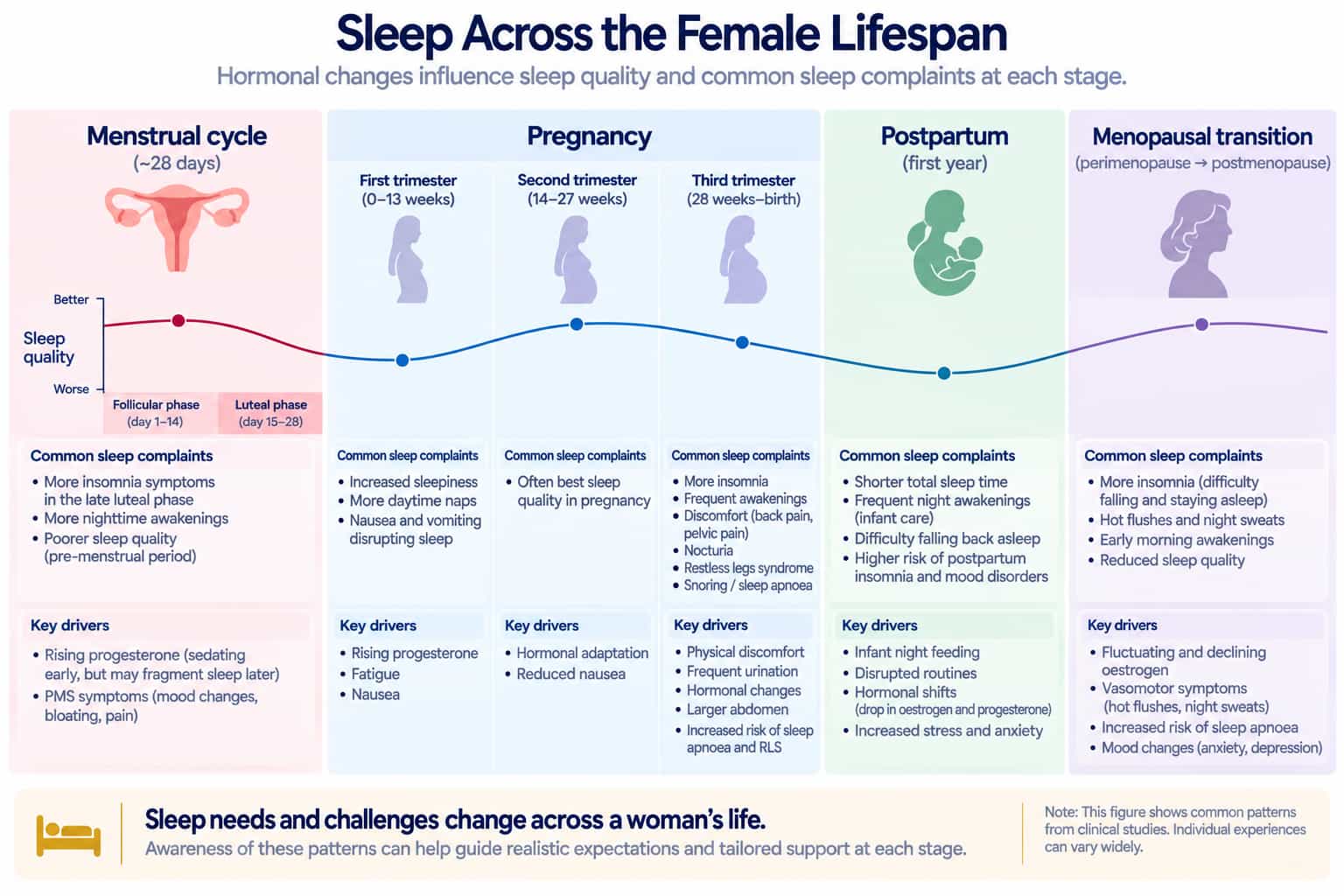
How it works: two hormones, two different effects
Progesterone has genuine sedative properties and also raises core body temperature slightly — this matters directly in light of the thermoregulation mechanism covered in our Sleep Hygiene article, where a drop in core temperature is part of what triggers sleep onset. Progesterone's temperature-raising effect, which rises after ovulation each cycle and drops sharply after childbirth and during the menopause transition, works against this natural cooling process, offering a genuine mechanistic explanation for cycle-related, pregnancy-related, and menopause-related sleep disruption, not just a general hormonal association.
Estrogen affects sleep through several separate pathways: it influences REM sleep and sleep onset latency, supports serotonin production (relevant to the mood-sleep relationship covered in our Sleep and Brain Health article), and — critically for the menopause section below — helps maintain upper airway muscle tone, the same tissue whose collapse during sleep causes obstructive sleep apnea, covered in depth in our Sleep Apnea article.
What the research shows
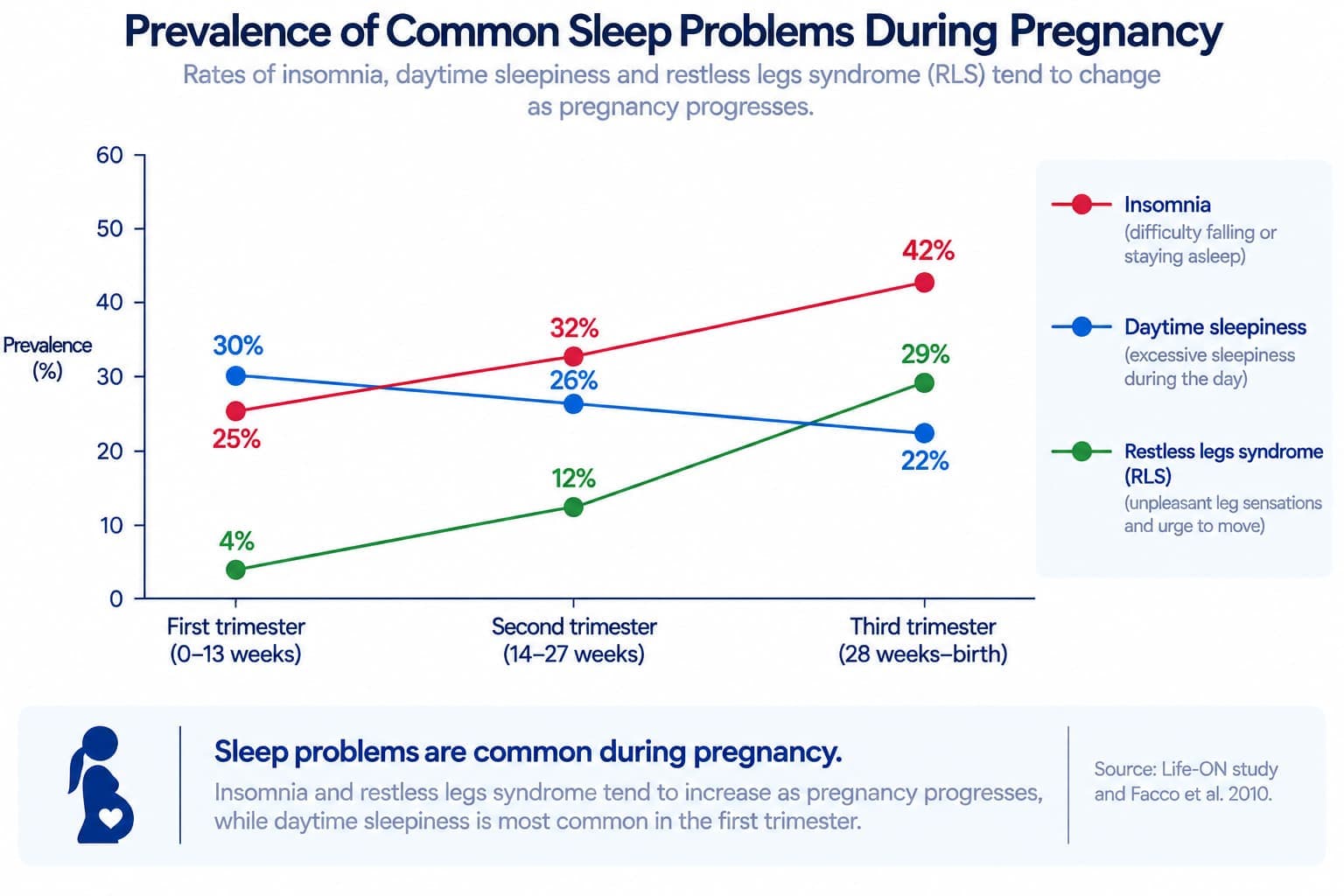
Pregnancy: a genuinely difficult stretch for sleep, with real downstream stakes. Sleep complaints shift by trimester rather than staying constant. Daytime sleepiness peaks early, affecting roughly 30% of women in the first trimester as progesterone rises sharply, before easing to around 22% by the third trimester. Insomnia moves in the opposite direction — rising from around 25% in the first trimester to over 40% by the third, driven by frequent urination, physical discomfort, difficulty finding a comfortable position, and reflux. Restless legs syndrome, a condition causing an uncomfortable urge to move the legs that worsens at rest, affects a genuinely substantial share of pregnant women — estimates from large cohort studies range from roughly 16% to 25% by the third trimester, before dropping sharply after delivery. Sleep-disordered breathing and OSA symptoms also increase during pregnancy, particularly with higher BMI, and are linked to increased risk of gestational hypertension and pre-eclampsia. A genuinely important downstream finding: excessive daytime sleepiness and RLS specifically in the third trimester have been shown to measurably predict postpartum depression risk, independent of other factors — a reminder that late-pregnancy sleep complaints aren't just a temporary discomfort to push through, but a signal worth taking seriously for what follows.
Postpartum: hormonal crash meets infant care. Beyond the well-known sleep fragmentation from newborn care itself, the sharp drop in both estrogen and progesterone immediately after delivery represents one of the most abrupt hormonal shifts in a woman's life, compounding the sleep disruption from infant feeding schedules. Given the bidirectional sleep-mood relationship covered in our Sleep and Brain Health article, and the specific late-pregnancy predictive findings above, this period carries genuine, elevated mental health stakes tied directly to sleep, not just physical exhaustion.
Sleep disturbance affects an estimated 40-69% of women across the menopausal transition, making it one of the most common and distressing symptoms of this life stage. Hot flashes (vasomotor symptoms) are closely implicated — research using objective sleep monitoring has found that hot flash onset and nighttime awakenings are closely time-linked (concurrent with roughly 78% of objectively measured hot flashes in one actigraphy study), suggesting a shared underlying mechanism in the brain's response to fluctuating estrogen, not simply that sweating happens to interrupt sleep. The most consequential finding for this series specifically: postmenopausal women are 2-3 times more likely to have obstructive sleep apnea than premenopausal women, a difference attributed to declining estrogen and progesterone's role in maintaining upper airway muscle tone — the same tissue collapse mechanism covered in our Sleep Apnea article. This directly explains why OSA prevalence statistics look so different by sex before versus after midlife, and it carries a genuine clinical risk: postmenopausal women's OSA symptoms are more likely to be mistaken for general menopause symptoms (fatigue, mood changes) rather than recognised and evaluated as sleep apnea specifically.
Recommendations by population group
- 1Pregnant women, particularly in the third trimester
Restless legs syndrome and excessive daytime sleepiness are common, but not something to dismiss as an inevitable part of late pregnancy — given the postpartum depression association, raising these specifically with an obstetric provider is worth doing proactively rather than waiting to be asked.
- 2New and expecting parents
Understanding that the postpartum period combines both an abrupt hormonal shift and severe sleep fragmentation, not just one or the other, can help normalise seeking support for both sleep and mood during this window rather than treating them as separate concerns.
- 3Perimenopausal and menopausal women, especially with snoring or unexplained fatigue
Given the 2-3x increase in OSA risk after menopause, and the tendency for its symptoms to be attributed to menopause generally, specifically asking a doctor about sleep apnea evaluation — not just assuming poor sleep is "just menopause" — is a reasonable, evidence-supported step.
- 4Partners and family members
Awareness that these are genuine, hormonally-driven changes rather than something within a person's full control can be a meaningful, practical form of support across pregnancy, postpartum, and the menopause transition.
- 5General / longevity-focused
The menopause-related OSA finding is a good example of how a sleep risk factor covered elsewhere in this series (in that case, cardiovascular and dementia risk connected to OSA) can shift dramatically in relevance across a person's life — the same condition worth screening for looks different depending on life stage and sex.
Practical notes
- →Late-pregnancy sleep complaints (RLS, excessive sleepiness) are worth flagging to a provider directly, given their documented association with postpartum depression risk — not just something to endure
- →Postmenopausal fatigue and poor sleep shouldn't automatically be attributed to menopause alone — given the significant OSA risk increase at this life stage, it's worth ruling out specifically rather than assuming
- →The progesterone-temperature connection is a genuine, useful mechanism to understand — it explains why sleep quality can shift predictably across the menstrual cycle, pregnancy, and menopause, tied directly to the thermoregulation principles covered in our Sleep Hygiene article
- →Postpartum sleep and mood should be addressed together, not separately — the hormonal and situational factors driving both are deeply intertwined during this specific window
- →None of these life-stage changes are a personal failing or something to simply push through — they reflect genuine, well-documented hormonal physiology, and are worth discussing with a doctor rather than normalising as unavoidable
Sleep's relationship with reproductive hormones runs through pregnancy, postpartum, and menopause with genuine, well-documented mechanisms — not vague or dismissible complaints, but identifiable physiological shifts with real downstream health implications. For the underlying mechanics of temperature, airway function, and mood connected to this picture, see our Sleep Hygiene, Sleep Apnea, and Sleep and Brain Health articles. If you'd like a clearer picture of your own sleep health at any life stage, our Longevity Doctors offer a free longevity assessment as a starting point.
How does your sleep
score on your longevity assessment?
Take the free Aevum Protocol assessment to see how your sleep & recovery and 6 other longevity domains are performing — and get a personalised 90-day plan.
Take the Free Assessment →