Sleep & Recovery
REM Sleep Behavior Disorder
& Parasomnias: When Sleep Becomes Physically Active
Our Sleep Architecture article covered a specific, essential feature of REM sleep: temporary muscle paralysis, which normally prevents the body from acting out dreams. This article covers what happens when that protective mechanism fails — REM Sleep Behavior Disorder — along with the broader category of parasomnias, and a genuinely striking finding that makes RBD one of the more consequential topics in this entire sleep series from a longevity standpoint.
Quick Summary
- →REM Sleep Behavior Disorder (RBD) occurs when the normal paralysis of REM sleep fails, allowing people to physically act out dream content — punching, kicking, shouting, and sometimes falling out of bed, occasionally injuring themselves or a bed partner
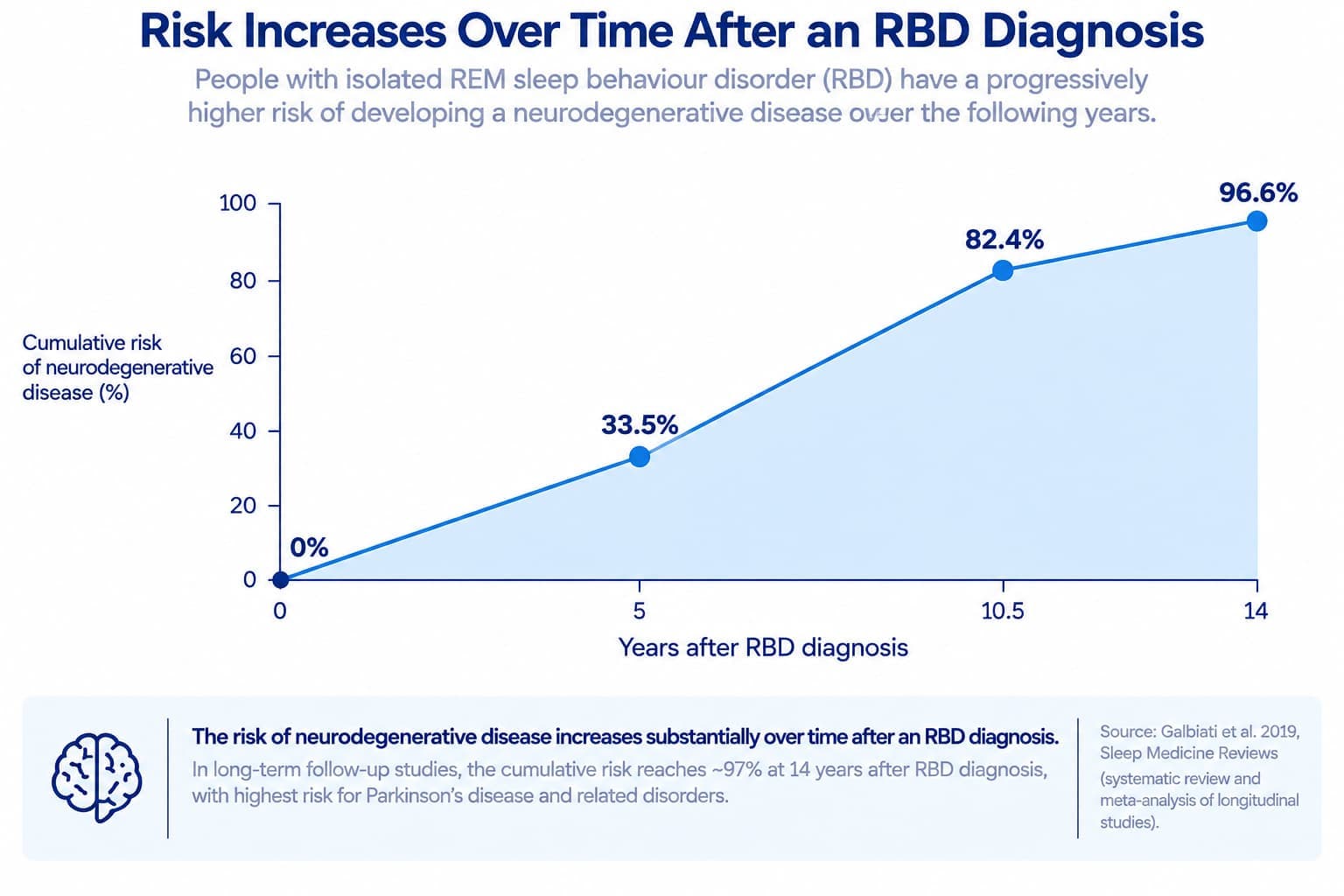
- →RBD is one of the strongest known predictors of future Parkinson's disease and related conditions — a systematic review found the risk of developing a neurodegenerative disease reached 33.5% at 5 years, 82.4% at 10.5 years, and 96.6% at 14 years after RBD diagnosis, an extraordinarily high conversion rate for a sleep disorder
- →This isn't a niche academic finding — RBD patients are now actively recruited into clinical trials testing neuroprotective treatments specifically because of how reliably RBD predicts future neurodegenerative disease, years to decades in advance of any other symptom
- →RBD is distinct from more common, generally benign parasomnias like sleepwalking and night terrors, which occur during deep sleep rather than REM, are far more common in children, and typically carry no such long-term neurological significance
- →Effective treatment exists for RBD's symptoms — low-dose clonazepam and melatonin both reduce dream-enactment behaviours and injury risk, though neither is known to alter the underlying neurodegenerative trajectory
Key numbers at a glance
| Measure | Figure |
|---|---|
| Neurodegenerative disease risk, 5 years after RBD diagnosis | ~33.5% |
| Neurodegenerative disease risk, 10.5 years after diagnosis | ~82.4% |
| Neurodegenerative disease risk, 14 years after diagnosis | ~96.6% |
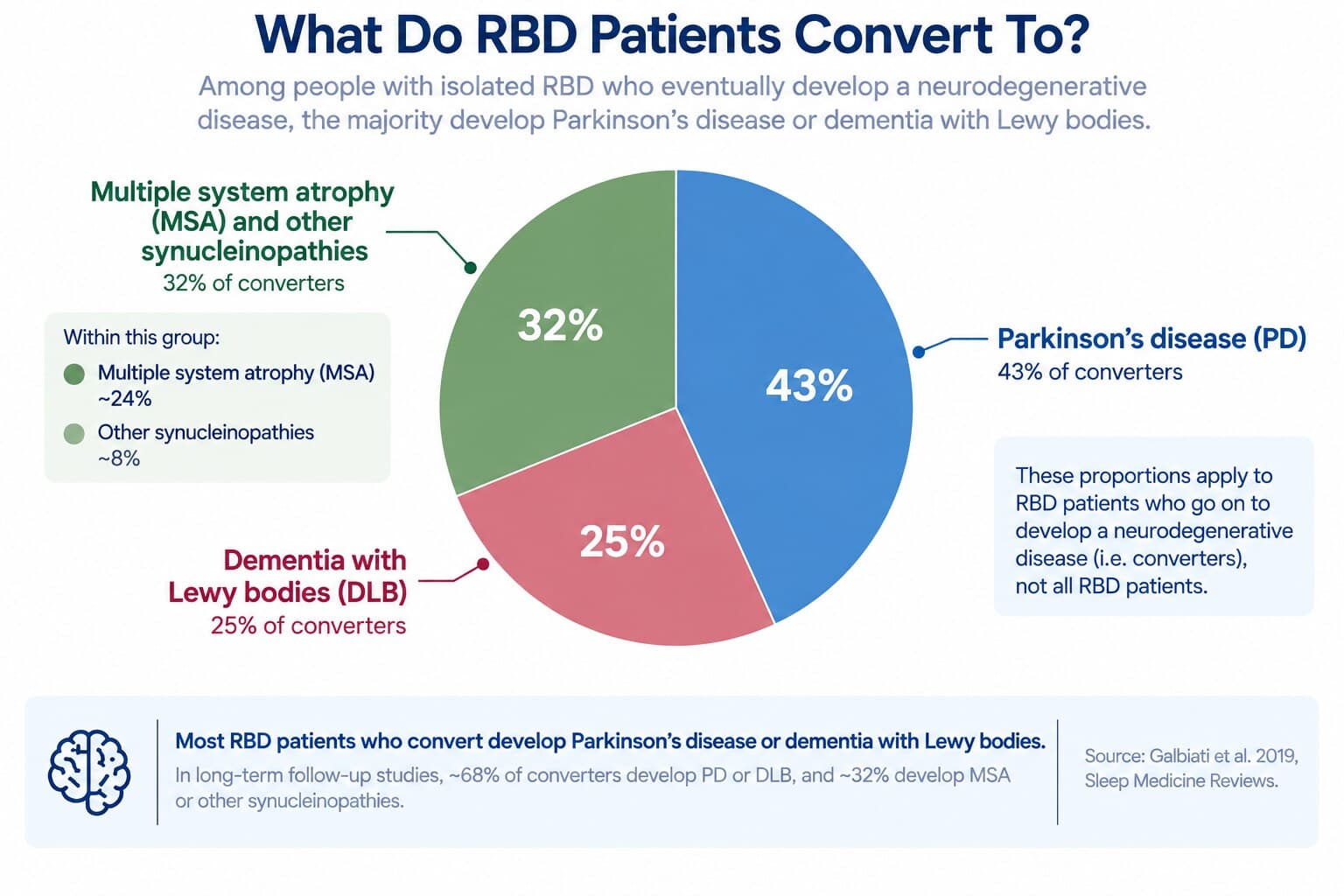
| Share of converters developing Parkinson's disease specifically | ~43-44% |
| Share of converters developing Dementia with Lewy Bodies | ~25% |
How it works: when REM paralysis fails
As covered in our Sleep Architecture article, normal REM sleep involves a temporary, near-total paralysis of the body's voluntary muscles — a protective mechanism that allows vivid dreaming to occur without the body physically acting it out. REM Sleep Behavior Disorder occurs when this paralysis is incomplete or absent, allowing the muscle activity that would normally accompany a dream to actually occur. This can range from mild limb twitching to violent, coordinated movements — punching, kicking, leaping out of bed — often directly matching the content of a vivid, action-oriented dream the person may recall afterward.
This is mechanistically distinct from the more familiar NREM parasomnias — sleepwalking, sleep terrors, and confusional arousals — which arise from a partial, incomplete arousal out of deep sleep (N3) rather than a failure of REM atonia. NREM parasomnias are considerably more common, particularly in children, and typically don't carry the same long-term neurological significance discussed below for RBD.
What the research shows
RBD as a prodromal marker — the central finding. Over the past two decades, RBD has become recognised as one of the most specific known predictors of future alpha-synucleinopathies — a group of neurodegenerative conditions including Parkinson's disease, Dementia with Lewy Bodies, and Multiple System Atrophy, all characterised by abnormal accumulation of a protein called alpha-synuclein in the brain. A systematic review and meta-analysis of longitudinal studies following people with isolated RBD found the cumulative risk of developing one of these conditions reached 33.5% at 5 years, 82.4% at 10.5 years, and 96.6% at 14 years — figures high enough that RBD is now considered close to a near-certain early warning sign given sufficiently long follow-up, rather than simply one risk factor among many. Of those who go on to develop a neurodegenerative disease, roughly 43-44% develop Parkinson's disease specifically and around 25% develop Dementia with Lewy Bodies, with the remainder developing other related conditions including Multiple System Atrophy.
Why this matters beyond individual diagnosis. This finding has reshaped how researchers study these neurodegenerative diseases. Because RBD reliably precedes diagnosable Parkinson's disease and related conditions by years to decades, RBD patients are now actively recruited into clinical trials testing neuroprotective treatments — the goal being to intervene during this prodromal window, long before the motor symptoms that traditionally define a Parkinson's diagnosis appear. RBD patients as a group have also been found to show early, measurable non-motor changes — including reduced sense of smell, subtle motor slowing, and changes in brain imaging — that overlap meaningfully with early Parkinson's disease itself, reinforcing that RBD isn't simply "linked" to these conditions but represents a genuine early phase of the same underlying disease process for many who have it.
Diagnosis and treatment. RBD is formally diagnosed via polysomnography with additional muscle activity (EMG) monitoring, specifically to confirm the loss of normal REM muscle atonia — a home sleep test isn't sufficient for this diagnosis, unlike the apnea testing covered in our Sleep Apnea article. Once diagnosed, low-dose clonazepam and melatonin are both established first-line treatments, shown to meaningfully reduce dream-enactment behaviours and injury risk to the person and any bed partner. It's important to understand what this treatment does and doesn't do: it manages the physical symptoms and reduces injury risk, but isn't known to slow or alter the underlying neurodegenerative process reflected in the risk figures above.
NREM parasomnias — a different, generally more benign picture. Sleepwalking, sleep terrors, and confusional arousals are considerably more common than RBD, particularly in children, and often resolve with age. They typically occur during partial arousal from deep sleep rather than reflecting REM atonia failure, and are commonly triggered by sleep deprivation, fever, certain medications, alcohol, or an underlying, separate sleep disorder like sleep apnea disrupting deep sleep. Unlike RBD, these parasomnias generally don't carry the same long-term neurodegenerative significance, though frequent or injury-causing episodes in adults are still worth medical evaluation.
Recommendations by population group
- 1Anyone experiencing dream-enactment behaviour, or whose bed partner reports punching, kicking, or shouting during sleep
This combination is genuinely worth a formal sleep medicine evaluation, including polysomnography with EMG monitoring, given both the injury risk and the significance of an accurate diagnosis.
- 2Family members or caregivers of someone with Parkinson's disease or Dementia with Lewy Bodies
Given how strongly RBD predicts these conditions, an earlier RBD diagnosis in the same person, if it occurred, is a meaningful piece of their diagnostic history worth being aware of, and RBD in a family member is worth mentioning to their treating neurologist if not already known.
- 3Adults recently diagnosed with RBD
While the conversion statistics above are genuinely significant, they describe population-level risk over many years, not a certainty for any individual on a specific timeline — this is worth discussing directly with a neurologist, including whether participation in prodromal Parkinson's research or monitoring programmes might be appropriate.
- 4Parents of children who sleepwalk or experience night terrors
These NREM parasomnias are common in childhood and typically outgrown, generally without the long-term significance associated with RBD — reassurance is usually appropriate, though frequent, injury-causing, or persistent-into-adulthood episodes are still worth a medical conversation.
- 5General / longevity-focused
RBD is one of the clearer examples in modern medicine of a sleep symptom functioning as a genuine, measurable early warning system for a major age-related disease, years before any other sign would prompt concern — a striking illustration of why sleep symptoms broadly deserve to be taken seriously rather than dismissed as unrelated to long-term health.
Practical notes
- →Acting out dreams physically is not a normal variation of sleep — it reflects a specific, identifiable failure of REM muscle atonia and warrants proper evaluation, not just being noted as unusual
- →The RBD-to-neurodegeneration connection is one of the most well-established prodromal markers in neurology — this isn't a speculative or preliminary association, but a repeatedly replicated finding across long-term studies
- →A diagnosis of RBD is not a diagnosis of Parkinson's disease — it reflects elevated future risk over years to decades, not a current, active neurodegenerative disease
- →Treatment reduces symptoms and injury risk but doesn't address the underlying process — this distinction is worth understanding clearly when discussing treatment goals with a doctor
- →Childhood sleepwalking and night terrors are a different, generally benign picture — don't conflate these common NREM parasomnias with the specific, more serious significance of adult RBD
REM Sleep Behavior Disorder stands out in this entire sleep series as a case where a specific sleep symptom functions as a genuine, well-validated early warning sign for a major neurodegenerative disease, often visible over a decade before any other symptom would appear. For the underlying mechanics of REM sleep and its connection to broader brain health, see our Sleep Architecture and Sleep and Brain Health articles. If you or a bed partner have noticed dream-enactment behaviour during sleep, our Longevity Doctors can help guide next steps as part of a free longevity assessment.
How does your sleep
score on your longevity assessment?
Take the free Aevum Protocol assessment to see how your sleep & recovery and 6 other longevity domains are performing — and get a personalised 90-day plan.
Take the Free Assessment →