Stress & Mental Wellbeing
Psychedelics for Mental Health:
Separating Evidence From Hype
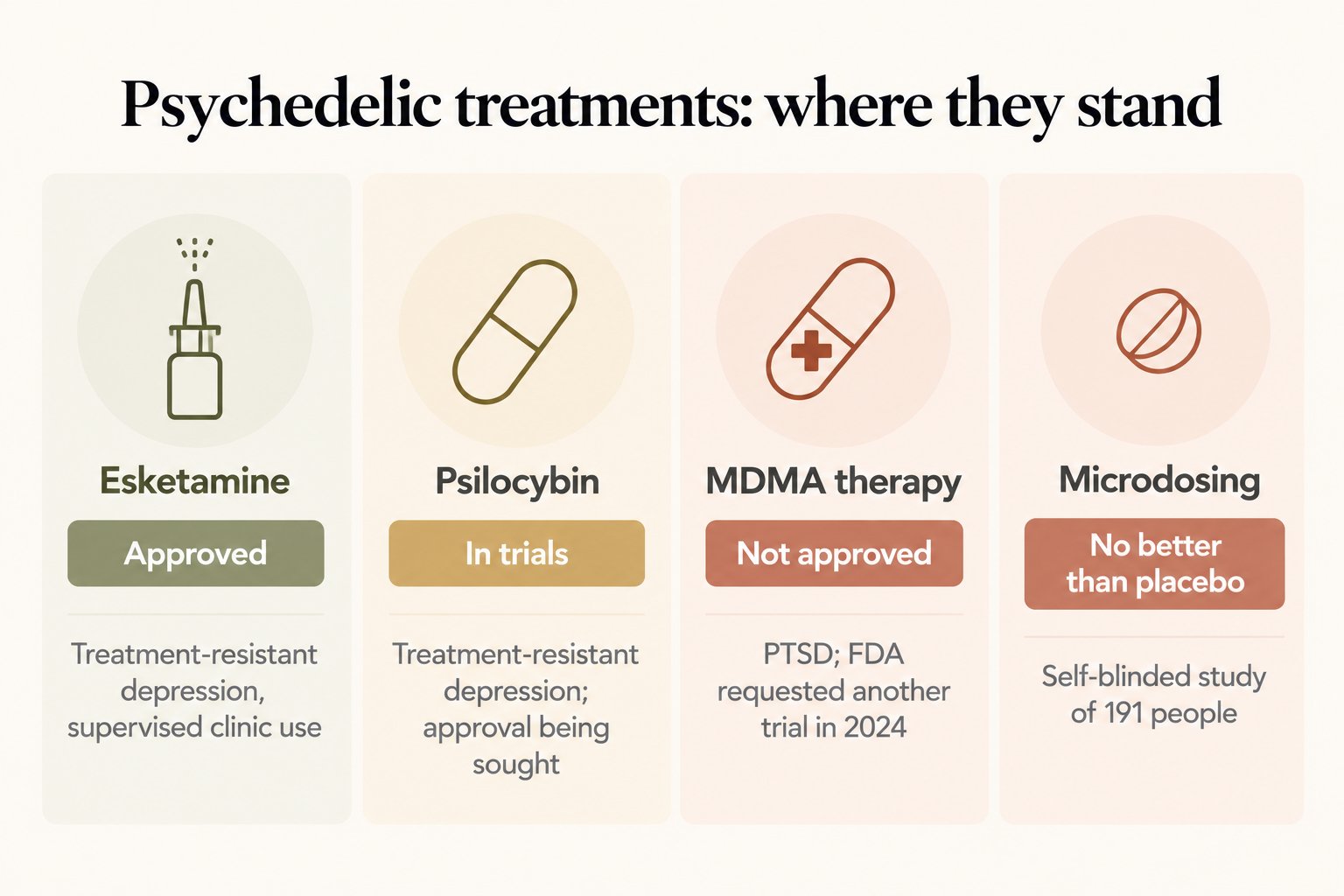
Psychedelic medicine is one of the most talked-about areas in mental health. Substances such as psilocybin (the active ingredient in "magic mushrooms"), MDMA and ketamine are being studied for depression and post-traumatic stress disorder (PTSD), often with dramatic headlines. Some of the promise is real, but the evidence is more mixed and cautious than the hype. Esketamine, a nasal-spray form related to ketamine, is the only drug in this group widely approved for depression; the US Food and Drug Administration (FDA) approved it in 2019 for treatment-resistant depression, and as a standalone treatment in 2025. It's only given in supervised clinical settings because it can cause sedation, dissociation and misuse. Psilocybin has shown benefits in trials of treatment-resistant depression: in a 2022 trial of 233 people, a single 25 mg dose reduced depression scores more than a 1 mg dose at three weeks, but the effect wasn't sustained at 12 weeks, and suicidal thoughts or self-injury were reported in 5% of the high-dose group. A 2025 phase 3 trial of 258 people found a smaller benefit over placebo, and approval is still being sought. MDMA-assisted therapy for PTSD was rejected by the FDA in 2024 over concerns about trial reliability, and microdosing performed no better than placebo in a self-blinded study. Australia allows specially authorised psychiatrists to prescribe psilocybin and MDMA in limited cases, but in most countries, these substances remain illegal outside approved research. Psychedelics are not a do-it-yourself treatment: they require careful screening, medical supervision and psychological support.
Key numbers
| Finding | Detail |
|---|---|
| Esketamine nasal spray | FDA-approved for treatment-resistant depression (2019) and as monotherapy (2025); restricted supervised use |
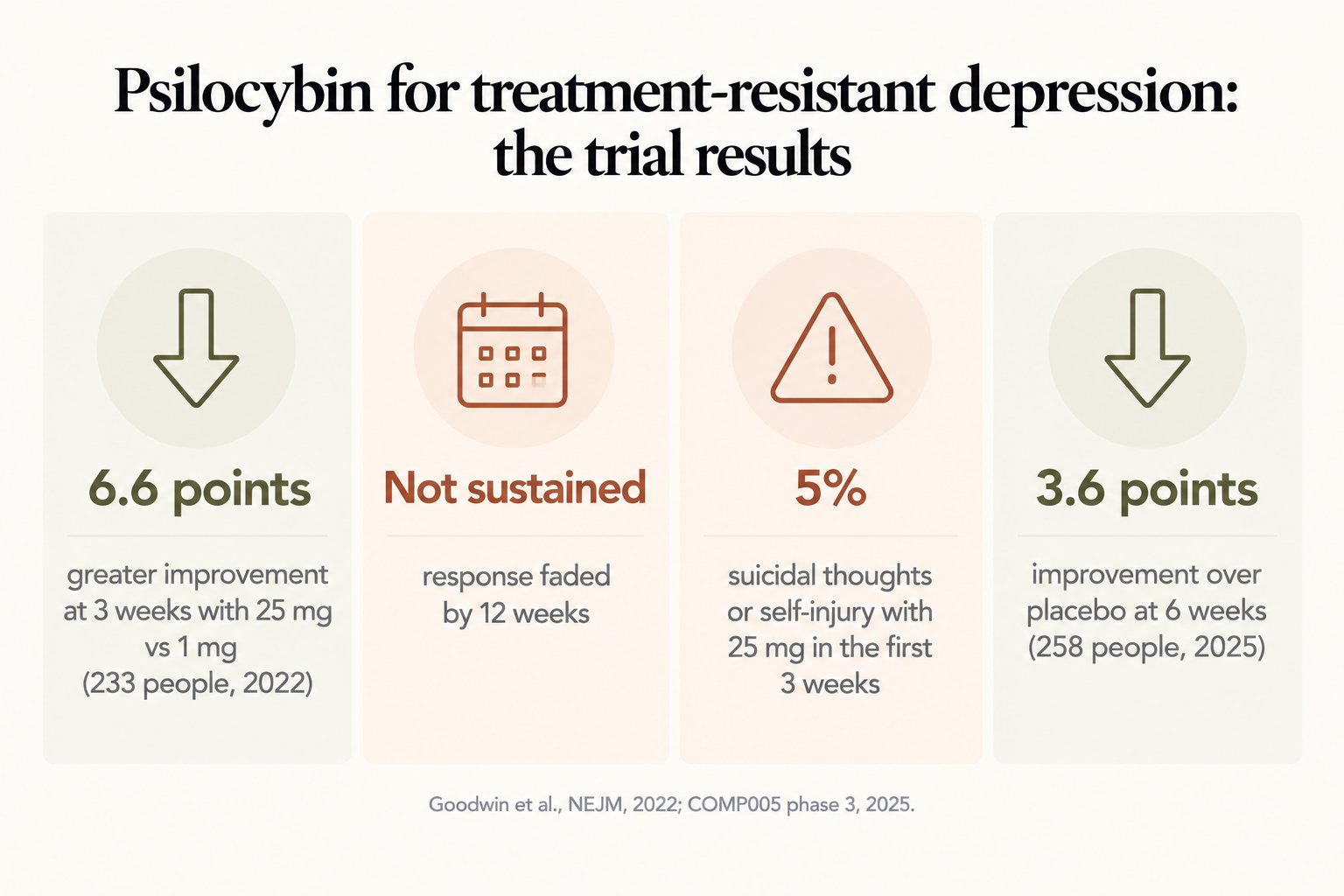
| Psilocybin phase 2 trial (233 people) | 25 mg reduced depression scores at 3 weeks vs 1 mg; benefit not sustained at 12 weeks |
| Suicidal thoughts or self-injury (same trial) | 5% with 25 mg and 4% with 10 mg vs none with 1 mg in the first 3 weeks |
| Psilocybin phase 3 trial (258 people) | Single 25 mg dose modestly better than placebo at 6 weeks |
| MDMA-assisted therapy for PTSD | FDA declined approval in 2024 and requested another phase 3 trial |
| Microdosing (191 people, self-blinded) | No better than placebo |
What psychedelics are and how they're used in research
Classic psychedelics, such as psilocybin and LSD, act mainly on serotonin 2A receptors in the brain, producing profound changes in perception, emotion and sense of self lasting several hours.
MDMA releases serotonin and other chemical messengers, producing feelings of closeness and reduced fear, which researchers hope can help people process traumatic memories.
Ketamine and esketamine are anaesthetic drugs that act on the glutamate system. At lower doses, they can rapidly reduce depressive symptoms, sometimes within hours.
In research settings, psychedelic treatment isn't simply taking a drug. It usually involves careful screening, preparation sessions with therapists, a supervised dosing session lasting six to eight hours, and follow-up "integration" sessions to make sense of the experience. This is very different from recreational use.
Evidence strength
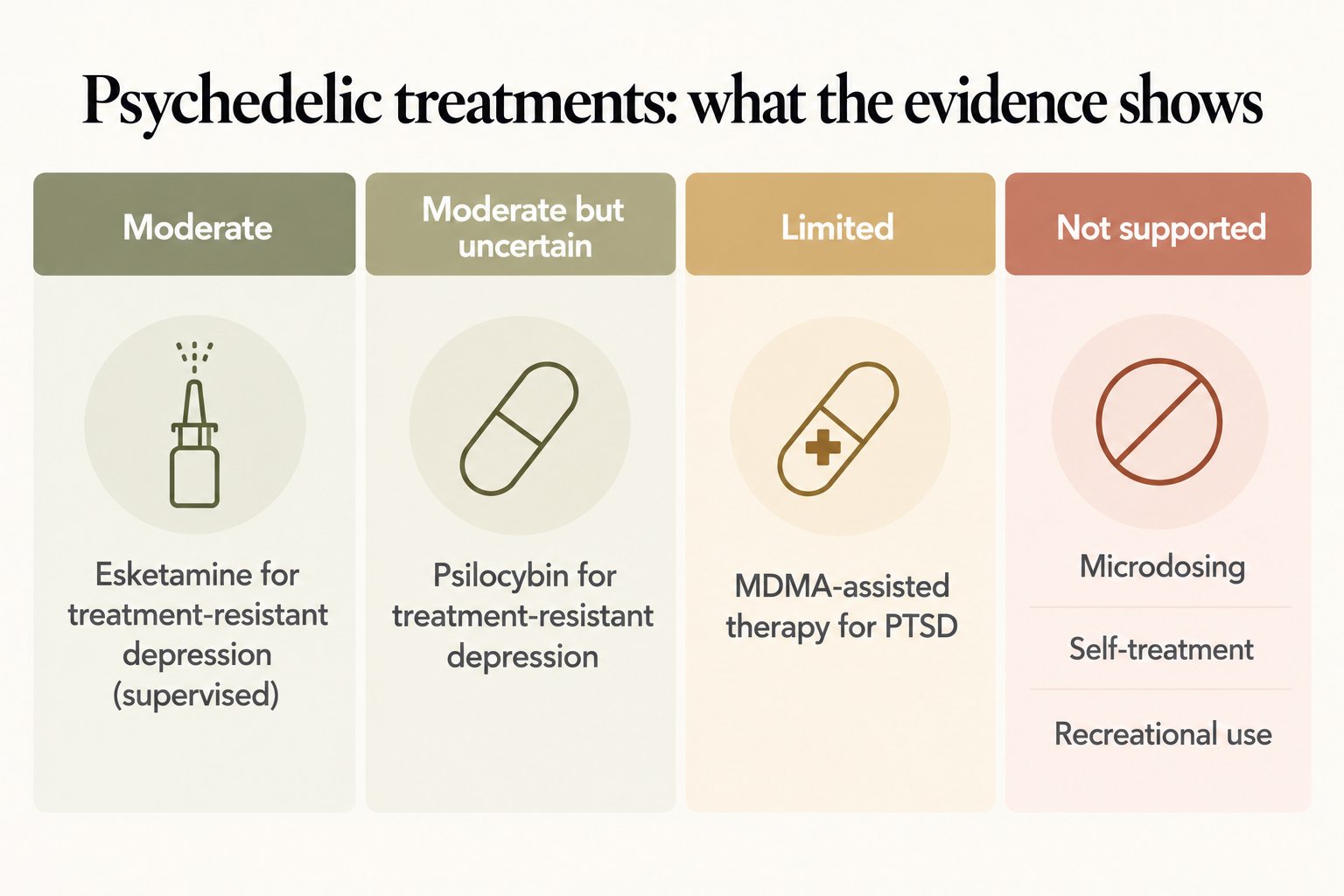
Moderate: esketamine for treatment-resistant depression. Esketamine nasal spray was approved by the FDA in March 2019 for adults with treatment-resistant depression, used alongside an oral antidepressant. In January 2025, it was approved as a standalone treatment for adults who haven't responded adequately to at least two oral antidepressants. It's only available through a restricted programme and given in a clinic under supervision, because of risks including sedation, dissociation, effects on breathing, and abuse and misuse. Ketamine itself is also used off-label in some specialist services.
Moderate but uncertain: psilocybin for treatment-resistant depression. In a 2022 phase 2 trial published in the New England Journal of Medicine, Guy Goodwin and colleagues gave 233 adults with treatment-resistant depression a single dose of 25 mg, 10 mg or 1 mg (as a control) of synthetic psilocybin, with psychological support. At three weeks, the 25 mg group's depression scores had improved by 6.6 points more than the 1 mg group on a standard 60-point scale. But response wasn't sustained at 12 weeks in any group, and suicidal thoughts or serious self-injury occurred in 5% of the 25 mg group and 4% of the 10 mg group in the first three weeks, compared with none in the 1 mg group.
In June 2025, the first phase 3 trial, COMP005, reported results in 258 adults with treatment-resistant depression at 32 US sites. A single 25 mg dose improved depression scores by 3.6 points more than placebo at six weeks, a smaller difference than in the earlier trial, with no new safety concerns and no clinically meaningful imbalance in suicidality. In early 2026, the company reported that a second phase 3 trial had also met its main goal, and said it planned to apply for FDA approval later in 2026. At the time of writing, psilocybin isn't approved by any major regulator for general use.
Limited: MDMA-assisted therapy for PTSD. MDMA-assisted therapy produced promising results in company-sponsored trials, but on 9 August 2024, the FDA declined to approve it and asked for an additional phase 3 trial. An FDA advisory panel had raised concerns about the reliability of the trial data, including that participants could usually tell whether they'd received MDMA or placebo, as well as the potential for abuse and cardiovascular effects, and concluded that the benefits didn't outweigh the risks.
Not supported: microdosing. Microdosing means taking small, regular doses of psychedelics, too small to cause noticeable effects, in the hope of improving mood, focus or creativity. In a 2021 study published in eLife, 191 people who were already microdosing used a "self-blinding" method that mixed their microdoses with placebo capsules. Both groups improved on psychological measures, but there was no significant difference between them. As lead author Balázs Szigeti put it, "Anecdotal reports about the benefits of microdosing are almost certainly biased by the placebo effect."
Not supported: self-treatment and recreational use. There's no evidence that unsupervised use of mushrooms, LSD, MDMA or ayahuasca treats depression, anxiety or trauma, and it carries real risks.
Important limitations and risks.
- Blinding is very difficult: participants usually know if they've received an active psychedelic, which can inflate benefits.
- Short follow-up: many trials follow people for weeks or months, not years.
- Selected participants: trials exclude people with psychosis, bipolar disorder, serious heart disease and other risks, so results don't apply to everyone.
- Psychological risks: frightening experiences, anxiety, worsening mood, suicidal thoughts and, in vulnerable people, triggering psychosis or mania.
- Physical risks: raised blood pressure and heart rate; with MDMA, overheating and dangerous drops in sodium; and interactions with medicines, including some antidepressants.
- Unregulated products: street drugs may contain unknown doses or other dangerous substances.
- Legal status: psilocybin and MDMA are controlled substances in most countries, including Sri Lanka, and are available only through approved research or, in Australia, through specially authorised psychiatrists since July 2023 for treatment-resistant depression (psilocybin) and PTSD (MDMA).
Recommendations by situation
| Situation | What the evidence supports |
|---|---|
| Depression that hasn't responded to two or more treatments | Ask a psychiatrist about all options, including therapy combinations, medication changes, and supervised treatments where available |
| Considering psilocybin or MDMA therapy | Only through regulated clinical trials or authorised programmes, never self-sourced |
| Interested in microdosing | Evidence suggests benefits are mostly placebo; not recommended |
| Personal or family history of psychosis or bipolar disorder | Avoid psychedelics |
| Heart disease or high blood pressure | Avoid; psychedelics and MDMA raise heart rate and blood pressure |
| Taking antidepressants or other psychiatric medicines | Never combine without specialist advice |
| Thoughts of suicide | Seek urgent help: 1926, your doctor or the nearest hospital |
Why this matters for longevity
Psychedelic research may eventually add new options for people with severe, treatment-resistant depression and PTSD, conditions that harm quality of life and shorten lifespan. But today, outside esketamine in specialist settings, these treatments remain experimental, with modest effects in the best trials, unresolved questions about long-term benefit and real risks. Proven treatments, including psychotherapy, medication, exercise, sleep and social connection, remain the foundation (see Therapy and Counselling and Depression and Physical Health).
Practical notes
If you're living with depression or PTSD that hasn't improved despite treatment, don't give up: there are many evidence-based options, and a psychiatrist can review what you've tried and what to try next. Be cautious of clinics, retreats or online sellers offering psychedelic "cures", and never self-medicate with street drugs. If you're interested in psychedelic treatment, talk to a psychiatrist about legitimate clinical trials. If you or someone you know is in crisis, contact the National Institute of Mental Health helpline on 1926, CCCline on 1333, or go to the nearest hospital. Our Longevity Doctors can help you understand your options and connect you with appropriate specialist care, starting with the free longevity assessment.
- Goodwin GM, et al. Single-dose psilocybin for a treatment-resistant episode of major depression. New England Journal of Medicine, 2022;387(18):1637-1648.
- Compass Pathways. Compass Pathways successfully achieves primary endpoint in first phase 3 trial evaluating COMP360 psilocybin for treatment-resistant depression. Press release, June 2025.
- US Food and Drug Administration. Spravato (esketamine) approval for treatment-resistant depression, 2019; monotherapy approval, January 2025.
- Lykos Therapeutics / US Food and Drug Administration. Complete response letter for midomafetamine (MDMA) capsules for PTSD, 9 August 2024.
- Szigeti B, et al. Self-blinding citizen science to explore psychedelic microdosing. eLife, 2021;10:e62878.
- Therapeutic Goods Administration (Australia). Change to classification of psilocybin and MDMA to enable prescribing by authorised psychiatrists. Effective 1 July 2023.
Free longevity assessment
Depression not improving
despite treatment?
Take the free Aevum Protocol assessment to see how your stress & mental wellbeing and 6 other longevity domains are performing — and get a personalised 90-day plan.
Take the free assessment