Sleep & Recovery
Napping: When It Helps,
When It Doesn't, and How Long Is Too Long
Our Sleep Architecture article covered how sleep cycles through distinct stages roughly every 90-110 minutes, and our Circadian Rhythm article covered how the body's clock drives natural dips in alertness. Napping sits at the intersection of both — and the research on it is more nuanced than "naps are good" or "naps are bad." This article covers what actually happens during a nap, why length matters more than most people realise, and a genuinely interesting, still-unsettled question about what long, frequent napping in later life might signal.
Quick Summary
- →A classic NASA study found a 26-minute nap improved pilot alertness by 54% and performance by 34% — but a follow-up study found even shorter, 10-minute naps produced the fastest, most complete improvement with zero grogginess afterward
- →Naps longer than about 30 minutes risk entering deep sleep, causing sleep inertia — the groggy, disoriented feeling that can leave someone performing worse than before the nap for 30-60 minutes after waking
- →Timing matters as much as length — afternoon naps aligned with the body's natural circadian dip are generally well-tolerated, while naps too close to bedtime can interfere with nighttime sleep
- →Long, frequent napping in older adults has a genuinely unsettled relationship with dementia risk — some large studies find an association, others find none once reverse causation is accounted for, closely paralleling the long-sleep debate covered in our Sleep Duration article
- →Strategic napping is a recognised, evidence-supported fatigue countermeasure for shift workers, not just a personal indulgence — timing it around a night shift specifically has real, practical performance benefits
Key numbers at a glance
| Measure | Figure |
|---|---|
| NASA study nap length | 26 minutes |
| Alertness improvement (NASA study) | ~54% |
| Performance improvement (NASA study) | ~34% |
| Nap length producing fastest benefit with no grogginess | ~10 minutes |
| Nap length threshold before sleep inertia risk rises | ~30 minutes |
| Full sleep cycle (avoids inertia by waking at the end of it) | ~90 minutes |
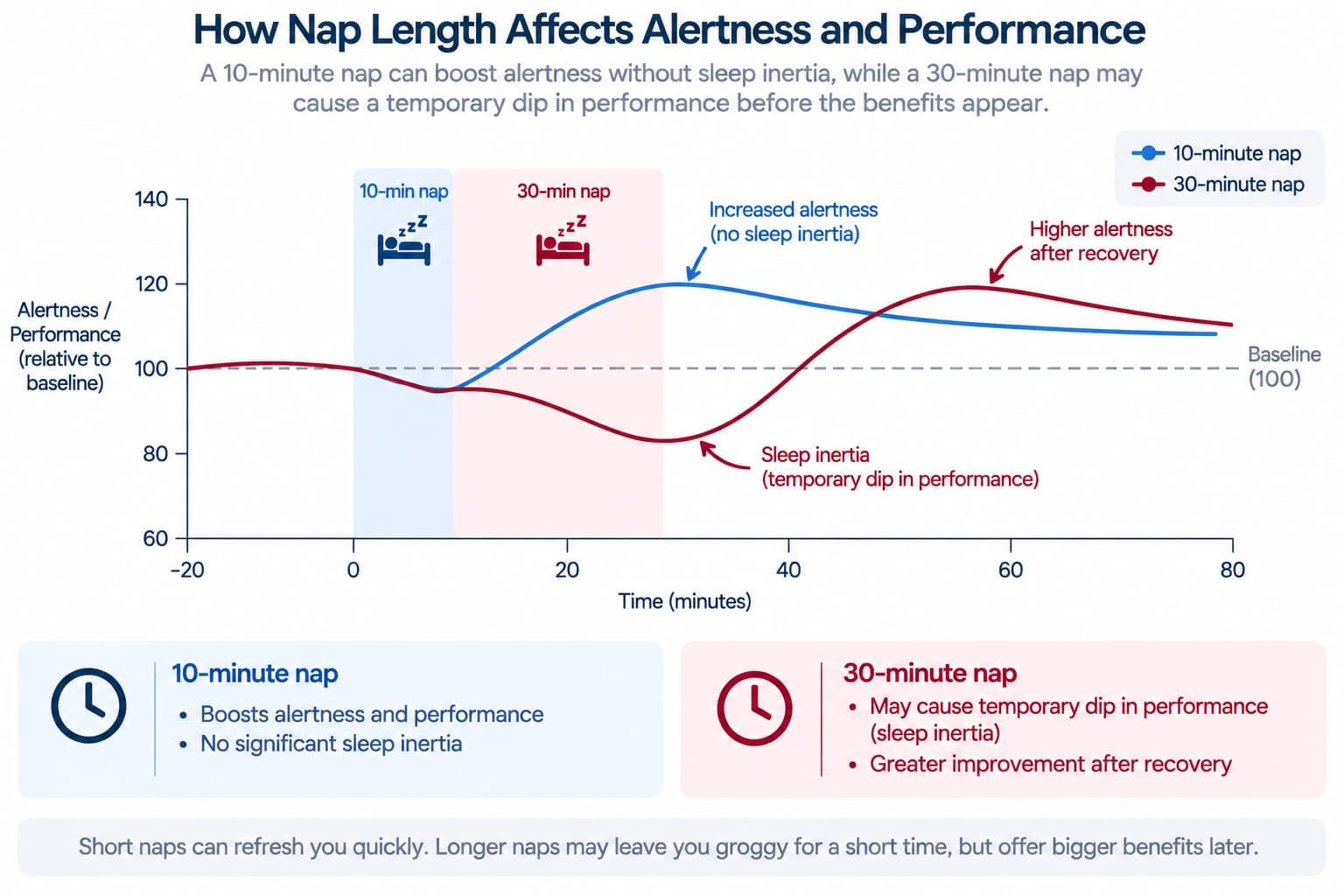
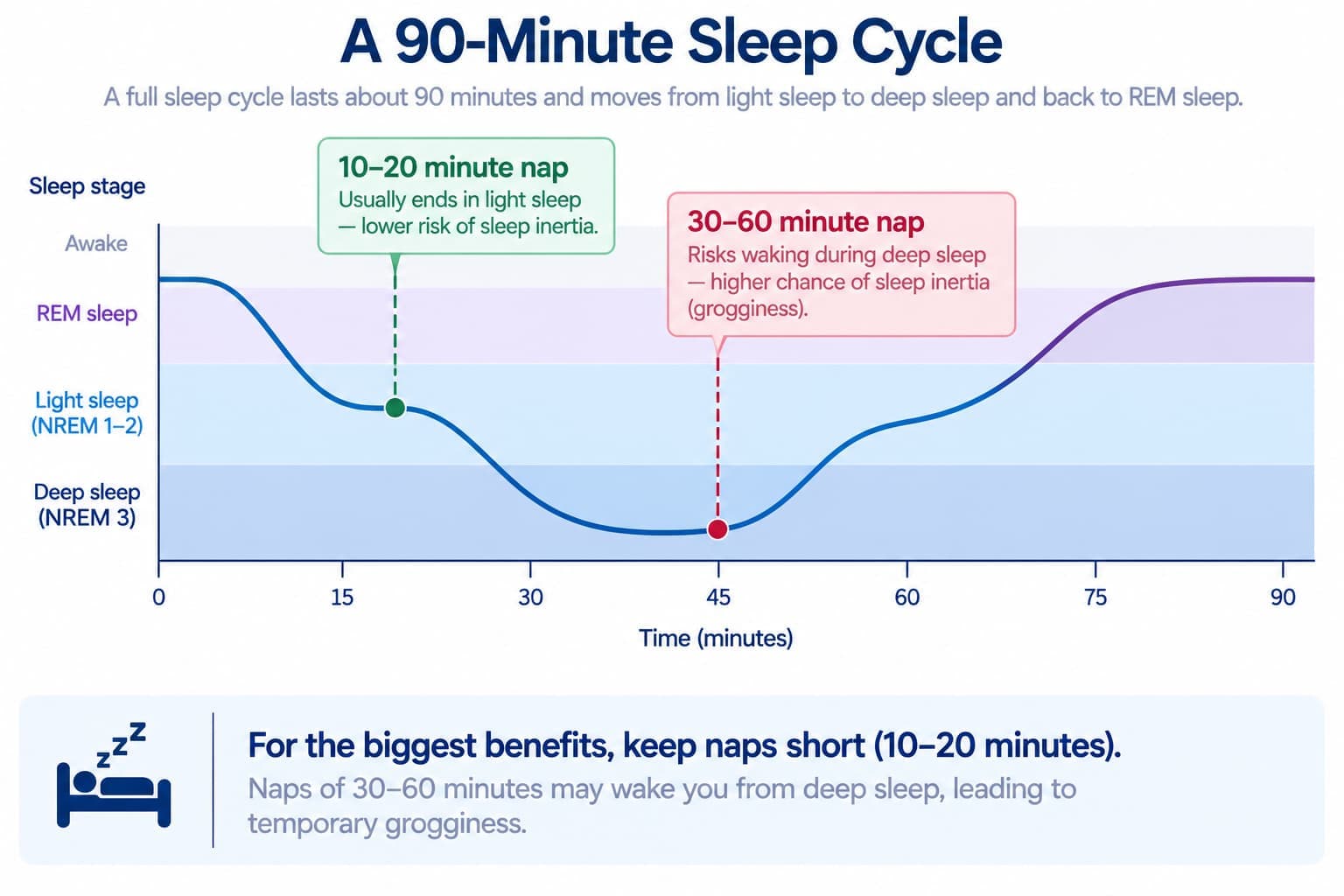
How it works: nap length, sleep inertia, and timing
As covered in our Sleep Architecture article, sleep moves through progressively deeper stages, typically reaching deep sleep (N3) around 30 minutes in. A short nap kept under this threshold stays in light sleep, allowing a person to wake up quickly and cleanly. Push past roughly 30 minutes, and there's a real chance of waking from deep sleep — producing sleep inertia, a period of grogginess, disorientation, and measurably impaired performance that can last 30 minutes or more after waking, sometimes leaving a person performing worse than if they hadn't napped at all. The two ways to avoid this are keeping naps short (under 30 minutes, ideally 10-20) or, if time allows, extending a nap to a full ~90-minute cycle, so waking happens at the natural end of a cycle rather than in the middle of deep sleep — the same cycle-based logic covered in our Sleep Architecture article's discussion of nighttime wake timing.
Timing within the day matters too. As covered in our Circadian Rhythm article, the body has a natural dip in alertness in the early-to-mid afternoon, largely independent of how much someone slept the night before. Napping during this window tends to align with the body's own rhythm rather than fighting it, while napping very late in the day — particularly within a few hours of a normal bedtime — can reduce the natural pressure to fall asleep at night, making naps closer to bedtime more likely to interfere with nighttime sleep than earlier ones.
What the research shows
Short naps genuinely improve performance. A now-classic NASA study, published in 1995 and still one of the most cited pieces of napping research, gave pilots a scheduled rest opportunity during long flights. The pilots who napped, averaging 26 minutes of actual sleep, showed a 54% improvement in alertness and a 34% improvement in task performance, measured through EEG and standardised vigilance testing, compared to non-napping controls. A later controlled study comparing 5, 10, 20, and 30-minute naps found that the 10-minute nap produced the fastest and most complete improvement in alertness and mood, with benefits appearing almost immediately and lasting over two hours, while the longer naps took longer to "kick in" due to mild sleep inertia — suggesting that for quick performance benefits without any grogginess trade-off, shorter is often genuinely better than the popular 20-30 minute recommendation.
This deserves the same careful treatment given to the long-sleep mortality question in our Sleep Duration article, because the research picture is similarly mixed. One well-designed study following over 1,400 older adults for up to 14 years found that people napping once or more daily had a 40% higher risk of developing Alzheimer's dementia than infrequent nappers — but the same research found a bidirectional relationship: the progression of Alzheimer's disease itself accelerated increases in napping, meaning worsening cognition may drive more napping just as much as napping might contribute to worsening cognition. A related study found that timing mattered independently of amount — more morning napping was linked to higher Alzheimer's risk, while early afternoon napping was linked to lower levels of amyloid-beta, the protein implicated in Alzheimer's pathology, a genuinely striking and specific distinction. Meanwhile, a much larger study — the Million Women Study, following roughly 800,000 women with over 34,000 dementia cases — found no meaningful association between regular napping and long-term dementia risk once enough follow-up time had passed, suggesting that shorter-term associations in other studies may substantially reflect undetected pre-clinical disease (reverse causation) rather than napping itself causing harm. A separate 5-year study, by contrast, found short naps under 30 minutes were associated with reduced risk of cognitive decline in older adults. The honest summary: short, appropriately-timed naps appear neutral-to-protective, while a pattern of long, frequent, or morning-heavy napping in older age may be worth mentioning to a doctor — less because napping itself is dangerous, and more because a change in napping pattern can be an early, easily overlooked signal worth investigating.
Strategic napping for shift workers. Unlike the more ambiguous longevity question above, napping's value as a short-term fatigue countermeasure is well established. Napping before or during a night shift measurably reduces drowsiness and helps maintain alertness and performance through the circadian low point — typically the early hours of the morning — making strategic, well-timed napping a genuine, evidence-supported tool for this population specifically, not just a comfort measure.
Recommendations by population group
- 1Anyone needing a quick performance boost
A 10-20 minute nap in the early-to-mid afternoon is the best-supported option — short enough to avoid sleep inertia, long enough to deliver a measurable, fast improvement in alertness.
- 2Shift workers
Strategic napping timed around a night shift is a genuine, research-backed fatigue countermeasure — worth planning deliberately rather than napping opportunistically or not at all.
- 3Anyone with insomnia or difficulty sleeping at night
Daytime naps, particularly later in the day, can reduce the natural drive to sleep at night and worsen the problem — this is a case where avoiding naps, or keeping them very short and early, is often the better approach, consistent with the sleep-restriction principles covered in our Insomnia article.
- 4Older adults, or anyone noticing a recent, unexplained increase in nap frequency or duration
Given the genuinely mixed research on long-term napping patterns and cognitive health, a noticeable change in napping habits is worth mentioning to a doctor as one data point among others — not a cause for alarm on its own, but a pattern worth tracking rather than dismissing.
- 5General / longevity-focused
Short, well-timed naps are a genuinely low-risk, evidence-supported tool for alertness — the more complex research questions in this article concern long, frequent, or morning-timed napping specifically, not the occasional strategic nap most people are likely to take.
Practical notes
- →10-20 minutes is the sweet spot for most people wanting a quick boost without grogginess — the popular "20-30 minute power nap" recommendation is reasonable, but even shorter may work just as well or better
- →If you have time for a longer nap, aim for a full 90 minutes rather than stopping in the middle — this avoids waking from deep sleep, the same cycle-based logic covered in our Sleep Architecture article
- →Early-to-mid afternoon is generally the best window — aligned with the body's natural circadian dip, and early enough to avoid interfering with nighttime sleep
- →The long-nap dementia research is genuinely unsettled, not a reason to fear napping — timing and pattern changes appear more informative than nap length alone, and the largest available study found no long-term association at all
- →If you struggle to sleep at night, napping (especially later in the day) is often working against you, not for you — this is one of the clearer exceptions to "napping is generally fine"
Napping is a genuinely useful, low-effort tool when timed and sized correctly — a short, well-placed nap can measurably improve alertness within minutes, while the more complex, still-unfolding research concerns a different pattern entirely: long, frequent, or morning-heavy napping in later life. For how sleep cycles, circadian timing, and overall duration connect to this picture, see our Sleep Architecture, Circadian Rhythm, and Sleep Duration articles. If you'd like a clearer picture of your own sleep patterns, our Longevity Doctors offer a free longevity assessment as a starting point.
How does your sleep
score on your longevity assessment?
Take the free Aevum Protocol assessment to see how your sleep & recovery and 6 other longevity domains are performing — and get a personalised 90-day plan.
Take the Free Assessment →