Movement & Strength
Muscle Fibre Types and Aging:
Why Fast-Twitch Fibres Disappear First
Our Muscle Mass article covered the overall rate of muscle loss with age, and our Grip Strength article touched on power and explosive force as relevant to recovering from a stumble. This article explains a genuinely specific, well-documented mechanism underlying both: muscle doesn't age uniformly — fast-twitch fibres, the ones responsible for power and explosive movement, deteriorate first and fastest, with a real, identifiable cause behind it, and a genuinely useful, specific training implication.
Quick Summary
- →Muscle fibres aren't uniform — fast-twitch (Type II) fibres, responsible for power and explosive force, are disproportionately affected by ageing compared to slow-twitch (Type I) fibres, which are used more for endurance and posture
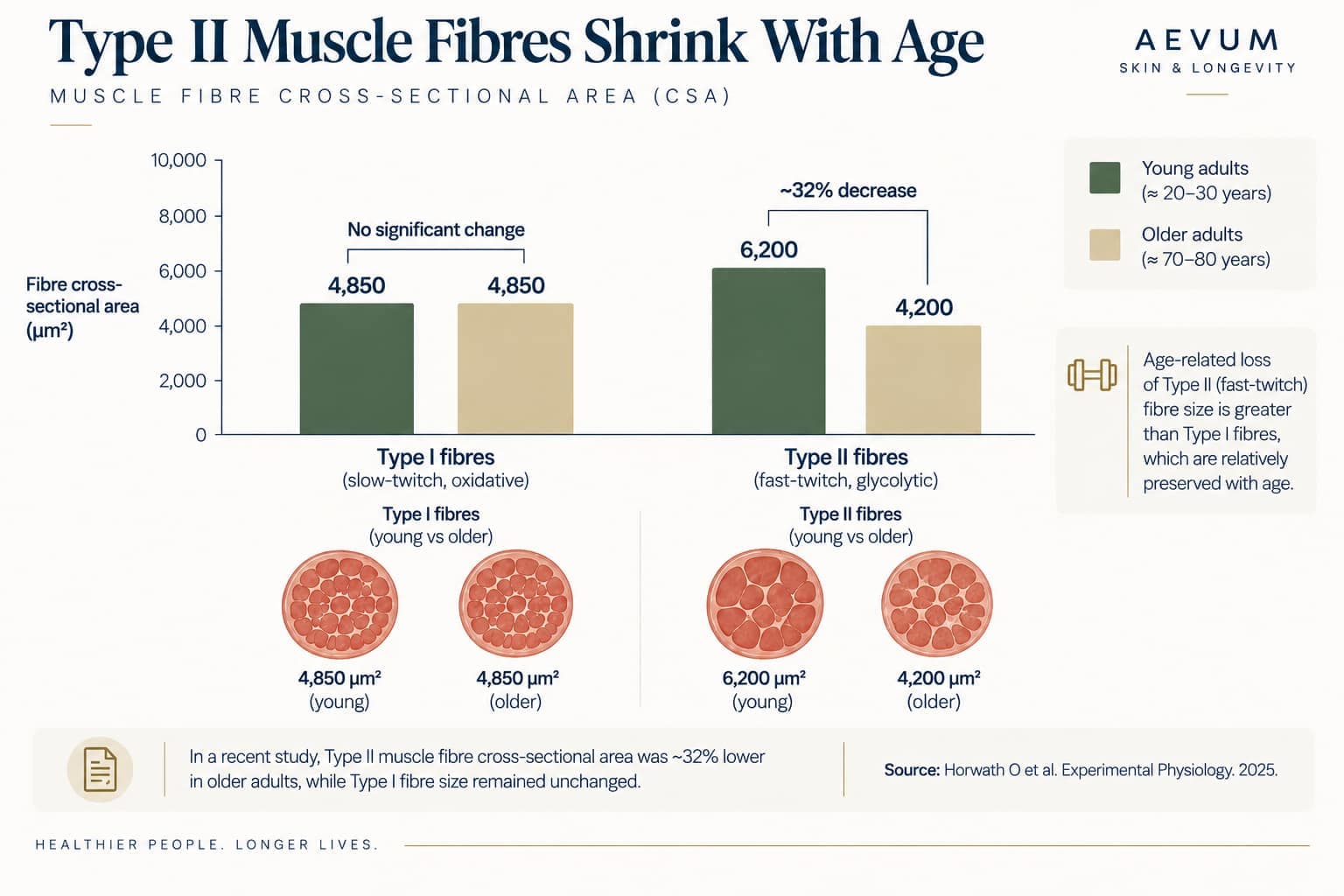
- →One well-controlled biopsy study found fast-twitch fibre cross-sectional area roughly 32% smaller in older adults than in young adults, while slow-twitch fibre size showed no significant difference by age — a striking, specific illustration of how selective this process actually is
- →The mechanism is genuinely well-understood: age-related motor neuron loss preferentially denervates fast-twitch fibres, and when these fibres get "rescued" through reinnervation, it's typically by neighbouring slow-twitch motor neurons — causing the fibre to actually convert toward slow-twitch characteristics, a process called fibre type grouping
- →This directly explains why older adults lose power disproportionately more than raw strength or endurance — since fast-twitch fibre size, not slow-twitch fibre size, was found to correlate directly with measured strength in older adults
- →Strength training specifically — not endurance training — has been shown to preserve fast-twitch fibre innervation and size, with lifelong strength-trained older athletes showing fibre patterns genuinely similar to young adults, while lifelong endurance-trained athletes did not show the same protection
Key numbers at a glance
| Measure | Figure |
|---|---|
| Fast-twitch (Type II) fibre size, young vs. older adults | ~32% smaller in older adults |
| Slow-twitch (Type I) fibre size difference, young vs. older | No significant difference |
| Age at which total muscle fibre number begins declining | ~25 years |
| Training type shown to preserve fast-twitch fibre innervation | Strength training (not endurance training) |
How it works: not all muscle fibres age the same way
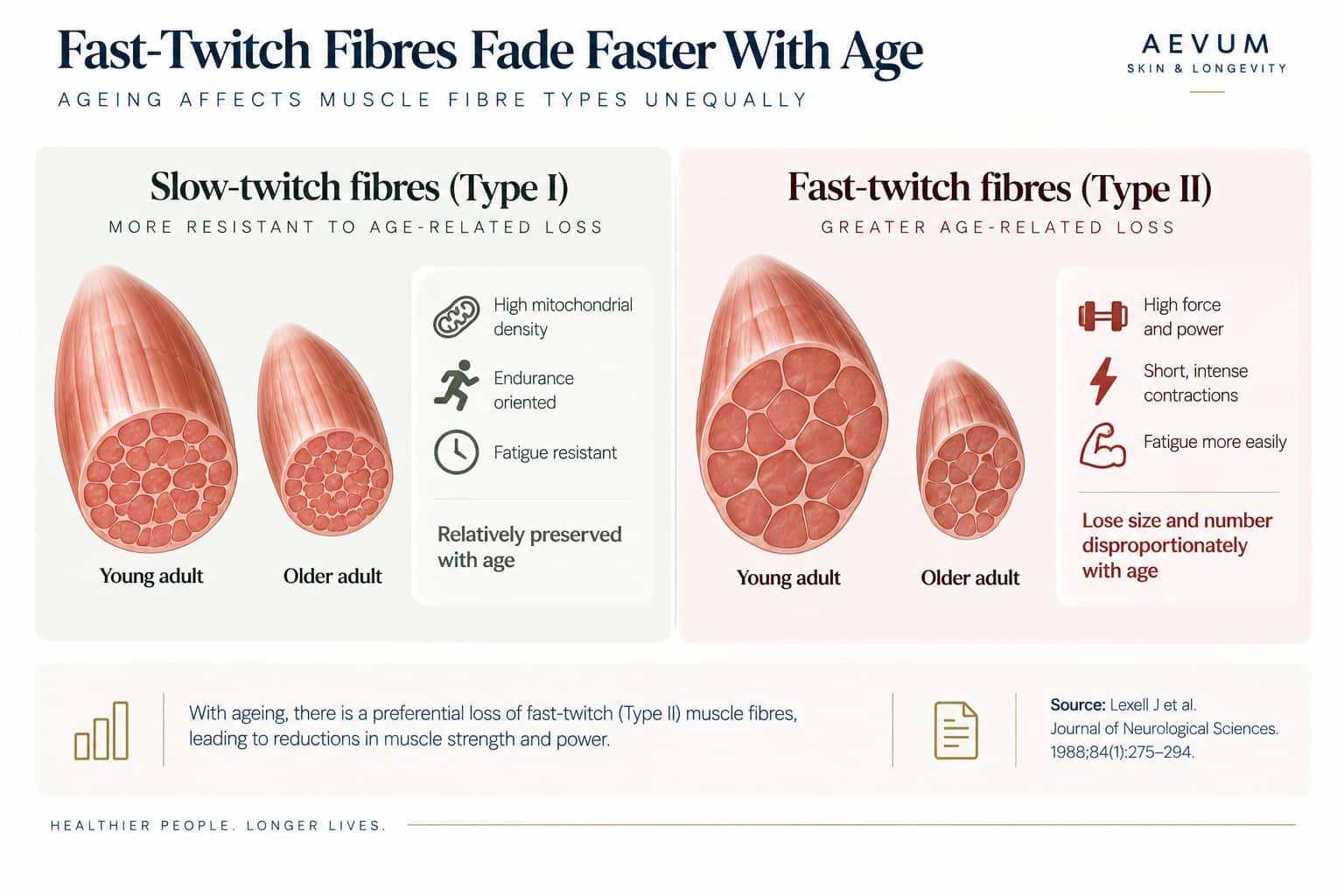
Skeletal muscle is made up of distinct fibre types with genuinely different properties. Type I (slow-twitch) fibres are fatigue-resistant, rely on oxidative metabolism, and are suited to sustained, lower-intensity activity like posture and endurance movement. Type II (fast-twitch) fibres contract rapidly and forcefully but fatigue quickly, relying more on glycolytic metabolism, and are responsible for power, speed, and explosive force — the kind of rapid, forceful contraction needed to catch yourself after a stumble or rise quickly from a chair.
The mechanism behind fast-twitch fibre loss is genuinely well-characterised. As motor neurons die with age (a process called denervation), the muscle fibres they once controlled lose their nerve connection. Some of these orphaned fibres are "rescued" through reinnervation — nearby surviving motor neurons send out new connections to take over the abandoned fibres. The problem is that this rescue process disproportionately involves slow-twitch motor neurons reinnervating fast-twitch fibres, and when this happens, the fibre itself gradually converts toward slow-twitch characteristics. This produces a distinctive histological pattern called fibre type grouping, where fibres of the same type cluster together in a way healthy young muscle doesn't show — a genuine, measurable sign of this age-related remodelling process, not a subtle or theoretical concept.
What the research shows
The scale of selective atrophy is genuinely striking. Research directly comparing muscle biopsies from young (~22 years) and older (~69 years) recreationally active adults found fast-twitch (Type II) fibre cross-sectional area was roughly 32% smaller in older adults than in young adults (about 4,200 vs. 6,200 µm²), while slow-twitch (Type I) fibre size showed no significant difference between the two age groups. This is about as clear a demonstration of selective, fibre-type-specific ageing as exists in the muscle physiology literature — the decline isn't a general shrinking of all muscle tissue equally, but a specific, disproportionate loss concentrated in the fibres responsible for power.
This selective atrophy directly explains functional decline, not just an abstract biopsy finding. In the same research, Type II fibre size correlated strongly with measured strength (10-repetition-max testing) in older adults, while Type I fibre size showed no equivalent relationship with strength at all. Given that explosive, rapid contractions depend specifically on a functioning pool of fast-twitch fibres, this pattern has real, practical consequences — plausibly affecting the ability to perform activities like climbing stairs quickly or catching one's balance after a stumble, both of which depend on rapid force generation rather than sustained, slow-twitch-driven strength.
A comparative biopsy study examined lifelong strength-trained master athletes, lifelong endurance-trained master athletes, recreationally active older adults, and young active adults. The finding was genuinely notable: strength-trained older athletes showed a Type II fibre proportion and fibre type grouping pattern similar to young adults, while endurance-trained older athletes and recreationally active older adults showed significantly more Type I fibre grouping and a higher percentage of atrophic fibres — despite endurance training still being a genuine, active form of regular exercise. The researchers concluded that strength training specifically preserves neural innervation of fast-twitch fibres, likely through the chronic high-force contractions this type of training requires.
A genuinely interesting, still-emerging line of research has begun investigating whether cellular senescence — the same "zombie cell" phenomenon covered in our Biology of Skin Aging article from our Skin & Longevity series — contributes to this fast-fibre atrophy specifically. One recent preprint found that myonuclear loss, rather than senescent myonuclei themselves, appeared to better explain the fibre-specific atrophy pattern observed — a nuanced, still-developing finding worth knowing about rather than a settled conclusion, but a genuinely interesting potential link between muscle ageing and the broader cellular ageing mechanisms studied elsewhere in longevity science.
Recommendations by goal
- 1Older adults focused on fall prevention
Given that fast-twitch fibre loss specifically undermines the rapid force generation needed to recover balance after a stumble, power- and strength-focused training deserves particular priority over endurance training alone.
- 2Anyone whose exercise routine is primarily cardio or endurance-based
Given the master athlete research above, endurance training alone doesn't appear to protect fast-twitch fibre health to the same degree strength training does — worth considering adding resistance training specifically, rather than assuming any regular exercise provides equivalent protection.
- 3Anyone noticing a decline in power or quickness rather than pure strength or endurance
This pattern is consistent with the selective fast-twitch fibre atrophy covered in this article — a genuinely specific, identifiable phenomenon rather than a vague sign of "getting older."
- 4Coaches and clinicians working with older adults
The distinction between strength/power training and endurance training's differential effects on fibre type preservation is a genuinely useful, specific piece of evidence to incorporate into programme design, rather than treating all exercise as interchangeable for this particular outcome.
Practical notes
- →Fast-twitch fibres are lost disproportionately compared to slow-twitch fibres with age — this is a specific, well-documented, selective process, not general muscle shrinkage
- →The mechanism runs through motor neuron loss and reinnervation, with fast-twitch fibres often converting toward slow-twitch characteristics when rescued by the "wrong" type of surviving motor neuron
- →Strength correlates specifically with fast-twitch fibre size, not slow-twitch fibre size, in older adults — directly connecting this fibre-level biology to real functional outcomes
- →Strength training, not endurance training, has been shown to preserve fast-twitch fibre health — a genuinely specific, actionable finding rather than generic "exercise is good" advice
- →This connects meaningfully to broader ageing biology, including emerging research on cellular senescence's possible role — a still-developing area worth watching rather than a settled conclusion
Muscle doesn't age as one uniform tissue — the selective loss of fast-twitch fibres is a specific, well-understood process with real functional consequences, and a genuinely clear training implication: strength training appears to protect this particular vulnerability in a way endurance training alone does not. For the broader muscle mass context this fits into, see our Muscle Mass article. If you'd like a clearer picture of your own muscle health and power capacity, our Longevity Doctors offer a free consultation as a starting point.
How much power and explosive
strength have you retained with age?
Take the free Aevum Protocol assessment to see how your movement & strength and 6 other longevity domains are performing — and get a personalised 90-day plan.
Take the Free Assessment →