Sleep & Recovery
Melatonin & Sleep Supplements:
What the Evidence Actually Supports
Our Circadian Rhythm article covered melatonin's natural role as the body's own darkness signal. This article covers melatonin and other common sleep supplements from a different angle — as products people buy and take — including a genuinely important manufacturing quality problem, a counterintuitive dosing finding, and an honest look at what the evidence actually supports for the other supplements sharing shelf space with melatonin.
Quick Summary
- →Melatonin's average effect on sleep is real but modest — a meta-analysis of 19 randomised trials found it reduced time to fall asleep by roughly 7 minutes and increased total sleep time by roughly 8 minutes compared to placebo, useful context against how it's often marketed
- →Lower doses often work as well as, or better than, higher ones — melatonin is a signalling hormone, not a sedative, and doses far above what the body naturally produces don't appear to improve effectiveness, with some researchers specifically recommending the lowest effective dose
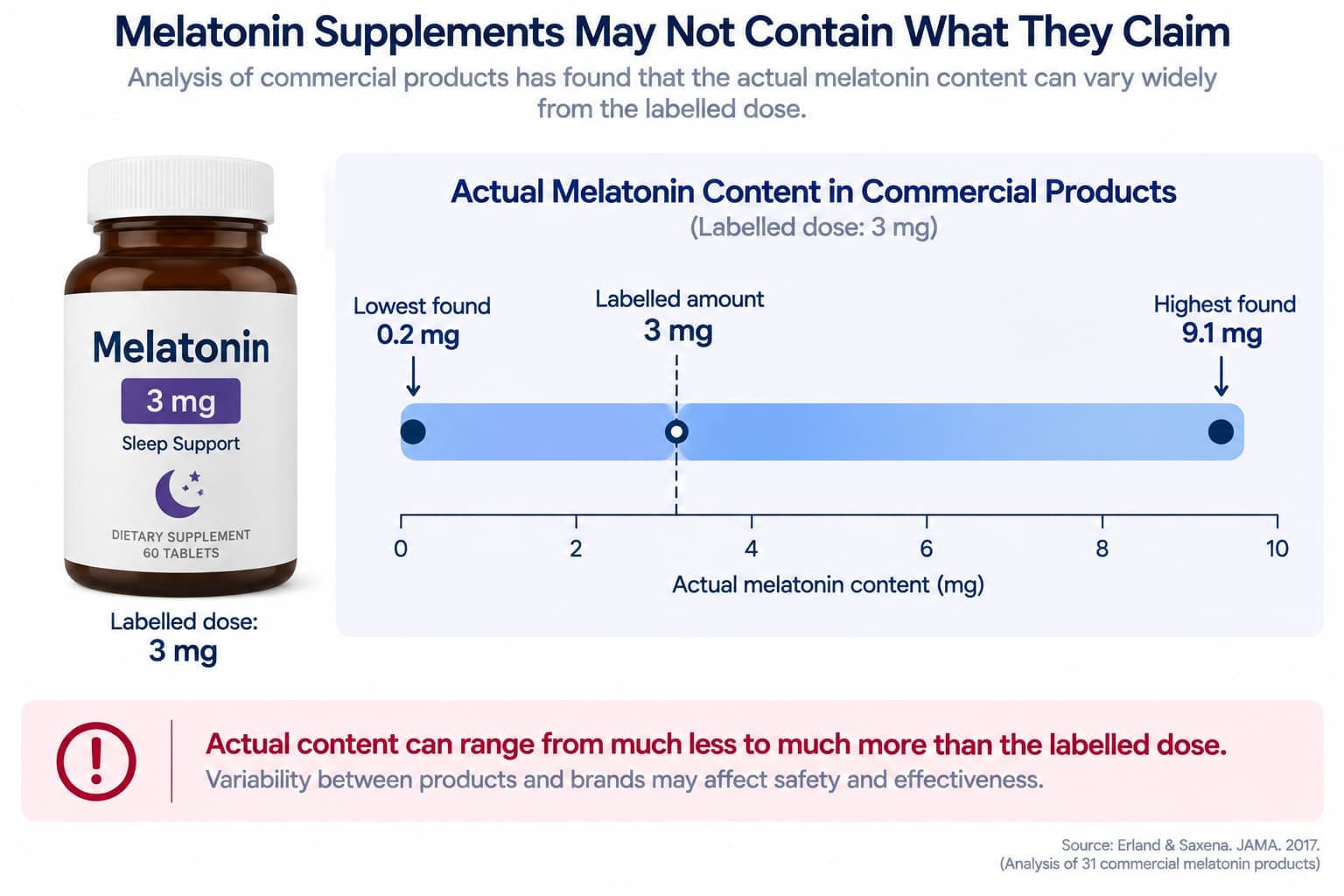
- →Melatonin supplement labelling is a genuine, well-documented problem — studies have found the actual content of commercial products ranging from 83% less to nearly 5 times more than the labelled amount, with one study also detecting serotonin, a controlled substance, as an unlisted contaminant in several products
- →Melatonin is best suited to circadian timing problems — jet lag, shift work adjustment, delayed sleep phase — rather than general chronic insomnia, where our Insomnia article's CBT-I remains the more evidence-backed first-line approach
- →Among the other popular sleep supplements, evidence quality varies considerably — magnesium has reasonably solid recent trial support, valerian root has repeatedly underperformed in controlled studies despite its popularity, and several others sit somewhere in between
Key numbers at a glance
| Measure | Figure |
|---|---|
| Melatonin's effect on sleep onset time (meta-analysis) | ~7 minutes faster |
| Melatonin's effect on total sleep time (meta-analysis) | ~8 minutes more |
| Commercial melatonin products outside 10% of labelled dose (2017 study) | ~71% |
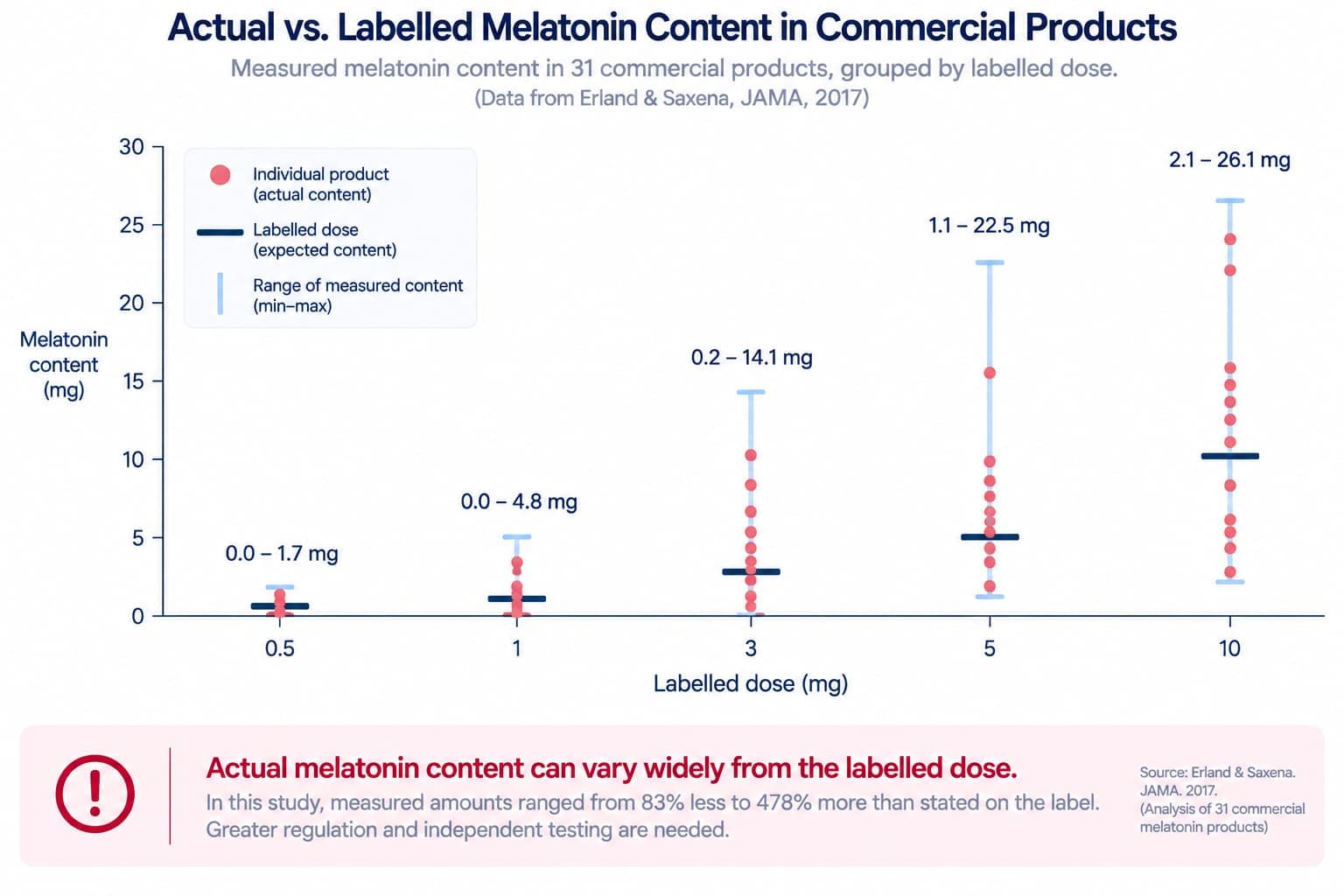
| Range of actual vs. labelled melatonin content found | -83% to +478% |
| Melatonin gummies inaccurately labelled (2023 JAMA study) | ~88% |
| High-dose (>5mg) melatonin use growth, US adults, 2005-2018 | More than tripled |
How it works: a timing signal, not a sedative
As covered in our Circadian Rhythm article, melatonin's natural role is to signal biological night to the rest of the body, reinforcing the timing set by the brain's master clock — it doesn't force sleep the way a sedative does. This distinction matters for how supplemental melatonin should be understood and used: it's genuinely more effective as a circadian timing tool — helping shift the body's internal clock for jet lag, shift work adjustment, or a naturally delayed sleep phase — than as a general-purpose sleep aid for someone whose clock is already well-timed but who simply has trouble sleeping for other reasons.
This also explains the dosing paradox covered below: because melatonin's job is signalling rather than sedation, larger doses don't necessarily produce a proportionally larger effect, and may in some cases prolong blood levels well past the natural physiological window, rather than more effectively inducing sleep.
What the research shows
The average effect is real, but modest. A meta-analysis pooling 19 randomised controlled trials and over 1,600 participants found that melatonin, compared to placebo, reduced the time it took to fall asleep by roughly 7 minutes and increased total sleep time by roughly 8 minutes. This is a genuine, statistically real effect — but a considerably more modest one than the confident marketing around melatonin products often implies, and worth knowing before expecting a dramatic transformation.
The dosing paradox: lower is often just as good, or better. Despite many commercial products being sold in 5-10mg doses, a systematic review of melatonin dosing in older adults found no clear dose-response relationship — doses between 0.5mg and 6mg appeared effective, while researchers specifically recommended using the lowest effective dose of an immediate-release formulation, in order to mimic the body's natural physiological melatonin pattern rather than producing prolonged, well-above-normal blood levels. This is a genuinely useful corrective: more melatonin is not straightforwardly better, and the widely available high-dose products may be working against the hormone's actual signalling role rather than enhancing it.
A genuine, well-documented manufacturing problem. Because melatonin is regulated as a dietary supplement rather than a medication in markets like the United States, it isn't subject to the same content-accuracy requirements as pharmaceuticals. A 2017 study analysing 31 commercial melatonin products found that 71% fell outside a 10% margin of their labelled dose, with actual content ranging from 83% less to 478% more than labelled — and lot-to-lot variability within the same product of up to 465%. The same study detected serotonin, a controlled substance, as an undisclosed contaminant in 8 of the 31 products tested. A 2023 follow-up study focused specifically on melatonin gummies found an even starker picture: only 3 of 25 products tested were within 10% of their labelled dose, and one contained no detectable melatonin at all. This is a genuine, replicated finding across multiple independent studies — not an isolated result.
Melatonin shares shelf space with several other popular supplements, and the evidence quality behind them varies considerably. Magnesium has reasonably solid recent trial support — a 2025 double-blind, placebo-controlled study of 155 adults with poor sleep quality found a standard dose of magnesium glycinate produced significant improvement in insomnia severity by the fourth week, though it generally takes longer to show benefit than melatonin. L-theanine has moderate evidence, particularly for sleep difficulty driven by anxiety or mental overactivity rather than circadian timing — it appears to work more through relaxation and reduced arousal than direct sedation. Valerian root, despite its long history of traditional use and continued popularity, has repeatedly underperformed in rigorous controlled trials — one review of relevant research found the majority of randomised crossover studies showed no meaningful benefit over placebo. Glycine has some genuinely promising early evidence, tied to its role in the core body temperature drop covered in our Sleep Hygiene article, but the supporting studies remain small in scale and concentrated among a limited number of research groups.
Recommendations by population group
- 1Anyone dealing with jet lag or shift work adjustment
This is the use case melatonin's evidence base best supports — a low dose, well-timed relative to the target sleep schedule, is a reasonable, evidence-backed tool for this specific circadian problem.
- 2Anyone with chronic insomnia
Melatonin is not the strongest evidence-based option here — our Insomnia article covers CBT-I, which has considerably stronger long-term evidence for this specific condition; melatonin may be worth discussing with a doctor as a secondary consideration, not a replacement for that approach.
- 3Anyone buying melatonin
Given the well-documented labelling problem, choosing products independently tested for content accuracy (look for third-party verification marks) is a reasonable precaution, and starting with a low dose (0.5-3mg) rather than the widely available 5-10mg options is worth considering given the dosing research above.
- 4Parents considering melatonin for children or adolescents
Given that high-dose melatonin use has risen substantially in recent years and melatonin is a genuine hormone with effects beyond sleep alone, this is a conversation worth having directly with a pediatrician rather than treating it as an automatically safe, over-the-counter solution — particularly given the same labelling accuracy concerns apply to children's gummies specifically.
- 5Anyone considering other supplements (magnesium, L-theanine, valerian, glycine)
Calibrate expectations to the evidence — magnesium currently has the more solid recent trial support among this group, while valerian's popularity considerably outpaces its actual demonstrated effectiveness in controlled research.
Practical notes
- →Melatonin works best as a circadian timing tool, not a general sleep aid — jet lag and shift work adjustment are its strongest, best-supported use cases
- →Lower doses (0.5-3mg) are a reasonable starting point, not just a cautious one — the evidence doesn't support higher doses being more effective, and may work against melatonin's actual signalling mechanism
- →The supplement quality problem is real and well-documented, not a fringe concern — multiple independent studies have consistently found major discrepancies between labelled and actual content
- →For chronic insomnia specifically, CBT-I remains the better-supported first approach, covered in our Insomnia article — melatonin is a secondary tool for this condition, not a primary treatment
- →Among other sleep supplements, evidence quality varies more than marketing suggests — magnesium currently has better recent trial support than the still-popular but weakly-supported valerian root
Melatonin and other sleep supplements occupy a genuinely useful but often oversold space — real, modest effects for the right use case, undermined by inconsistent product quality and dosing assumptions that don't match how the hormone actually works. For how melatonin functions naturally in the body, and for the more comprehensive approach to chronic insomnia specifically, see our Circadian Rhythm and Insomnia articles. If you'd like a clearer picture of your own sleep health and whether supplementation is appropriate for you, our Longevity Doctors offer a free longevity assessment as a starting point.
How does your sleep
score on your longevity assessment?
Take the free Aevum Protocol assessment to see how your sleep & recovery and 6 other longevity domains are performing — and get a personalised 90-day plan.
Take the Free Assessment →