Skin & Longevity
Glycation & Sugar:
The Overlooked Driver of Skin Aging
Our Collagen Loss article covered how MMP enzymes fragment and break down collagen over time. This article covers a genuinely different, separate process affecting the same protein — one that doesn't break collagen down so much as lock it into a stiffer, less functional state, driven not by enzymes or sun exposure, but by sugar. It's also one of the more genuinely well-measured connections between skin ageing and whole-body ageing in this entire series.
Quick Summary
- →Glycation is a non-enzymatic reaction between sugar molecules and proteins, the same basic chemistry behind browning and crust formation in cooking (the Maillard reaction) — happening slowly, continuously, inside the body as well
- →Collagen is unusually vulnerable to this process for two specific reasons: it's one of the longest-lived proteins in the body, giving glycation more time to act before the protein is replaced, and its amino acid composition (rich in arginine and lysine) makes it chemically more prone to the reaction in the first place
- →Glycated collagen becomes stiffer, more brittle, and resistant to normal repair and remodelling — a genuinely different problem from the collagen fragmentation covered in our Collagen Loss article, since glycation doesn't break collagen down so much as lock existing collagen into a dysfunctional state
- →Skin AGE accumulation can now be measured directly and non-invasively, using a technique called skin autofluorescence — and because skin AGEs have an estimated half-life of around 15 years, this measurement functions as a genuine marker of long-term "metabolic memory," not just current blood sugar
- →Large population studies have linked skin AGE levels to frailty, cardiovascular disease, and fracture risk — and this relationship holds even in people without diabetes, suggesting glycation is a relevant, continuous process for essentially everyone, not just those with diagnosed blood sugar problems
Key numbers at a glance
| Measure | Figure |
|---|---|
| Estimated half-life of skin AGEs | ~15 years |
| Participants in the Rotterdam Study frailty analysis | 2,521 |
| Participants in the EPIC-Potsdam vascular stiffness analysis | 3,535 |
| Populations showing the AGE-vascular stiffness link | Normoglycemic, prediabetic, and diabetic groups alike |
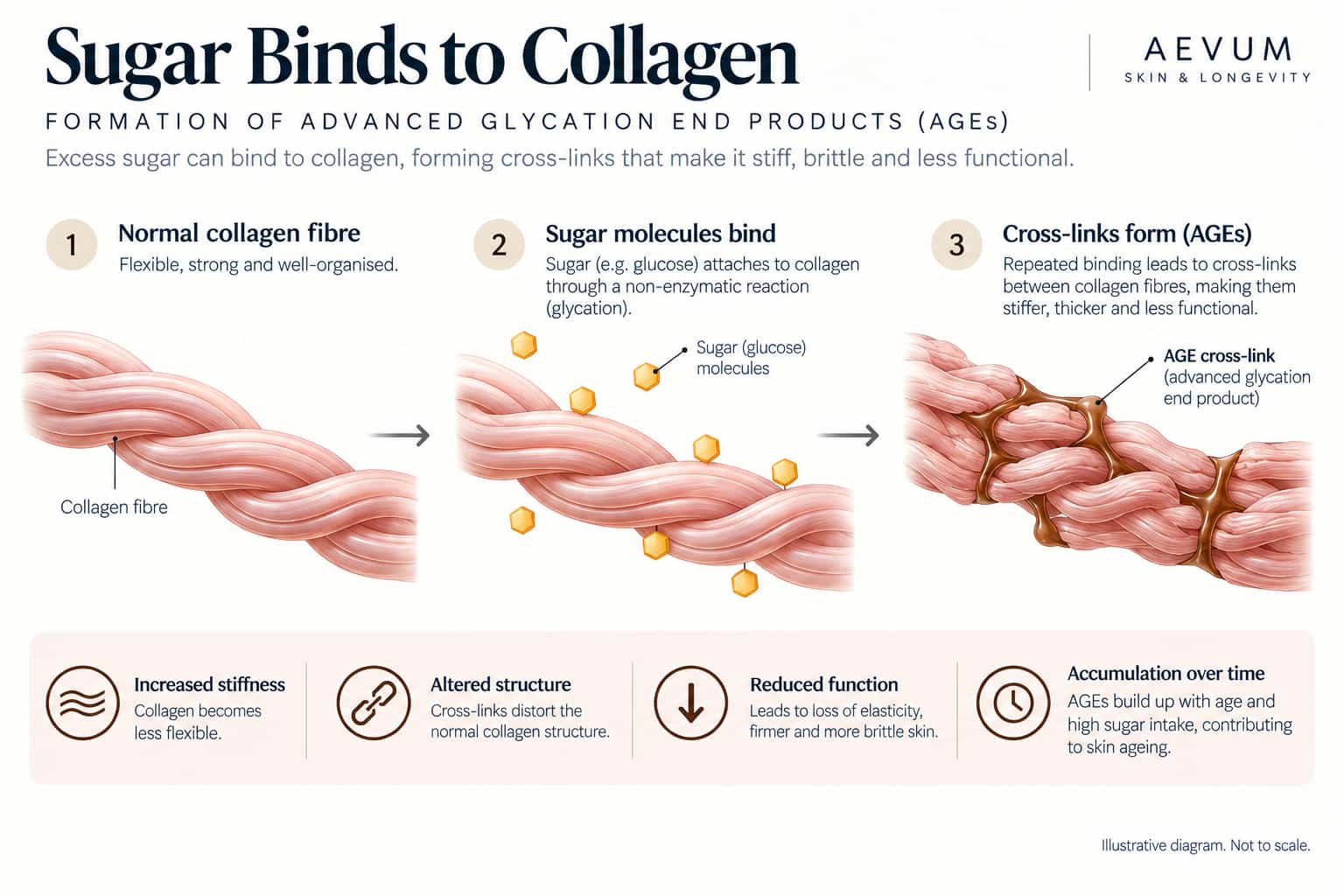
How it works: the Maillard reaction, and why collagen is especially vulnerable
Glycation happens when sugar molecules (primarily glucose) react directly with the free amino groups on proteins, without the involvement of any enzyme — the same fundamental chemistry as the Maillard reaction responsible for browning bread crust or searing meat, just happening slowly inside living tissue rather than in a hot pan. Over time and repeated exposure, this initial reaction progresses into stable, essentially permanent structures called advanced glycation end-products (AGEs).
Collagen is disproportionately affected by this process for two specific, compounding reasons. First, it's one of the longest-lived proteins in the human body — unlike many cellular proteins that are regularly broken down and replaced, structural collagen in the extracellular matrix can persist for years, giving glycation far more cumulative time to act before the affected protein is ever replaced. Second, collagen's specific amino acid composition — rich in repeating arginine and lysine residues — makes it chemically more reactive with glucose than many other proteins, further predisposing it to this specific type of damage.
The resulting damage is genuinely distinct from the collagen fragmentation covered in our Collagen Loss article. Where MMP enzymes break existing collagen down, AGE cross-linking does something different: it binds adjacent collagen fibres together in abnormal, rigid connections, making the overall structure stiffer, more brittle, and resistant to the body's normal repair and remodelling processes — the enzymes that would ordinarily break down and replace ageing collagen have genuine difficulty accessing collagen that's been cross-linked this way. AGEs also bind to a specific cell-surface receptor, RAGE, triggering inflammatory and oxidative stress signalling — meaning glycation damages skin through both a direct structural mechanism and a separate inflammatory one simultaneously.
What the research shows
Skin AGE accumulation can now be measured directly, and the finding it enables is genuinely significant. A non-invasive technique called skin autofluorescence (SAF) takes advantage of the fact that AGEs naturally fluoresce under certain light — measured using a device called an AGE Reader. Because skin AGEs have an estimated half-life of around 15 years, this single, simple measurement reflects a genuinely long window of accumulated glycation exposure, functioning as a marker of long-term "metabolic memory" rather than a snapshot of recent diet or blood sugar alone.
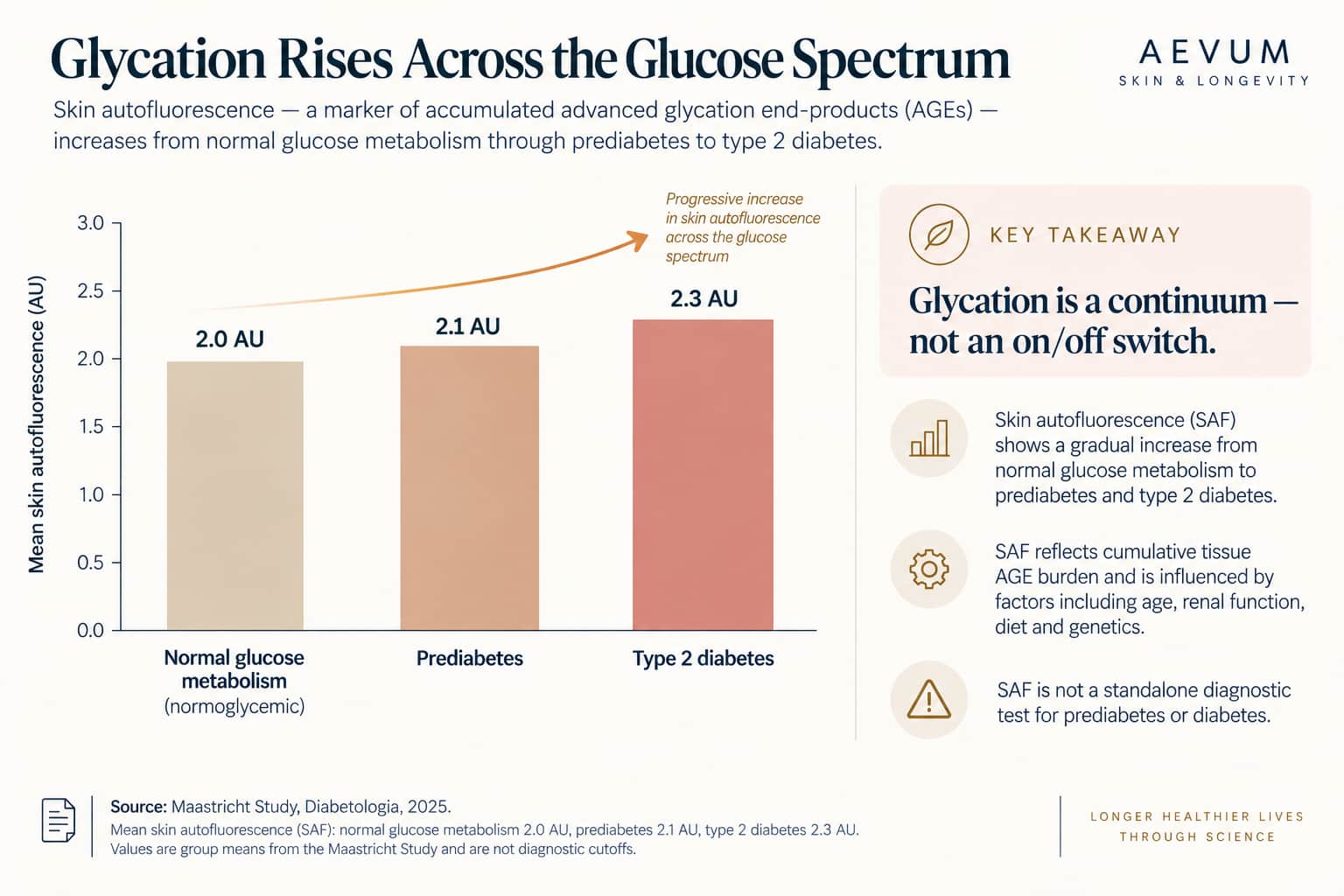
Large population studies have connected this measurement to significant whole-body ageing outcomes. The Rotterdam Study, a large, well-established longitudinal cohort, found skin AGE levels (measured via SAF) significantly associated with frailty in an analysis of over 2,500 participants, and separately associated with subclinical cardiovascular disease and fracture risk in related analyses from the same cohort. A separate large cohort study (EPIC-Potsdam, over 3,500 participants) specifically examined the relationship between skin AGEs and vascular stiffness across different blood sugar categories, and found the association present in normoglycemic and prediabetic participants, not just those with diagnosed diabetes — a genuinely important finding suggesting glycation-related tissue damage is a continuous process relevant across the full range of blood sugar levels, not a concern that only begins at a diabetes diagnosis. A 2025 study from the Maastricht Study cohort independently confirmed this same graded pattern, finding mean skin autofluorescence rising step-wise from 2.0 AU in people with normal glucose metabolism, to 2.1 AU in prediabetes, to 2.3 AU in type 2 diabetes.
Diet contributes to the body's AGE burden through two separate pathways. Beyond the internal, blood-sugar-driven glycation process described above, AGEs can also be consumed directly — high-heat, dry cooking methods (grilling, frying, roasting) generate dietary AGEs that contribute to the body's overall AGE pool once absorbed, a topic covered in more depth in our Diet and Skin article. This means both blood sugar management and cooking method are genuinely relevant levers, not just one or the other.
Recommendations by skin concern
- 1Anyone with prediabetes, diabetes, or elevated blood sugar
Given the direct, well-documented relationship between blood glucose and AGE formation, this is a population where skin ageing genuinely connects to the same metabolic management already relevant to broader health — the glycemic index and blood sugar content covered in our Rice and Fibre articles applies directly here too, not just to diabetes management in isolation.
- 2Anyone assuming glycation is only relevant to diagnosed diabetics
The EPIC-Potsdam finding is worth taking seriously — the AGE-related tissue stiffening relationship held in normoglycemic participants too, meaning this is a relevant, continuous process for most people, not a concern that switches on only at a diabetes diagnosis.
- 3Anyone interested in the connection between diet and visible skin ageing
Glycation is one of the more direct, mechanistically clear links between blood sugar, cooking habits, and skin structure covered anywhere in this series — worth understanding as a genuine bridge between nutrition and skin health, expanded further in our Diet and Skin article.
- 4General / longevity-focused
Skin autofluorescence is a genuinely compelling example of skin functioning as a visible, measurable window into whole-body ageing — the same biomarker linked to frailty and cardiovascular risk in major population studies is, quite literally, measured on the skin itself.
Practical notes
- →Glycation and collagen fragmentation (covered in our Collagen Loss article) are two separate problems, not the same process — one stiffens existing collagen, the other breaks it down
- →Collagen's long lifespan and specific amino acid composition make it unusually vulnerable to glycation — this isn't a general property of all body proteins equally
- →Skin AGE accumulation reflects roughly 15 years of cumulative exposure, not a recent snapshot — a genuinely long-memory biomarker
- →This isn't purely a diabetes-specific concern — research has found the same tissue-stiffening relationship in people with completely normal blood sugar, just to a lesser degree
- →Diet affects AGE burden through two separate routes — how much sugar is in the bloodstream, and how much AGE-forming, high-heat-cooked food is eaten directly
Glycation is one of the more genuinely underappreciated drivers of skin ageing covered in this series — a slow, sugar-driven chemical process working alongside, but mechanistically distinct from, the collagen breakdown and UV damage covered elsewhere. For the collagen fragmentation process this differs from, see our Collagen Loss article, and for the dietary connection this sets up, see our Diet and Skin article, alongside our existing Rice and Fibre articles on blood sugar management. If you'd like a clearer picture of your own metabolic and skin ageing profile, our Longevity Doctors offer a free consultation as a starting point.
How does your skin
score on your longevity assessment?
Take the free Aevum Protocol assessment to see how your skin & longevity and 6 other longevity domains are performing — and get a personalised 90-day plan.
Take the Free Assessment →