Skin & Longevity
Diet and Skin:
What You Eat and How It Shows Up on Your Skin
This article closes out our Skin & Longevity series by drawing together a thread that's run quietly through nearly every piece in it — diet's direct, mechanistic influence on skin health. Several connections have already been made explicitly across this series (glycation, vitamin C, zinc, omega-3s); this article consolidates them and adds one of the more substantial, well-evidenced diet-skin connections not yet covered directly: diet's genuine, mechanistically-explained relationship with acne.
Quick Summary
- →A meta-analysis spanning 78,529 children, adolescents, and young adults found a consistent association between dairy intake and acne risk, working through a well-characterised hormonal pathway rather than a vague correlation, with a separate meta-analysis finding the association strongest and most consistent specifically for skim milk
- →High-glycemic-index diets are independently linked to acne through the same underlying mechanism — elevated insulin and IGF-1, directly connecting to the glycation biology covered in our Glycation & Sugar article and the glycemic index content in our Rice article
- →A 2025 systematic review and meta-analysis found Mediterranean diet adherence associated with significantly less severe acne, attributed to its naturally lower glycemic load, reduced dairy content, and higher intake of antioxidant and anti-inflammatory foods — though the same review found no significant association with the likelihood of developing acne in the first place
- →Several nutrients already covered in depth elsewhere in this series work identically whether discussed topically or dietarily — vitamin C is the clearest example, playing the same collagen-synthesis cofactor role covered in our Vitamin C article, regardless of whether it arrives through skin or through food
- →This article is best read as a synthesis, not a new standalone topic — nearly every section connects back to a dedicated article elsewhere in this series where the underlying mechanism is covered in full depth
Key numbers at a glance
| Measure | Figure |
|---|---|
| Participants in the dairy-acne meta-analysis | 78,529 |
| Dairy type most consistently linked to acne | Skim milk |
| Mediterranean diet adherence and acne severity | Associated with significantly less severe acne |
| Shared hormonal pathway (dairy and high-GI diets) | Insulin / IGF-1 |
The connections already covered across this series
Several diet-skin relationships have already been established in earlier articles, worth briefly consolidating here rather than repeating in full:
- →Glycation, covered in our dedicated Glycation & Sugar article, showed how blood sugar directly cross-links and stiffens skin collagen over time — a genuine, measurable process (skin autofluorescence) connecting dietary sugar intake to structural skin ageing, independent of the acne mechanism covered below
- →Vitamin C plays an identical biochemical role whether it arrives topically or through diet — a required cofactor for the enzymes that stabilise collagen molecules, covered in depth in our Vitamin C article, and equally relevant to dietary intake covered in our Vitamins article from our nutrition series
- →Zinc, covered in our Minerals article, supports wound healing and immune function relevant to skin resilience and infection resistance
- →Omega-3 fatty acids, covered in our Fats article, contribute to the skin barrier lipid composition covered in our Skin Barrier article, alongside genuine anti-inflammatory properties
- →Protein and amino acid intake, covered in our Protein and Vegetarian Protein articles, provides the literal raw material — particularly glycine, proline, and lysine — that fibroblasts require to synthesise new collagen, covered in our Collagen Loss article
- →Hydration, covered in our Hydration article, supports overall skin barrier function and moisture retention
What the research shows: diet and acne
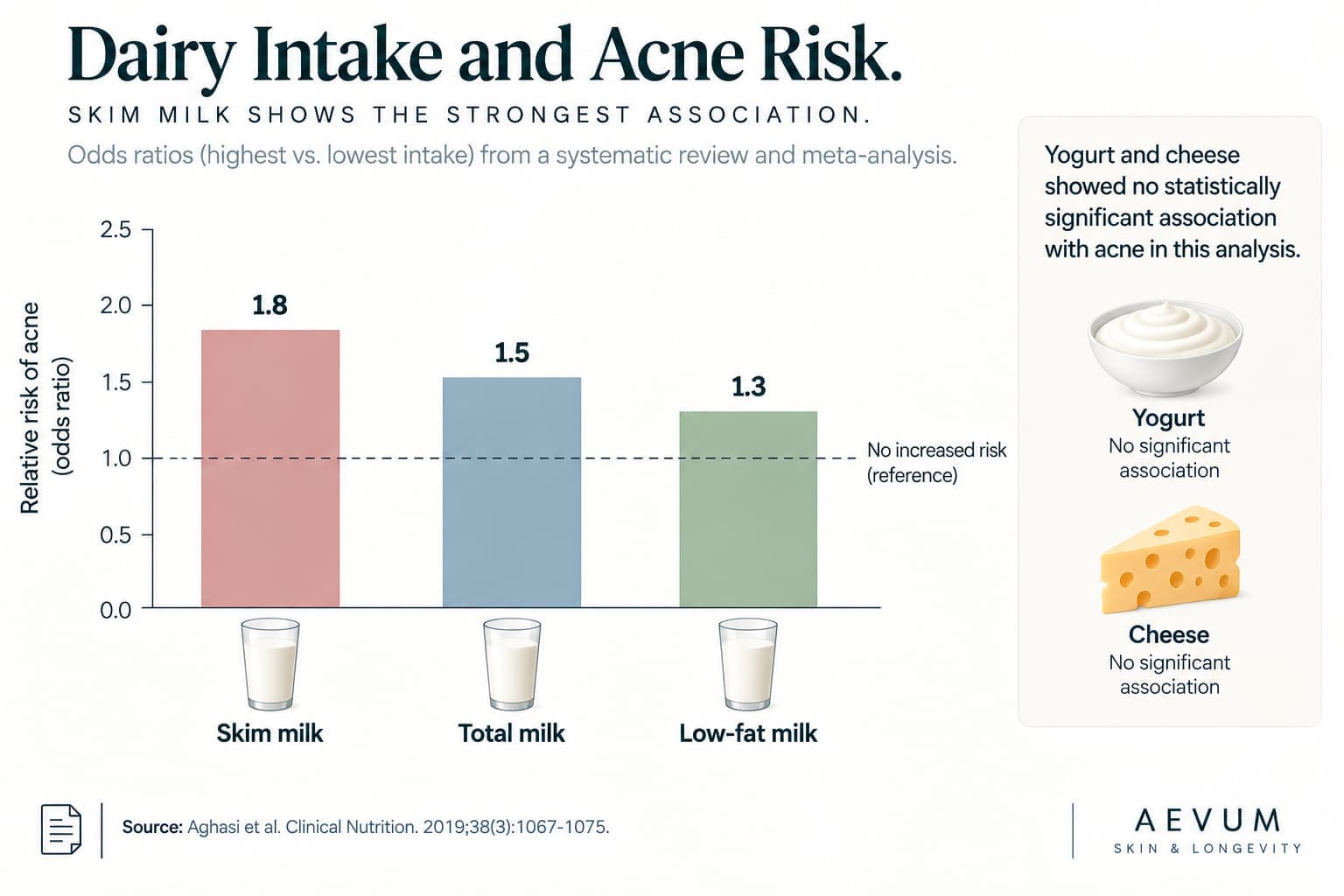
This is the most substantial diet-skin connection not yet covered directly in this series, and the evidence base is genuinely large. A systematic review and meta-analysis spanning 78,529 children, adolescents, and young adults found a consistent association between dairy consumption and acne — any dairy, milk, cheese, and yogurt were all associated with increased odds of acne. A separate meta-analysis of observational studies found this association strongest and most consistent for skim milk specifically (odds ratio ~1.8 for highest vs. lowest intake), with cheese and yogurt showing no statistically significant association in that analysis — underscoring that the picture varies somewhat by study and dairy subtype, even as the overall direction (dairy intake associated with higher acne risk) remains consistent.
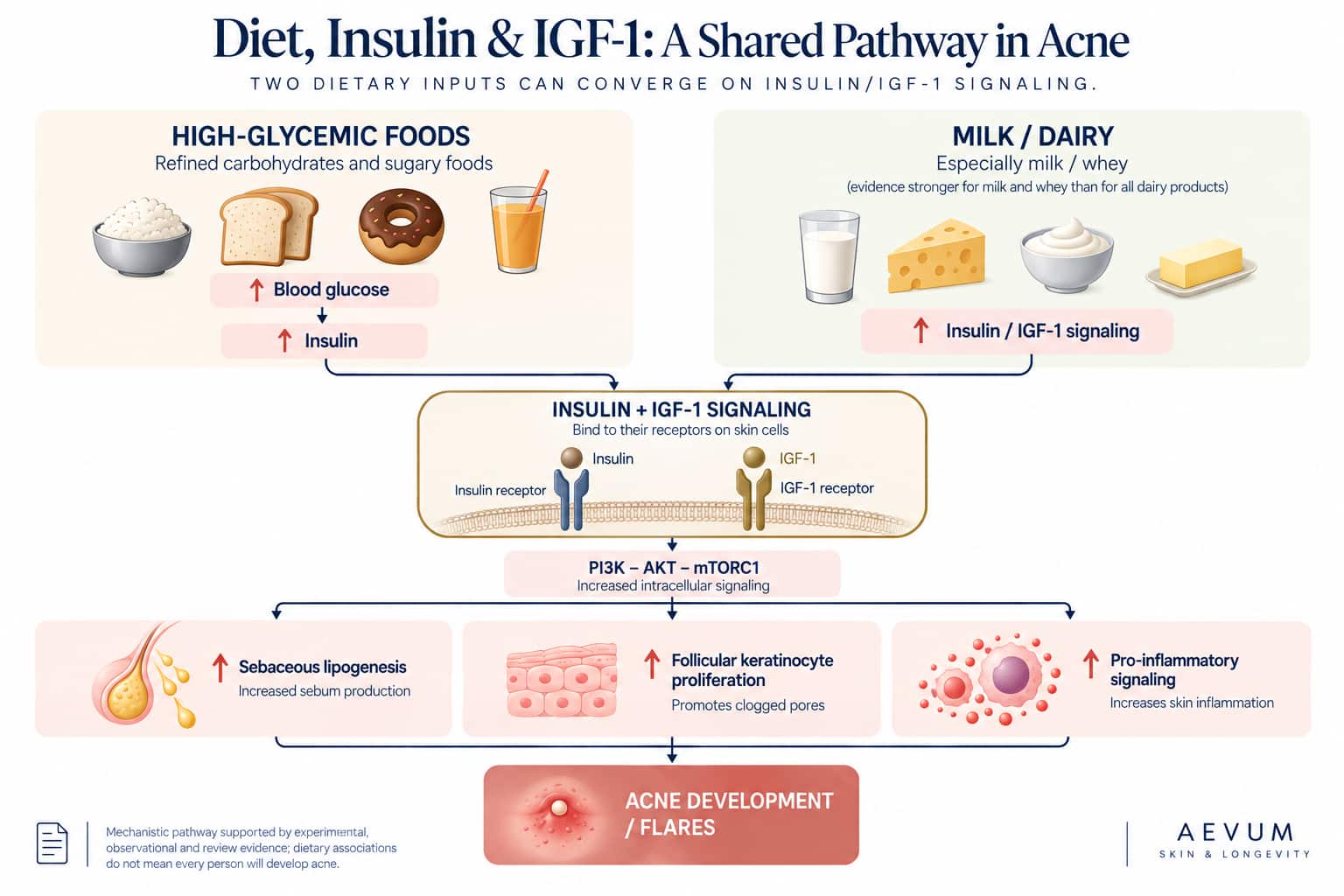
The mechanism is well-characterised, not just a statistical correlation. Milk consumption measurably raises insulin and insulin-like growth factor-1 (IGF-1) levels, while simultaneously decreasing IGFBP-3 (a protein that normally regulates IGF-1's activity). Elevated IGF-1 stimulates keratinocyte proliferation, increases sebum production, and upregulates androgen signalling — a combination of effects that directly promotes the follicular blockage and inflammation underlying acne. Milk also naturally contains hormones and hormone precursors, including compounds related to dihydrotestosterone, adding a second, complementary pathway alongside the insulin/IGF-1 mechanism.
High-glycemic-index diets promote acne through the identical pathway. Just as with dairy, high-GI foods drive hyperinsulinemia and elevated IGF-1, triggering the same downstream sebum and inflammatory effects — this is the direct link back to the glycation biology covered in our Glycation & Sugar article and the glycemic index content covered in our Rice article, now connected specifically to acne rather than structural collagen ageing.
The Mediterranean diet shows a partially inverse relationship, with a plausible, multi-factor explanation. A 2025 systematic review and meta-analysis found adherence to a Mediterranean-style diet significantly correlated with less severe acne among those who had it — though the same review found no statistically significant association between Mediterranean diet adherence and the likelihood of developing acne in the first place, a distinction worth being precise about rather than overstating. The proposed explanation for the severity finding draws together several threads already covered separately in this series: the Mediterranean diet's naturally lower glycemic load, its comparatively lower dairy content, and its higher intake of antioxidant- and anti-inflammatory-rich foods (olive oil, fish, fruits, vegetables) — plausibly working through reduced IGF-1 signalling alongside genuine anti-inflammatory effects, rather than through a single isolated nutrient.
Recommendations by skin concern
- 1Anyone with persistent or adult acne who hasn't considered dietary factors
Given the scale and consistency of the dairy and high-GI evidence above, this is a genuinely reasonable, evidence-backed factor worth discussing with a dermatologist — particularly reducing skim milk specifically and moderating high-GI foods, rather than assuming diet plays no role, a view increasingly outdated relative to current evidence.
- 2Anyone focused on collagen and structural skin ageing rather than acne specifically
The glycation mechanism covered in our dedicated article remains the more directly relevant dietary connection — a low-glycemic dietary pattern, covered in more depth in our Rice and Fibre articles, supports this goal alongside the acne-related benefits covered above.
- 3Anyone wanting one dietary pattern that touches most of the evidence covered across this entire series
A Mediterranean-style diet is a reasonable, well-evidenced default — lower glycemic load (addressing glycation and acne severity), meaningful omega-3 intake (supporting barrier function), and high antioxidant intake (complementing topical antioxidants like the vitamin C covered in our Vitamin C article) all in one dietary pattern, rather than needing to address each nutrient in isolation.
- 4General / longevity-focused
This article is intentionally a synthesis — the real depth on any single nutrient or mechanism lives in its dedicated article elsewhere in this series. The broader point worth taking away is that skin health was never fully separable from the nutritional picture covered throughout our Nutrition & Metabolism series — the two are mechanistically connected at nearly every level covered in both.
Practical notes
- →The dairy-acne connection is genuinely well-evidenced at scale, not a fringe or unproven claim — a meta-analysis of over 78,000 people, with a clear, plausible hormonal mechanism behind it
- →Skim milk shows a stronger, more consistent association with acne than other dairy forms in the available research — a specific, actionable detail rather than a blanket "avoid all dairy" recommendation
- →High-glycemic-index diets and dairy intake promote acne through the same underlying insulin/IGF-1 pathway — connecting directly to the glycation biology covered elsewhere in this series
- →A Mediterranean-style dietary pattern touches most of the evidence-backed nutritional levers covered across this entire skin series simultaneously — a reasonable, well-evidenced default rather than needing to optimise each nutrient separately
- →This article works best as a map back to the rest of the series — nearly every claim here has a dedicated, deeper treatment elsewhere in these 23 articles
This brings our Skin & Longevity series full circle — skin ageing and skin health were never separable from the broader nutritional picture covered throughout our Nutrition & Metabolism series, and the mechanisms connecting the two are genuinely well-understood rather than speculative. For the full depth behind each connection summarised here, see our Glycation & Sugar, Vitamin C, Collagen Loss, Skin Barrier, and Fats articles, alongside our Rice, Fibre, Protein, Vitamins, and Minerals articles from our Nutrition & Metabolism series. If you'd like a clearer, comprehensive picture of how your own diet connects to your skin and longevity goals, our Longevity Doctors offer a free consultation as a starting point.
How does your skin
score on your longevity assessment?
Take the free Aevum Protocol assessment to see how your skin & longevity and 6 other longevity domains are performing — and get a personalised 90-day plan.
Take the Free Assessment →